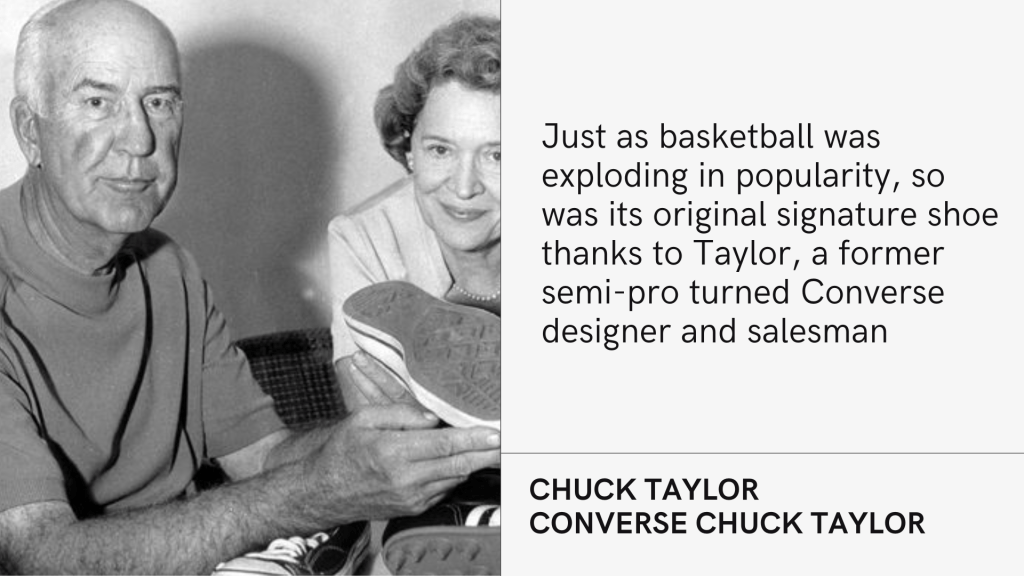
1) Converse Chuck Taylor All-Stars (Chuck Taylor)
Founded in 1908 in Malden, Massachusetts, just a couple hours drive from the birthplace of basketball in Springfield, the Converse company hired Taylor as a salesman in 1921 to market its new “Non-Skid” shoes, intended for indoor sports. Taylor, a semi-pro player with years of experience, had some feedback on the design and the company not only listened, they renamed the shoe after him. Over the next few decades, Taylor traveled the world evangelizing not just his signature Converse All-Star shoes but the sport of basketball itself, by managing clinics, developing and distributing a basketball yearbook, making publicity appearances, inventing new equipment (including the first stitch-less ball), and acting as player-coach of the Converse All-Star barnstorming team. Thanks largely to Taylor’s efforts, the sport of basketball exploded in popularity in the pre-war era, as did the All-Star shoe. By the ’50s, the Chuck Taylor All-Star was the dominant shoe of choice at the high school, college, NBA, and Olympic levels, and remained as such until other companies with updated technology like Adidas began flooding the basketball shoe market in the early ’70s. It was a precipitous fall from grace for All-Stars in basketball and by the end of the decade, Tree Rollins was the only NBA player left sporting them. But the shoe line had already found a second life as a lifestyle and fashion brand, notably sported by the likes of James Dean, Andy Warhol, Joey Ramone, Sylvester Stallone, and Kurt Cobain. As for Taylor, he remained an employee of the Converse company basically up until his death in 1969 but never made a single cent on commission or licensing, instead just accepting a salary for almost 50 years. He also never played or coached above the semi-pro level but his contributions to basketball at large got him inducted into the Naismith Hall of Fame.
2) Puma Clyde (Walt Frazier)
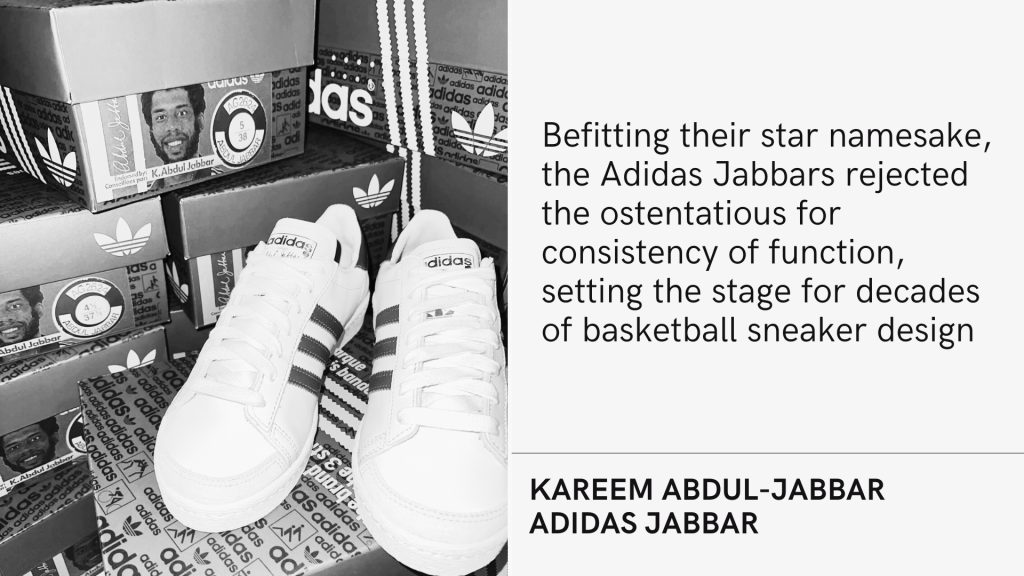
3) Adidas Jabbar (Kareem Abdul-Jabbar)

Our seventh volume will be published throughout the ’24-’25 NBA season
Two of the most recognizable global sports brands in the world got their start in a rift between German Nazi brothers. Older brother Rudolph and younger brother Adolf (nicknamed “Adi”) started an athletic shoe company in their small, German town in 1924. Their first big break came in 1936, when they convinced Jessie Owens to don their cleats while winning four gold medals at the Berlin Olympics. Despite their willingness to grant Owens the first ever sponsorship deal for an African-American, both brothers also joined the Nazi Party, which is where their trouble began. Adolf (befitting his name) was reportedly the much more committed fascist, which created a personal rift between them that spilled over into business operation disagreements. They split the company in 1948, with Adolf starting Adidas (a combination of his nickname, Adi, and the first three letters of their last name, Dassler) and Rudolph founding Puma. Both brands began quickly racking up sponsorship deals and their sibling rivalry reached the NBA in 1971. Adidas turned to the game’s best player at the time, releasing the Adidas Jabbars, while Puma struck a deal with the game’s most stylish player and created the Puma Clydes (with Frazier memorably donning a different colorway for every game). Though both shoes were a huge hit, it was Adidas that won out with its leather design over Puma’s suede base, and by the end of the ’70s almost every NBA player was donning a shoe similar to Kareem’s. Both Frazier and Abdul-Jabbar have remained global ambassadors of their respective brands to this day. In fact, about the time that Kareem’s all-time scoring record was being broken by LeBron James, Adidas released a new throwback line of Jabbar shoes and apparel, including the jacket that Kareem wore when he was honoring James at the record breaking game.
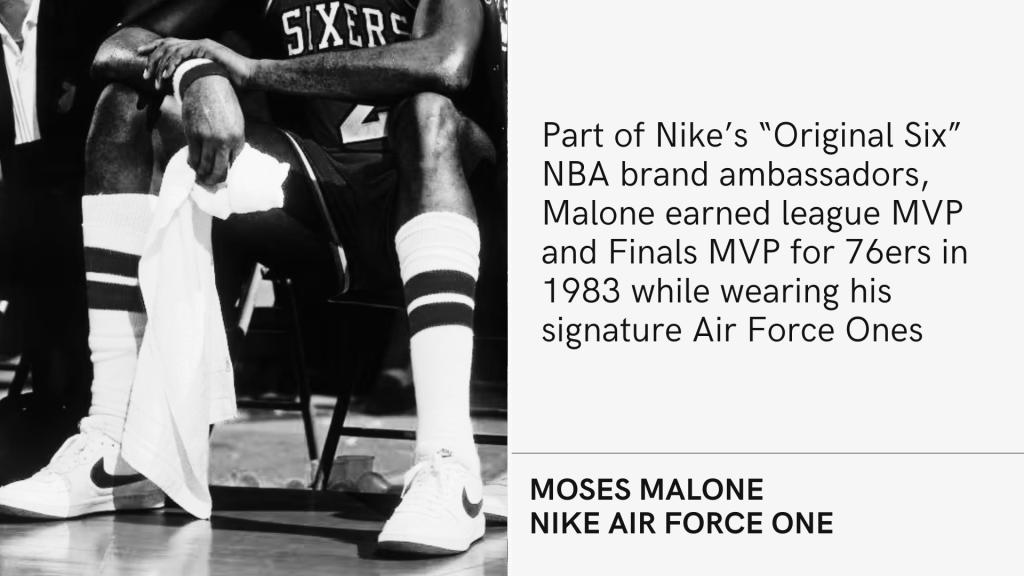
4) Nike Air Force Ones (Moses Malone)
In the same year that Adidas and Puma were entering the NBA sponsorship market, Nike released its own signature basketball shoe, the Bruin. It didn’t catch on as expected (though it did find a second life in skateboarding culture and was famously worn by Michael J. Fox in Back to the Future) and Nike went back to the drawing board, returning a decade later with the Air Force Ones. This new brand was much stickier, thanks to its clever design (which combined the weightlessness of Nike’s running shoes with the durability of their hiking boots) and its instant association with Malone, who wore his signature pair while earning both league MVP and Finals MVP in 1983 (Malone was joined initially by five other players to wear Air Force Ones, with Nike advertising them as “The Original Six”: Michael Cooper, Calvin Natt, Bobby Jones, Mychal Thompson, and Jamaal Wilkes). Nike ended up cannibalizing itself later in the decade, pushing the Air Force Ones out of the basketball market by releasing the upgraded Air Jordan lines. But as was the case with many of its ’80s competitors, AF1s were soon after revived as leisurewear, especially in the then burgeoning hip-hop culture.
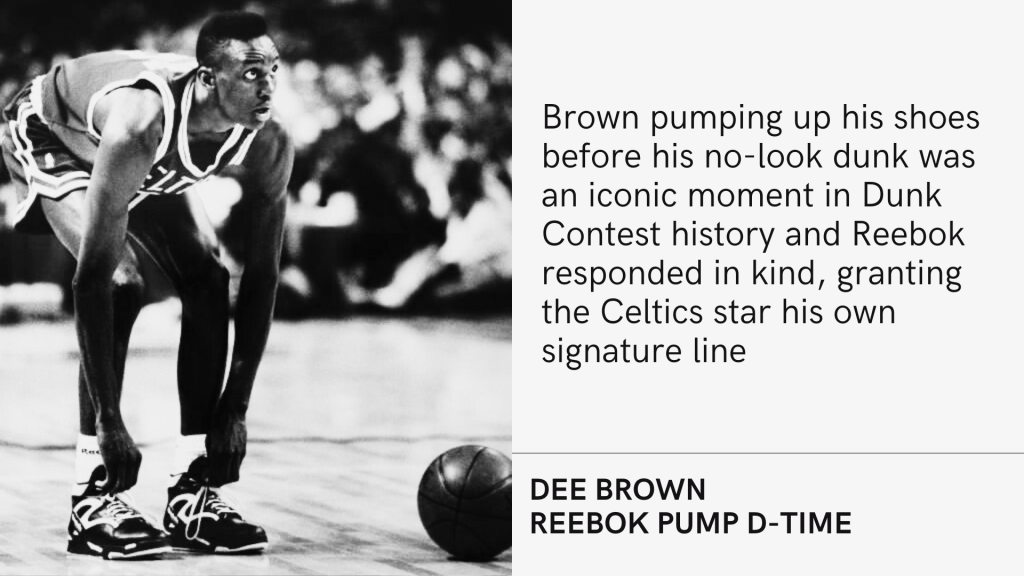
5) Reebok Pump D-Time (Dee Brown)
When the athletic shoe market exploded exponentially over the course of the ’80s, innovation became the name of the game for brand differentiation. By decade’s end, nothing was more in the air than “air” itself. This was certainly apt in basketball, where a light (“airy”) shoe allowing one to better jump to the hoop (“sky through the air”) was the ideal. Looking to fend off Nike’s incursions into its market share, Reebok took things one step further, conceptualizing air as not just an ethos but a practical comfort feature. Released in late 1989, the signature of their Pump line was a mechanism on the shoe tongue that, when pressed, would control the amount of air within a bladder in the shoe’s lining, essentially adjusting the shoe’s fit. It was a little goofy but made tactical sense, and the Pumps quickly took off. Dominique Wilkins was the original NBA spokesman for the brand but it was a fellow Slam Dunk Contest champion who truly immortalized them. Before his infamous “no look” dunk in the 1991 contest, Dee Brown pumped up his Reeboks as part of a showmanship preparation routine. One year later, Reebok gave Brown his own signature line, the “D-Time,” featuring a silhouette of his championship winning dunk on the heel. But this was arguably the peak for both the player and the brand. Brown never became a superstar, instead quietly settling into a bench scoring specialist role, while the Pumps, despite also nabbing Shaquille O’Neal as a spokesman, similarly faded out during the ’90s due to other technological breakthroughs quickly rendering its functionality obsolete.
6) Nike Air Jordan I (Michael Jordan)
7) Nike Air Jordan XI (Michael Jordan)
Shoe endorsements were nothing new when Michael Jordan was drafted by the Bulls in 1984 and subsequently inked a deal with Nike. But this was an unparalleled marriage of the greatest star in the sport’s history with a fledgling but keen sportswear company. Jordan took the court in his rookie season wearing the Nike Air Ship and it was immediately banned by the league under an archaic color percentage rule that was eventually repealed. Nike wisely jumped on the marketing opportunity, claiming Jordan’s sneakers were banned for providing him an unfair advantage and covering the Bulls star’s fines as he continued to wear them during games. In the spring of 1985, they released the shoes to the general public as the Air Jordan I (with a new color scheme that fit within the NBA regulation) and shoe culture has never been the same. Even now, two decades removed from Jordan’s last NBA appearance, the Air Jordan is still the most popular basketball shoe brand in the world and Nike continues to release new versions (there’s 38 and counting as of this writing). Arguably the most successful iteration was the Air Jordan XI, released in 1995. It was a serious upgrade in both style and function (most notably its improved responsiveness in the sole) and an instantly iconic hit. Granted, a lot of that popularity is tied up in this being the shoe Jordan wore in his ’95-’96 comeback season and while filming Space Jam. Nike has repeatedly re-released the Air Jordan I and Air Jordan XI over the years, while the originals fetch a mint on the secondary market.
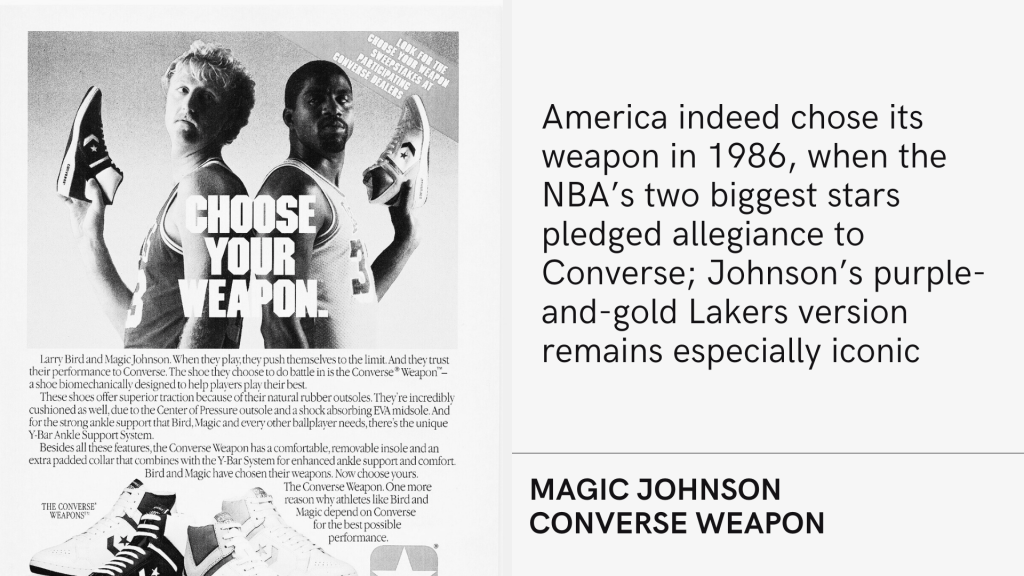
8) Converse Weapon (Magic Johnson)
Adding to the legacy that started with Chuck Taylor in the 1920s, Converse arguably peaked in the basketball shoe market with the Weapon. Featuring a revamped padding system, the Weapon debuted in 1986 and quickly conquered the NBA shoe space. It certainly helped that the Weapon was worn exclusively by the league’s two biggest stars, Larry Bird and Magic Johnson. Bird is the one who first debuted the shoe, donning Weapons as he won the inaugural Three-Point Contest during the 1986 All-Star Weekend. But Johnson is the one who got his own signature pair, in the classic Lakers purple-and-gold colorway. Johnson and Bird appeared together in the iconic “Choose Your Weapon” campaign for Converse, which included an infamous commercial in which they rapped alongside several other NBA superstars. Despite its immense popularity, the Weapon was overwhelmed in the late ’80s by the Air Jordans and quickly discontinued. But Converse recently brought back its basketball classic, effecting a new campaign behind Shai-Gilgeous Alexander while simultaneously reviving the classic Johnson design with the latest technology and features.


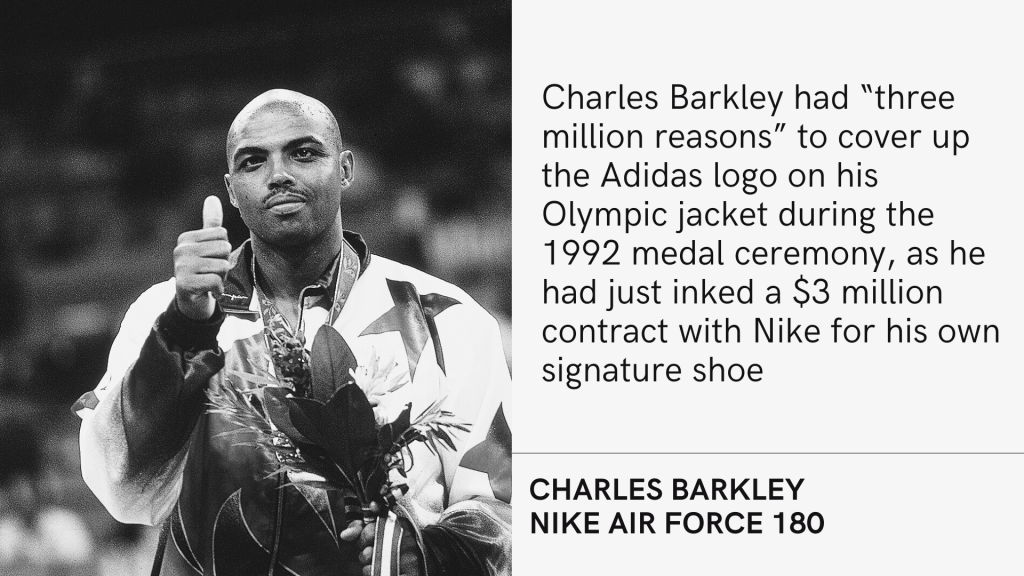



9) Nike Air Force 180 (Charles Barkley)
With NBA superstars set to take the Olympic court for the first time in 1992, in the form of the U.S. “Dream Team,” corporate sponsorships became a major pre-tournament talking point. Reebok paid a reported $4 million for the exclusive rights to produce apparel for U.S. athletes, which included the men’s basketball team. But none of the 12 Dream Team members were Reebok endorsers. In fact, half the team was either endorsed by, or exclusively wore Nikes: Michael Jordan, John Stockton, Chris Mullin, David Robinson, Scottie Pippen, and Barkley. Jordan was the only member of that list with a signature shoe before 1992 but Barkley was joining him just on time for his sojourn to Barcelona. When the pugnacious power forward dropped 24 points in Team USA’s opening win over Angola, he did so in the new Nike Air Force 180s. Designed exactly to Barkley’s specifications and measurements, the shoes appropriately featured a red, white, and blue colorway, with touches of gold. Speaking of gold, when the American team took to the podium to accept their medals, Barkley was amongst the players who covered up the Reebok logo on his jacket with an American flag out of loyalty to Nike. Two years later, the Barkley Air Force 180s were made commercially available in a slightly altered version, though the original Olympics version remained so iconic that Nike revived it in 2016.
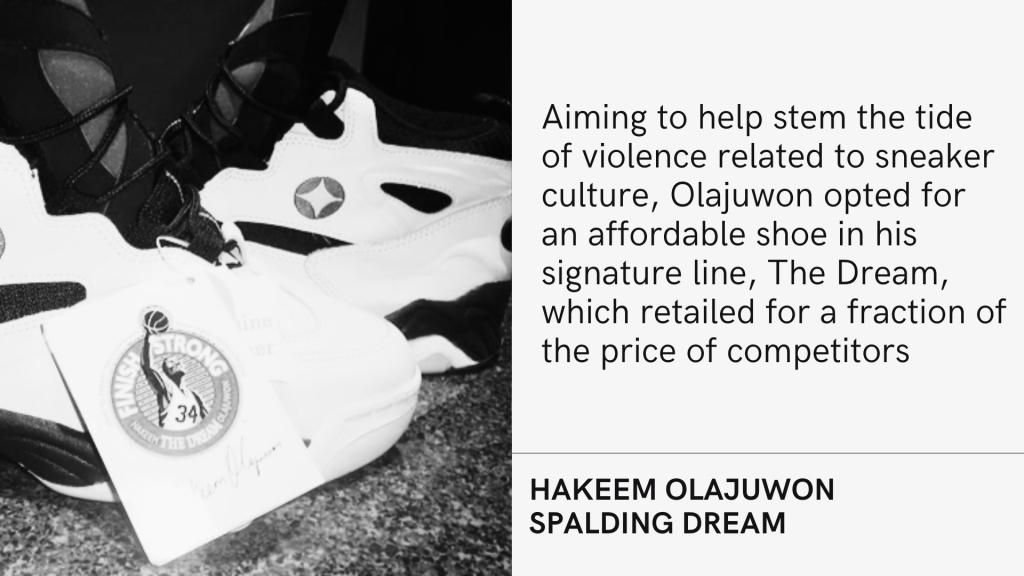
10) Spalding Dream (Hakeem Olajuwon)
As sneaker culture became indelible to U.S. consumerism during the ’80s and ’90s, an unfortunate side effect was the rise of violent crime related to the products. As with most things involving crime in America, the breadth and severity of kids getting assaulted or even killed over sneakers was overblown, but was no doubt spiking to some extent every time a new Air Jordan was released. In 1995, Olajuwon made a concerted if misguided effort to combat the trend by signing an endorsement contract with Spalding, which released his “Dream” line. Priced at just $34.99 (an homage to Olajuwon’s #34 Rockets jersey), the shoes were considerably cheaper compared to top level brands like the Air Jordans, which cost up to $200, and were sold in discount distributors like Payless as opposed to high-end shops like Foot Locker. But the “Dream” shoes were also noticeably cheaper in appearance and far less durable than those released by the major companies. There was also a branding issue, as Olajuwon was a reigning Finals MVP and arguably the second best player in the world upon their release but his popularity still paled in comparison to lesser rivals like Shaquille O’Neal and David Robinson. While the “Dream” shoes were not a lucrative investment for Spalding, Olajuwon’s valiant effort to market affordable basketball shoes was inspirational, and it inspired more successful future economical shoe endeavors, most notably Stephon Marbury’s “Starbury” signature line.
11) Ewing Athletics 33 HI (Patrick Ewing)
Ewing faced an early career crossroads heading into the ’88-’89 season. He had just made his first All-NBA team, had led the Knicks to the playoffs for the first time, and his original shoe contract with Adidas had just expired. The superstar center and his agent David Falk were mulling an offer from Nike when a sneaker magnate named Robert Muller approached them with a novel idea. The trio started up their own sneaker company called Ewing Athletics and released their signature shoe, the 33 HI. Designed in large part by Ewing himself, the 33 HI was most notable for its unique reversible ankle strap, which could tighten across the front or back of the shoe. Originally worn by the Knicks center in a plain white colorway as a prototype, the 33 HI hit stores in 1989, making Ewing the first NBA athlete with his own distinct shoe branding, even ahead of fellow Falk client Michael Jordan. After some early success, Ewing Athletics declined in the ’90s amidst stiff competition and eventually shuttered. But the company and brand were revived in 2012 by Ewing himself, who now offers a replica of the original in numerous styles and colorways, many of them inspired by his own career, the city of New York, and/or the late ’80s and ’90s culture of which he was a part.
12) Nike Air Foamposite (Penny Hardaway)
While leading the Magic to a near upset of the Heat in the first round of the 1997 playoffs, Hardaway played some of the best basketball of his NBA career and did so in a mysterious pair of unique white sneakers. They were later revealed to be an early version of the Nike Foamposite, which quickly became one of the most sought after shoes on the market when they hit stores during the ’97-’98 season. These were the second signature Nikes in the career of Hardaway, who originally sported the Air Penny brand, as immortalized in the “Lil’ Penny” commercials that were ubiquitous in the mid ’90s. Right around the time that Hardaway was inking his original Nike contract, the company was developing (reportedly for Scottie Pippen) a completely different style, with an exterior design inspired by beetle shells. After years of fits and starts for that design, it likely would have never escaped the Nike offices if not for a chance marketing meeting in which Hardaway eyed a prototype version and was instantly smitten. Though Hardaway struggled with injuries in his first season in the Foamposites, the design was a huge hit and revolutionized both the sneaker industry and street culture.
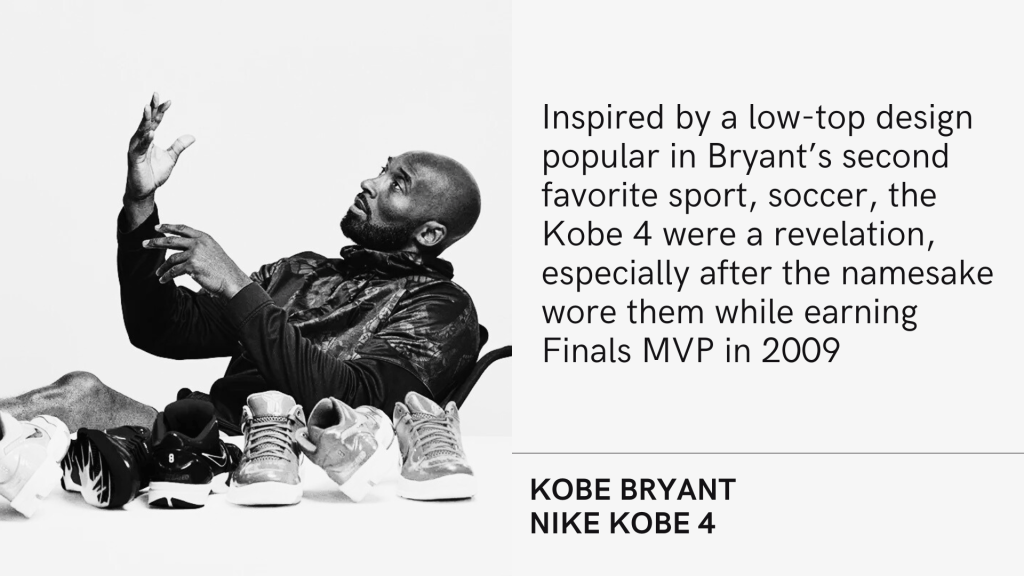
13) Nike Kobe 4 (Kobe Bryant)
When designing a new signature shoe for Bryant, esteemed Nike designer Eric Avar took inspiration from another sport beloved by the Lakers superstar. Conventional wisdom had held for years that high-top shoes were essential for basketball, with their ankle support. But Avar took note of the low top nature of elite soccer shoes, which managed to retain ankle support while maximizing lightness, a top priority for Bryant. In tandem with the new lightening Nike Flywire technology that had been developed for running shoes, Avar took these concepts to create the Kobe 4. In one of his first games wearing the new signature shoes, Bryant set a Madison Square Garden record with 61 points in a 126-117 Lakers victory over the Knicks. By season’s end, the Lakers superstar had earned his first Finals MVP trophy while Nike had another innovative, smash hit sneaker line on its hands.
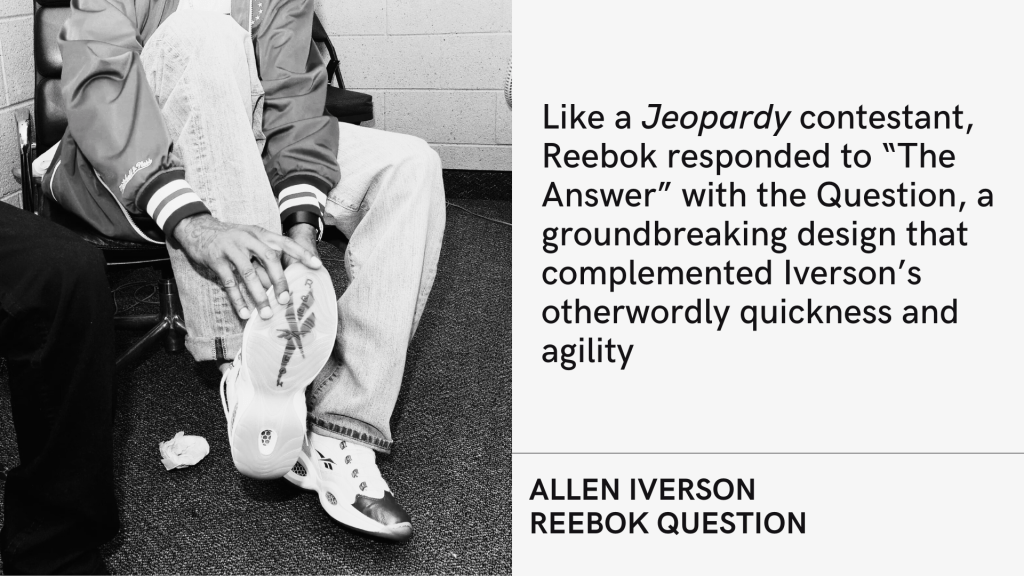
14) Reebok Question (Allen Iverson)
Even before the dynamic guard was selected #1 overall in the 1996 NBA Draft, an Iverson shoe contract with Nike seemed like an inevitability. After all, the sneaker behemoth had all but cornered the market on basketball superstars, not to mention that Iverson’s Georgetown coach, John Thompson, served on the company’s board of directors while his agent, David Falk, also represented Nike’s flagship client, Michael Jordan. But one could say that Iverson pulled a cross-over on expectations, signing instead with Reebok, where the superstar felt he could be an authentic centerpiece of the brand, rather than just another company man below Jordan. It turned out to be a perfect marriage of company and client, as Iverson got to sport groundbreaking speed design in The Question, while Reebok revived its flagging reputation amongst youth via association with the superstar. In 2001, in recognition of that relationship and of Iverson’s league MVP season, Reebok inked him to a lucrative lifetime contract as a brand ambassador.
15) Fila Grant Hill 2 (Grant Hill)
The basketball world was shocked in 1994, when Pistons draftee Hill signed a contract with Fila over Nike, Adidas, and Reebok. An Italian sportswear company better known for sponsoring European tennis stars, Fila was eager to expand into the exploding U.S. sneaker market in ’90s and made a huge splash by starting with Hill. The resultant design was certainly unconventional, a boxy, understated, arguably clunky sneaker called simply “The Grant Hill 1.” But they were a massive hit thanks in no small part to Hill himself, who became an instant NBA superstar and earned Rookie of the Year honors while donning them. In fact, the Grant Hill 1s became the best selling signature sneaker of an NBA rookie since the original Air Jordans a decade earlier. The Grant Hill 2, released a year later, was an even bigger hit with its sleeker design and improved performance. Fila made further inroads soon after in streetwear and basketball, notably also inking a deal with Jerry Stackhouse, but the brand took a sharp decline by the early ’00s, just as Hill’s career stagnated due to injuries. The brand and star parted ways around that time but reunited in 2018, with Fila celebrating Hill’s Naismith Hall of Fame induction by granting him a lifetime contract and reviving his ’90s shoe line.
16) Nike Air Swoopes (Sheryl Swoopes)
A gifted all-around player who earned every accolade possible while starring at Texas Tech, Swoopes was a perfect candidate to be the first woman player with her own signature sneaker. In 1995, Nike sent one of its top designers to work with Swoopes on creating a design that was unique to her specifications. The result was the Air Swoopes, a mid-top shoe with numerous Swoopes touches, including a wide heel loop to accommodate the star’s long fingernails. Most notably, the shoe featured a straightforward black-and-white colorway, a stark contrast to traditional women’s shoes designs that often relied on pink, white, and light blue. It was the first basketball shoe marketed as by women and for women, and Its impact on sneaker culture is undeniable. By the time Swoopes was starring on the legendary 1996 U.S. Olympic team, Nike had developed the Air Swoopes II and granted her a special red, white, and blue colorway version of it. The WNBA started soon after and Swoopes was arguably its biggest early star, winning four championships and earning three league MVP awards. But while the women’s game has grown in popularity and many other players have had their own signature shoe since, nothing has come close to matching the impact of the Air Swoopes.
Next up in Jerseys, Shoes, and Uniforms
- Separated laundry: 18 NBA players with a jersey retired by multiple franchises
- Honorary decree: Seven people with retired NBA jerseys who never played or coached
- From zero to hero: 21 greatest players who wore/wear the jersey number 0 or 00
- It belongs in a museum: 10 notable pieces of basketball memorabilia
- Soles power: 16 notable signature basketball shoes
- Golden voices: Eight NBA announcers with retired microphones
- For those updating rosters at home…: 11 NBA players who underwent a legal name change
- Strictly commercials: 19 memorable television advertisements starring NBA players
- Don’t you forget about me: 80 basketball moments from the ’80s that changed the sport forever
- Joy of six: 13 notable facts about jersey #6 and the players who have worn it
Next up in Michael Jordan
- Welcome to the big leagues: Ranking the NBA careers of the 52 Naismith Award winners
- Adding insult: 13 NBA players who suffered unusual off-court injuries
- Head of the class: 18 greatest Naismith Hall of Fame NBA induction classes
- Separated laundry: 18 NBA players with a jersey retired by multiple franchises
- Tough act to follow: 23 (mostly) forgotten NBA players who replaced departing legends
- Primetime players: 14 notable NBA crossovers with Saturday Night Live
- It belongs in a museum: 10 notable pieces of basketball memorabilia
- Off the mark: Eight legendary players who struggled in the Three-Point Contest
- Soles power: 16 notable signature basketball shoes
- Over the hill and on the court: 31 NBA players who stayed active into their 40s
 Basketball, Listed