Editor’s note: All franchise records mentioned are franchise records for the SuperSonics years only and do not include their Oklahoma City years, unless noted.
23) Bob Rule, 1967-1971
We start, appropriately enough, with one of the original Sonics. Rule was a second round pick out of Colorado State by the expansion franchise in 1967 and immediately became their starting center. Despite being undersized at 6’9″, 220 pounds, he was determined and skilled and averaged 18.1 points per game as a rookie, setting a franchise record that would stand for over 40 years until Kevin Durant broke it. With 22.3 points and 10.4 rebounds per game in his first three seasons, plus an All-Star nod in 1970, Rule was a burgeoning star until an Achilles’ tear suffered in 1971 effectively ended his career. Though he played just three full seasons with the team, he is 10th in Sonics history in career rebounds and 16th in total points.
22) Wally Walker, 1977-1982
Though he was the fifth overall pick in the 1976 NBA Draft, Walker played limited minutes as a rookie for the Trail Blazers, was traded soon after to the Sonics, and then logged only minor playing time in Seattle his first two seasons. But those three years all ended with NBA Finals appearances and two championships, in 1977 with Portland and in 1979 with Seattle. His role with the Sonics increased from there and by ’81-’82 he was starting at small forward and averaging 9.9 points per game when he was traded again, this time to the Rockets. In addition to his legacy on the court, Walker contributed even more to Sonics history in his role as the team’s president and general manager for 12 years, starting in 1994. During that stretch, he put together several key pieces of the 1996 Finals team but also made several controversial moves, most notably his disastrous signing of Jim McIlvaine.
21) Michael Cage, 1988-1994
Nicknamed “Windex Man” for his propensity for cleaning the glass, Cage averaged eight-plus rebounds per game seven times in his career, including four seasons in Seattle. In fact, he was the reigning rebounding league leader when he came to the Sonics via trade from the Clippers in 1988. Replacing the high-scoring Tom Chambers in the Seattle lineup, Cage brought a completely different dimension to the floor, supplying steady, stout defense and compiling 3,975 rebounds (fourth in franchise history) over seven years. He left as a free agent with the Cavaliers in 1994 but returned to the Sonics franchise two decades later, signing on as a television broadcaster for the Thunder.

Our fifth volume will be published throughout the ’22-’23 NBA season
20) Sam Perkins, 1993-1998
The Sonics were one of three teams with which Perkins reached the NBA Finals, none of whom came away with a title. The first were the Lakers, who signed him in 1990, reached the Finals in 1991, then traded him at the deadline in 1993 to the Sonics for the aging Benoit Benjamin and the young Doug Christie. In five-and-a-half seasons with Seattle, Perkins mostly came off the bench at power forward and center. He was effective and consistent, averaging between 11 and 13 points per game in the first four seasons, deploying his patented long-range shooting that was a novelty at the time for big men. With Perkins in tow as the sixth man, the Sonics reached the Conference Finals in 1993 and then the NBA Finals in 1996. He eventually signed with the Pacers as a free agent in 1999 and played in one more Finals with them in 2000 before retiring. His 592 three-point field goals for the Sonics is sixth in franchise history.
19) Derrick McKey, 1987-1993
Wise beyond his years and able to defend effectively at three positions, McKey quickly became a key piece of the Sonics after they drafted him ninth overall out of Alabama in 1987. He perfectly complemented Xavier McDaniel as a forward duo, bringing a defensive intensity and versatility at both ends of the court. Though he never put up huge stats, McKey is top 15 in Sonics franchise history in points, rebounds, steals, and blocks. He was traded in a blockbuster to the Pacers in 1993 in exchange for Detlef Schrempf and played in eight seasons with Indiana, eventually reaching the NBA Finals late in his career in 2000 as teammates with fellow former Sonics front court star Sam Perkins.
18) Tom Chambers, 1983-1988
As the possibly apocryphal story goes, in the 1988 meeting where unrestricted free agency was finalized by NBA brass, a fellow general manager turned to Seattle’s Barry Ackerly and simply stated “you’re going to lose Chambers.” It turned out to be prophetic, as Chambers departed that summer for a huge contract with the Suns, ending a five-year run with the Sonics. During that time, he compiled over 8,000 points and was fifth in franchise history in total scoring (he’s still 10th). He averaged as many as 23.3 points per game in ’86-’87, the same season that he was not only named to the All-Star Game but earned MVP in it. To top that off, he then helped lead Seattle to a surprise appearance in the 1987 Western Conference Finals. Though he held no animus towards the Sonics, Chambers seemed to specifically torture them in his prime with the Suns, including a 60-point performance against his former team in March of 1990.
17) Xavier McDaniel, 1985-1990
With his signature mien (featuring a shaved head and eyebrows), combative style, “X-Man” nickname, and unique scoring touch, McDaniel was a fan favorite in his five-plus seasons with the Sonics. In fact, he was so popular in Seattle that the seminal grunge culture film “Singles” featured him in a brief but memorable cameo. Drafted #4 overall in 1985 to replace the disappointing Danny Vranes at small forward, McDaniel was 1st-Team All-Rookie in ’85-’86, an All-Star in 1988, and averaged 20.7 points and 7.0 rebounds per game in his time with the Sonics. But with the team looking to rebuild around young stars Gary Payton (whom McDaniel once almost choked out in practice) and Shawn Kemp, McDaniel was traded during the ’90-’91 season to Phoenix, where he reunited with Tom Chambers. He bounced around the league from there, spending time with the Knicks, Celtics, and Nets before retiring in 1998.
16) Lenny Wilkens, 1968-1972
Despite coming off a season where he averaged career highs in points and assists per game, played in his fifth All-Star Game, and was named second in MVP voting, Wilkens was disgruntled with Hawks management in the summer of 1968 and vice versa. He was traded to Seattle, where he instantly became the face of a young franchise. In his first season with the Sonics, he averaged a career high 22.4 points per game and then in ’69-’70 he dished out a league leading 9.1 assists per game. Wilkens also took over player-coach duties in 1969, becoming just the second Black coach in NBA history (the first, Bill Russell, would coincidentally eventually succeed him in Seattle). He was the first Sonics player to make multiple All-Star appearances (three in a row, starting in 1969), the first to lead the league in any major category, the first to log a triple-double, and held the franchise scoring and assists records for many years. Though he was traded to the Cavaliers in 1972, Wilkens returned to Seattle as coach in 1977, leading the franchise to its first and only championship soon after.
15) John Johnson, 1977-1982
Though he had two All-Star appearances to his name, Johnson was considered a disappointment when he was traded to the Sonics early in the ’77-’78 season. The former Iowa superstar and #7 overall pick was already joining his fourth team in eight seasons, a rarity for a high draft pick in the pre-unrestricted free agency era of the NBA. He remade himself in Seattle as a two-way role player, starting at small forward on the Sonics teams that reached the NBA Finals in 1978 and then won the championship in 1979. Johnson was the leading rebounder and fifth in scoring on the latter team and despite his 6’7″ height he was an excellent play maker, which was a major asset on a team that lacked a natural point guard. “JJ” was also a terrific defender and notably shut down Washington’s Bobby Dandridge in the 1979 Finals. He ended up spending his final five seasons in Seattle before retiring in 1982.
14) Dale Ellis, 1986-1991 and 1997-1999
Maybe the second most controversial star in Sonics history after Shawn Kemp, Ellis spent his first five years with the franchise creating nearly as many embarrassing moments as he did indelible ones. On the good side of the ledger: He was named Most Improved Player in ’86-’87 after the Sonics lifted him off the scrap heap by trading for him from the Mavericks, with whom he was languishing on the bench. Ellis was the leading scorer and second leading rebounder in the 1987 postseason as the Sonics reached the Conference Finals, then peaked individually in ’88-’89, averaging a career high 27.5 points per game and getting named to the All-Star Game (he additionally won the Three-Point Contest that weekend). But he also had been arrested for domestic abuse and a DWI, suspended for fighting teammates and arguing with officials, and held out of training camp multiple times. He was traded away to the Bucks in 1991 but despite all the contention, returned to Seattle via trade in 1997 as a more mature player, welcomed back by fans who had missed his long range shooting prowess.
13) Ray Allen, 2003-2007
His most memorable singular moments may have come in other locales, especially in terms of postseason success, but the best individual seasons of Allen’s career all happened with the Sonics. That included ’04-’05, when he was named 2nd-Team All-NBA and finished ninth in MVP voting, ’05-’06, when he set the single season record for three-point field goals with 269, and ’06-’07, when he averaged a career high 26.4 points per game right before getting traded to the Celtics. Despite his individual heroics, Seattle was pretty bad for most of his five seasons there with the exception of ’04-’05, when Allen teamed up with Rashard Lewis to lead the Sonics to their final 50-win season and final playoff appearance before moving to Oklahoma City. His 869 three-point field goals are third in Sonics franchise history, behind only Lewis and Gary Payton.
12) Nate McMillan, 1986-1998
Over a 12-year career that was spent entirely with the franchise, McMillan became so synonymous with Seattle basketball that he’s still known as “Mr. Sonic.” That distinction comes despite the fact that after he relinquished the starting point guard position to Gary Payton in 1990, McMillan became a bench role player for the rest of his career. In fact, even as a starter he never averaged as many as eight points per game in a season, though he did rack up assists early on, averaging 8.7 per game in his first three seasons. More so than his scoring or play making, the Sonics relied on him for his steady leadership, versatility (he could naturally play both guard positions) and defensive intensity. He was the only Sonics player to be part of the 1987 team that reached the Conference Finals and the 1996 team that made it to the NBA Finals. Second in franchise history in both assists and steals (behind Payton in both), he’s the rare player in NBA history to have his jersey number retired despite never even making an All-Star team.
11) Lonnie Shelton, 1978-1983
After getting pushed around in the 1978 NBA Finals by Washington’s formidable front court, the Sonics went searching for a missing piece that offseason. They found it in Shelton, a tough yet athletic power forward who had spent his first two seasons with the Knicks. He was fourth in scoring, second in rebounding, and a paint defense leader for the Sonics in ’78-’79, as they won the championship in a Finals rematch against the Bullets. A former overlooked second round pick out of Oregon State developed even further from there, eventually getting named an All-Star and All-Defensive in ’81-’82. His career slipped soon after, with the Sonics trading him to the Cavaliers in 1983 amidst rumors that he was partying too hard off the court and supposedly abusing drugs. Though he returned to his native California after retiring from basketball in 1986, Shelton’s son, Marlon, also played basketball in Seattle, at the University of Washington.
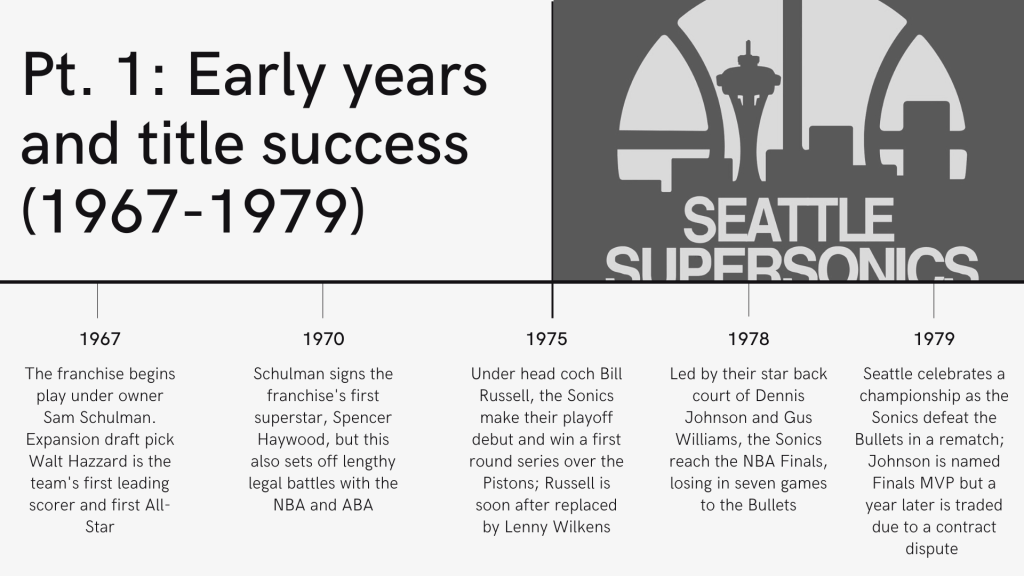
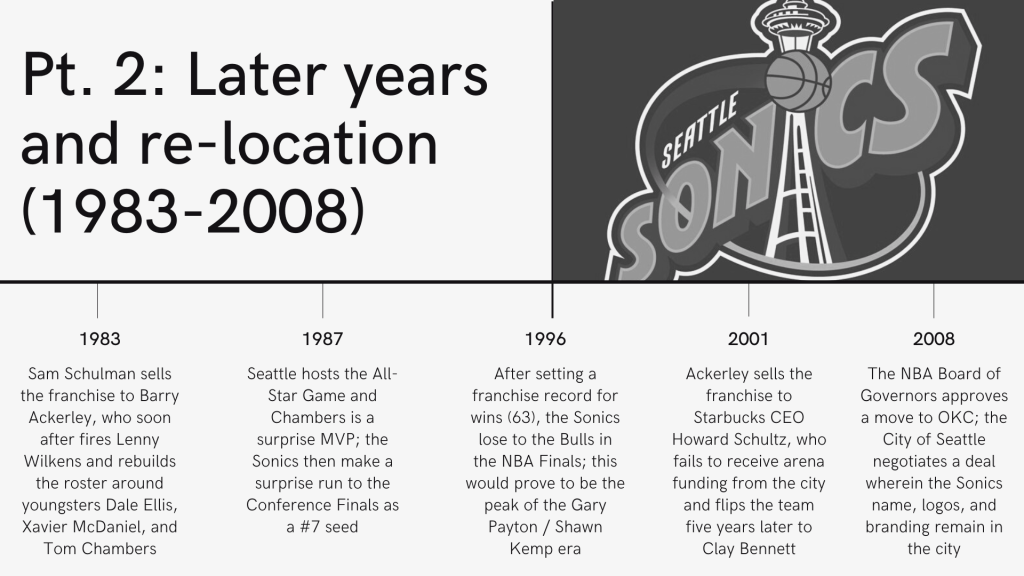
A timeline of SuperSonics franchise history
10) Dick Snyder, 1969-1974 and 1978-1979
Similar to Nate McMillan, Snyder was never a top scorer or an All-Star for the Sonics, but he was an indelible member of the team, who endeared himself to fans with his steady play and hustle. Originally drafted by the Hawks, he was traded to the Suns early in his career and then to Seattle soon after. Joining a young franchise mired in mediocrity, Snyder slotted into the back court with Lenny Wilkens as a killer play making duo. Though the team failed to make the postseason in his initial five season run with them, Snyder did make a name for himself, averaging 16.2 points and 4.0 assists per game. He was traded away in 1974 to his hometown Cavaliers (for whom he made the game winning shot in the 1976 “Miracle in Richfield” playoff win) but returned to the Sonics as a free agent four years later. By now, Snyder was 34 years old and not the same player anymore, but put in some minutes off the bench as the Sonics won their only championship in franchise history.
9) Spencer Haywood, 1970-1975
Disinterested in playing college ball but barred from the NBA due to its eligibility rule at the time (players had to be four years removed from their high school graduation), Haywood was nonetheless such a superstar in the ABA in ’69-’70 that Sonics owner Sam Schulman was willing to break the rules to sign him. Even knowing it would set off legal challenges from the NBA and ABA, Schulman signed Haywood and put him on the floor. While the lawsuits got settled out of court, Haywood dominated on the court, averaging 24.9 points and 12.1 rebounds per game in his five seasons in Seattle, getting named to four All-Star teams, 1st-Team All-NBA twice, and 2nd-Team All-NBA twice. He was reviled by opposing fans, players, and media members for his supposed skirting of the rules, but beloved by most of the Seattle faithful, especially when he helped lead the franchise to its first playoff appearance in 1975. His fifth place finish in MVP voting in ’71-’72 is the highest of any player in Sonics history besides Gary Payton and his 2,251 points scored in ’72-’73 was the franchise record for 15 years until Dale Ellis broke it.
8) Detlef Schrempf, 1993-1999
In a rare blockbuster trade that ultimately benefitted both teams, Schrempf came to the Sonics from the Pacers in 1993 in exchange for Derrick McKey. Though he was born in Germany, Schrempf was already an adopted local, having played his high school basketball in Centralia, WA and his college hoops at University of Washington in Seattle. He brought the Sonics some veteran leadership and offensive skills and was third in both scoring and rebounding on the ’95-’96 NBA Finals team. A two-time Sixth Man of the Year winner in Indiana, Schrempf’s time in Seattle was actually his first chance at being a full-time NBA starter at age 31. He was an All-Star in 1995 and 1997 representing the Sonics, and averaged a career high 19.2 points per game in ’94-’95. Though he finished out his playing career with the Trail Blazers, Schrempf returned to Seattle as an assistant coach in 2005 and today he still lives in the city, co-chairing the non-profit charitable Detlef Schrempf Foundation with his wife.
7) Rashard Lewis, 1998-2007
A decade after they sent shockwaves through the league by drafting Shawn Kemp despite his lack of college experience, the Sonics joined the late ’90s prep-to-pro boom in 1998 by selecting Lewis. The 18-year-old fell to them in the second round and after a slow start to his pro career proved to be a steal. Ahead of his time as a rangy, sharpshooting big man, he developed into one of the best three-point shooters in the NBA, especially after the Sonics paired him with fellow bomber Ray Allen. Lewis was an All-Star in ’04-’05, when he averaged a then career high 20.5 points per game, and proceeded to average 20+ points per game in each of the next two seasons as well. He eventually set the Sonics franchise record for three-point field goals, breaking Gary Payton’s mark, and is fourth all-time in team history in scoring and sixth in total rebounds. He left as a free agent for the Magic in 2007 and after reaching the playoffs just three times in nine seasons with Seattle, never past the second round, Lewis played in the 2009 NBA Finals with Orlando and eventually won a title in 2013 with the Heat.
6) Dennis Johnson, 1976-1980
His time with the Sonics was brief, lasting just four seasons, the first of which was a relatively quiet rookie one, but Johnson is an unquestioned franchise legend and the only Sonics player ever to win Finals MVP. Having earned a reputation already as a malcontent, Johnson fell to Seattle in the second round in the 1976 NBA Draft (their first round pick, Bob Wilkerson, lasted just one unsuccessful season with the team). Sure enough, he struggled throughout the first half of his career in getting along with teammates and coaches, most notably Sonics legend Lenny Wilkens. But once Wilkens inserted him into the starting lineup as a shooting guard midway through the ’77-’78 season (point guard was his original natural position), Johnson and the Sonics were a formidable force. He was third in scoring, second in assists, and the defensive anchor as the Sonics reached the 1978 NBA Finals but also played disastrously in game seven of that series, missing all 14 shots he attempted in a loss. He vowed to make amends and did so in 1979, earning that Finals MVP trophy while leading the Sonics to a Finals sweep of the Bullets. But Wilkens grew tired of his attitude, labeling him a “cancer” and eventually shipping the two-time All-Star to the Suns in 1980 for Paul Westphal. This immediately dropped Seattle from a title contender to a fringe playoff team and it took them most of the remainder of the ’80s to rebuild while Johnson was busy winning three more championships with the Celtics.
5) Shawn Kemp, 1989-1997
An argument can be made that no Sonics player ever had a more impressive two-week span than Kemp in the 1996 NBA Finals. Still only 26 years old at the time, the man that Seattle fans had claimed as their “Reign Man” was dominant in that series, averaging 23.3 points and 10.0 rebounds per game against arguably the greatest team in NBA history. But that was unfortunately the beginning of the end of Kemp’s career, as general manager Wally Walker refused to extend his contract that summer, instead spending big on stiff Jim McIlvaine. One year later, Kemp, despite coming off five consecutive All-Star appearances and three 2nd-Team All-NBA nods, was traded to the Cavaliers for a collection of talented but ultimately fruitless assets. Despite the acrimonious end, his fan favorite status in Seattle is forever secure, thanks to his brutal in-game dunks, his brash celebrations, and his preternatural skills despite being just the fourth player in league history to be drafted without NCAA playing experience. Kemp will forever stand as the all-time Sonics leader in blocked shots, fifth in points, and second in rebounds.
4) Gus Williams, 1977-1984
Before the Lakers had “Magic” the Sonics had “The Wizard” in Williams, a basketball maestro with his signature behind-the-back passes and unstoppable drives to the basket. Like so many members of the ’78-’79 Sonics title team he was something of a scrap heap find. The Warriors had drafted him in the second round in 1975 and let him walk as an unrestricted free agent two years later. His talent was quickly realized in Seattle, orchestrating the offense on a team that lacked play makers and he was the leader in scoring and assists in the 1978 playoffs as the Sonics reached the NBA Finals. One year later, Williams arguably deserved Finals MVP honors as he averaged a team high 29.0 points per game in Seattle’s five game series win over the Bullets. He only got better from there, earning 2nd-Team All-NBA in ’79-’80, 1st-Team All-NBA in ’81-’82 (over Magic Johnson), and finishing in the top 10 in the NBA in assists three times. He also sat out an entire season in his prime, in ’80-’81, due to a contract dispute. He is fourth in Sonics franchise history in assists, sixth in points, and fourth in steals, and in 2004 had his jersey #1 retired by the team.
3) Fred Brown, 1971-1984
The best pure scorer in Sonics history, Brown racked up points with his long range shooting throughout his 13-year career, all spent in Seattle. He would have totaled even more if the three-point line was instituted prior to 1979. As it stands, he was the first player ever to lead the league in three-point shooting percentage, with 44.3% in ’79-’80, proving the efficacy of his nickname “Downtown.” A first round pick out of Iowa in 1971, Brown built his reputation in the lean years of the early ’70s, peaking in ’75-’76 with a career high 23.1 points per game and his only All-Star appearance. As the starting shooting guard, he was the second leading scorer on the ’77-’78 Sonics NBA Finals team and then the team captain off the bench on the ’78-’79 title team. He trails only Gary Payton in Sonics history in total scoring, and is additionally third in assists and third in steals, and holds the franchise records for points in a single regular season game (58) and points in a postseason game (45). In 1986 he became just the second Sonics player to have his jersey retired, as his #32 was lifted to the rafters alongside Lenny Wilkens’ #19.
2) Jack Sikma, 1977-1986
Though he was only a rookie, Sikma was arguably the difference maker for the Sonics in ’77-’78 as they reached the NBA Finals for the first time in franchise history. Immediately the starting center after getting drafted #8 overall out of Illinois Wesleyan, he was third on the team in rebounding and fifth in scoring, deploying his patented “Sikma Move,” a step-back jumper in the post. His true legacy amongst Sonics fans started the next year, when he led the way in game seven of the Western Conference Finals against the Suns, finishing with 33 points and 11 rebounds in a nail biting win. Sikma was ultimately the leading rebounder and third in scoring on the ’78-’79 Sonics championship team but his best statistical years came later. Starting in ’80-’81, he averaged 18+ points and 10+ rebounds per game for five straight seasons for Seattle, and was eventually named to seven All-Star teams, a franchise record that was ultimately bested only by Gary Payton. By far the all-time Sonics leader in total rebounds (even when taking into account their Oklahoma City years), he is also third all-time in points, second in blocks, sixth in steals, and seventh in assists.
1) Gary Payton, 1990-2003
Only twice in franchise history did the Sonics pick as high as #2 in the NBA Draft, and they nailed it both times. The latter example was Kevin Durant, who had his best years with the Oklahoma City Thunder, but the first was Payton, the consensus greatest player in SuperSonics history. Though he was born and raised in Oakland, the Pacific Northwest became Payton’s adopted home, starting with his matriculation at Oregon State, where he was an All-American in ’89-’90. Even though the Sonics already had a solid veteran point guard in Nate McMillan, Payton started immediately. He quickly remade the team in his image, with a steady, un-flashy offensive style and a defensive intensity that earned him the nickname “The Glove” and the Defensive Player of the Year award in ’95-’96. Though the ’95-’96 Sonics lost in the NBA Finals, they were arguably the most memorable squad in franchise history and Payton was the centerpiece, doing a little bit of everything in that postseason. But with the franchise struggling in the early ’00s, the star point guard began to feud with new owner Howard Schultz, who summarily traded him during the ’02-’03 season to the Bucks. Unless a new SuperSonics franchise is founded, Payton will forever stand as the team’s all-time leader in points, assists, steals, and win shares. Amongst his legion of accolades, he was also the first player ever to represent the Sonics at the Olympics, earning a gold medal with the 1996 U.S. team.
Next up in SuperSonics
- Loyal foot soldiers: 10 role players who spent their entire NBA career with one team
- Foundational pieces: 30 notable NBA expansion draft picks
- Won’t see my picture on the cover: 10 NBA Finals that weren’t featured on a Sports Illustrated cover
- Golden voices: Eight NBA announcers with retired microphones
- We built this city for pick and roll: 10 cities that have been rumored NBA franchise destinations
- Testing the waters and creating a ripple: 15 free agency signings that changed the NBA
- Sonic boom: Ranking the 23 greatest players in Seattle SuperSonics history
- Meet the new boss, same as the old boss: 22 NBA coaches who had multiple stints with the same franchise
Next up in Franchise Legend Rankings
- Mamba’s den mates: Ranking the 31 players who won a title as Kobe Bryant’s Lakers teammate
- Itttttttt’s Showtime!: Ranking the 30 players who won a title as Magic Johnson’s Lakers teammate
- Bird is the word: Ranking the 21 players who won a championship as Larry Bird’s Celtics teammate
- Sonic boom: Ranking the 23 greatest players in Seattle SuperSonics history
- Dream weavers: Ranking the 16 players who won a title as Hakeem Olajuwon’s Rockets teammate
- Cleveland’s rocks: Ranking the 23 greatest players in Cavaliers franchise history
- Heat check: 23 greatest players in Suns franchise history
- Bad boys for life: Ranking the 15 players who won a title as Isiah Thomas’ Pistons teammate
 Basketball, Listed