1) Atari Basketball (1978)
Long before the days of authentic graphics, intrinsic controls, smooth gameplay, and endless NBA licensing, basketball in video game form started with two humanoid figures tossing a square ball at something vaguely resembling a hoop. “Atari Basketball” was initially released on the Atari 2600 console in 1978, bringing basketball into pixelated form for the first time. It was also revolutionary in being one of the first video games games to feature single-player mode with an AI opponent (two-player mode was also an option). An updated version with more realistic graphics was released in 1979 for arcades and the Atari 400/800.
2) NBA Basketball (1980)
Looking to horn in on the success of “Atari Basketball,” Mattel’s rival home console, Intellivision, released “NBA Basketball” in 1980. The name is crucial here, as “NBA Basketball” was the first game to feature official licensing from the pro league. But beyond the NBA logo being featured heavily on the cover art, the license wasn’t apparent anywhere else, with no team or player names. It was the first basketball game to feature more than two players (it was three-on-three action, with the famous Intellivision “running man” avatars), a simulated full court, overtime, and a shot clock (that would hilariously reset after completed passes). Seven years later, Mattel impressively expanded its gameplay, graphics, and game options (including salary caps and drafts) with “Super Pro Basketball” on the Intellivision. They also had lost their NBA license by then, leading to amusing fake player names like Toothpick Green, Ace Maverick, and Houdini Watts.
3) One on One: Dr. J vs. Larry Bird (1983)
Significant not just as the first basketball video game to feature actual professional players, “One on One” also launched the EA Sports brand, which eventually cornered the market with its Madden, FIFA, and NBA Live series. Inspired by a 1972 NBA one-on-one tournament that was broadcast during halftime of games (and won by Bob Lanier), EA founder Trip Hawkins envisioned a game with groundbreaking graphics (on the new Apple II) and processing power that could be emphasized by having only two players on the floor. Though they couldn’t secure an NBA license, EA did manage to snag Erving (Hawkins’ favorite player) and Bird as the playable characters and on the iconic cover art. Unfortunately, they didn’t have enough time to render their actual attributes, so the virtual Bird was as good a dunker as the virtual Erving, and both players were similarly, unrealistically skilled in long range shooting. Five years later, EA released a sequel featuring Bird and Michael Jordan, which introduced the three-point shootout and dunk contest to the video game realm.

Our fifth volume will be published throughout the ’22-’23 NBA season
4) Double Dribble (1986)
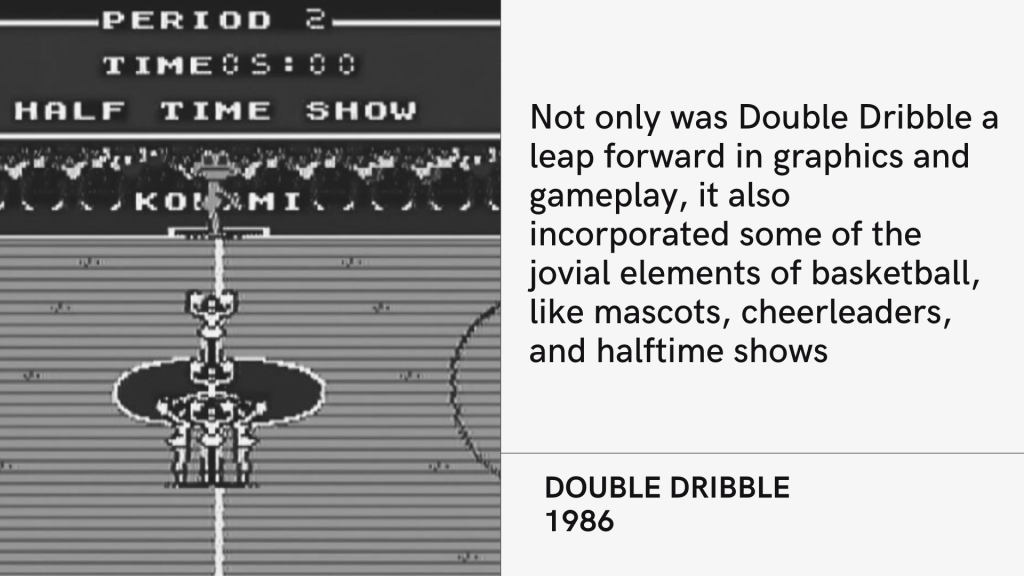
Building on their previous success with the “Super Basketball” arcade game, Japanese developer Konami revolutionized five-on-five video game basketball with “Double Dribble.” Initially released in arcades in 1986, “Double Dribble” soon after found its true calling as the first Nintendo Entertainment System (NES) basketball game in 1987. It was notable on the technical side for its solid graphics and accurate gameplay, really nailing the speed, mechanics, and skill-building of basketball, while each team had unique strengths and weaknesses. It was also memorable for its extraneous fun elements, from the knock-off team names (e.g., Boston Frogs, Los Angeles Breakers) to the pre-game national anthem to the cut-scene dunks to the halftime show featuring cheerleaders and mascots. Any basketball fan that grew up playing the NES likely has a special place in their heart for “Double Dribble.”
5) Lakers vs. Celtics and the NBA Playoffs (1989)
After years of waiting, “Lakers vs. Celtics” finally gave basketball fans a chance to use actual NBA teams and players in a realistic video game. Granted, there was only eight teams (10 if you count the All-Star squads) but this was a huge leap forward in authentic basketball gaming. Released first on MS-DOS in 1989 and two years later on the Sega Genesis, it was the latest in a long line of successful EA titles, and a true precursor to the NBA Live series that would eventually dominate the home console market. In addition to the two titular teams, you could play as the Bulls, Pistons, Knicks, Sonics, Suns, or Jazz, all with authentic rosters (the Knicks, Sonics, and Jazz were swapped out in the Genesis version for the 76ers, Spurs, and Blazers). This even included Michael Jordan, who did not yet have an exclusive likeness rights deal.
6) Bill Laimbeer’s Combat Basketball (1991)
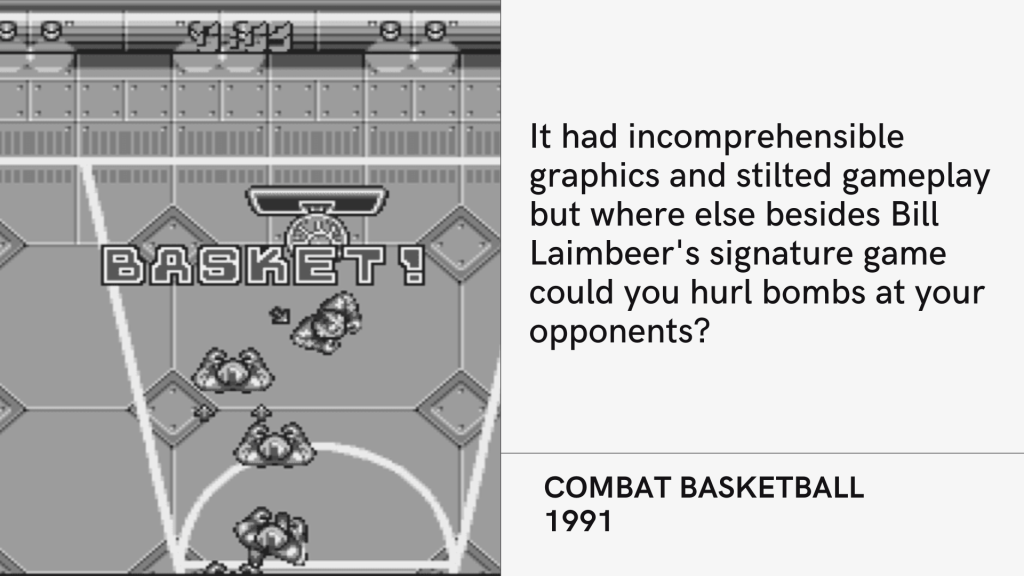
Like an alternate universe where Paul Verhoeven was a huge Pistons fan, “Combat Basketball” portrayed a grim, gritty vision of the future of pro basketball. The first basketball game released for the Super Nintendo, it posited that “Bad Boys” antagonist Laimbeer would soon be banned from the NBA for life but return in 2030 as the commissioner of a new rival league, where players are heavily armored, referees are banned, and fans hurl weaponry onto the court. For such a ridiculous premise, the game had a surprisingly robust and ahead-of-its-time franchise mode, with player transactions and a league relegation system. Unfortunately, the graphics, overhead view, and over-reliance on the B button added up to horrendous gameplay.
7) NCAA Basketball (1992)
Making optimal use of the Mode 7 graphics that were unlocked by the advent of the Super Nintendo, “NCAA Basketball” recast basketball gameplay with a 3-D player’s perspective that would eventually become the norm. It wasn’t the first major college basketball video game, but it was by far the best of the earliest titles, not just for its advanced graphics and controls but also for its entertaining season mode, which culminated in a March Madness tournament (although it was lacking enough schools for a full 64-team tournament, as only the ACC, SEC, Big 8, Big East, and Southwest Conferences were represented). Players were lovingly rendered in sharp 3-D graphics, but that didn’t extend off the court, as the crowd was missing and the negative space was filled with an unnerving wall of blue. This was the first sports game developed by Sculptured Software, which was concurrently working on “Tecmo NBA Basketball.” They also created the legendary SNES “Super Star Wars” series and the only other sports title to make use of Mode 7, “NHL Stanley Cup,” before getting bought out by Acclaim in 1995.
8) Tecmo NBA Basketball (1992)
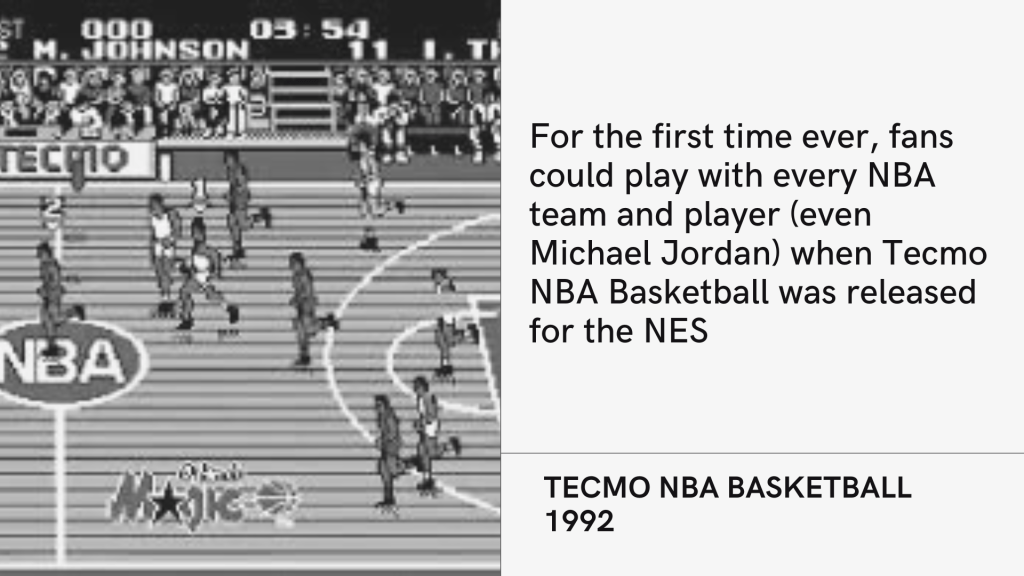
Though it never reached the popular heights of its sister gridiron title, “Tecmo Bowl,” the NES release “Tecmo NBA Basketball” is still beloved and significant for being the first game to feature every NBA team and every NBA roster. This was thanks to coupled agreements with the NBA and the Players’ Association, which allowed full use of team names, logos, and rosters (including even Michael Jordan, who would soon after opt out of the agreement and start exclusively lending his likeness to non-basketball video game titles like “Space Jam” and “Michael Jordan: Chaos in the Windy City”). Players could participate in single games or the full ’91-’92 season, and enjoy vast player ratings and stat tracking. Unfortunately, the player rendering was still lacking, leaving the 5’4″ Muggsy Bogues and the 7’6″ Manute Bol looking nearly identical on the virtual court. This improved somewhat a few months later with the release of “Tecmo Super NBA Basketball,” the SNES (and, eventually Sega Genesis) version of the game with upgraded graphics and gameplay.
A visual history of basketball video games




9) Bulls vs. Lakers and the NBA Playoffs (1992)
10) Bulls vs. Blazers and the NBA Playoffs (1993)
11) Team USA Basketball (1992)
Following the runaway success of “Lakers vs. Celtics” in 1989, EA regrouped two years later and began an annual tradition of releasing updated NBA titles. The first was “Bulls vs. Lakers,” released exclusively on the Sega Genesis in 1992. In addition to vastly improved graphics and controls, it also expanded the number of available teams from eight in “Lakers vs. Celtics” to 16 (those 16 being the playoff teams from the ’90-’91 season that ended with the Bulls and Lakers in the NBA Finals). Other new innovations included in-game instant replay, broadcast-style presentations (with a fictional EA Sports Network), co-operative two-player mode, and team logos rendered on the court. One year later, the series continued with “Bulls vs. Blazers” on the SNES, with the name once again reflecting the latest NBA Finals match-up. The biggest leap forward in this version was “marquee shots,” with star players able to perform their signature move, such as Michael Jordan’s free throw dunk and Magic Johnson’s no-look pass. It was also the first title in the series that featured every NBA team and is notable as the final officially NBA licensed video game to include Charles Barkley, who soon after opted out of all non-individual licensing agreements. In the middle of this run, EA took advantage of Dream Team mania by releasing “Team USA Basketball” in the summer of 1992. Players could control the 1992 U.S. Olympic team in tournament or exhibition play against the other 11 Olympic squads that year (or try to upend the Dream Team as, say, Australia). All real players were added, not just on the Dream Team but also Croatia’s Toni Kukoc, Brazil’s Oscar Schmidt, etc.
12) NBA Jam (1993)
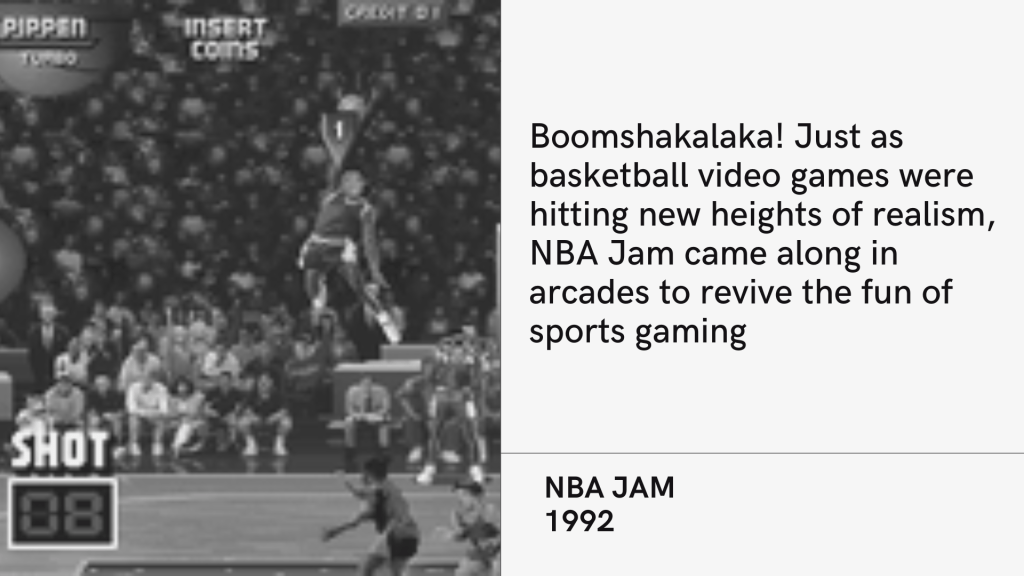
Increasing realism and authenticity was a definitive theme of basketball video games in the early ’90s until “NBA Jam” hit arcades in April of 1993 and shattered all preconceived notions. Perfectly marrying the inherent fun of early ’90s NBA with bombastic, bigger-than-life arcade game style, it was a massive hit and rewrote the rules of sports video games. Building on the style and philosophy of “Arch Rivals,” Midway’s original foray into sports titles, “NBA Jam” reigned in some of the goofy violence (you could literally punch opponents in “Arch Rivals”), amped up the dunking, shooting, and blocking aerobatics, and used the latest technology to render photorealistic versions of NBA stars that still maintained an element of fun cartoonish design. Since its initial release, “Jam” has spawned 12 sequels or reboots (including a particularly unsuccessful 3-on-3 version in 2001 called “NBA Hoopz”) and has been ported to dozens of home console systems, from the Super Nintendo, Game Boy, and Dreamcast to the Playstation 3 and XBox 360. In 2020, it was revived in its ultimate form as an arcade cabinet, a perfect addition to any basketball fan’s classiest room of their house.
13) Barkley Shut Up and Jam! (1993)
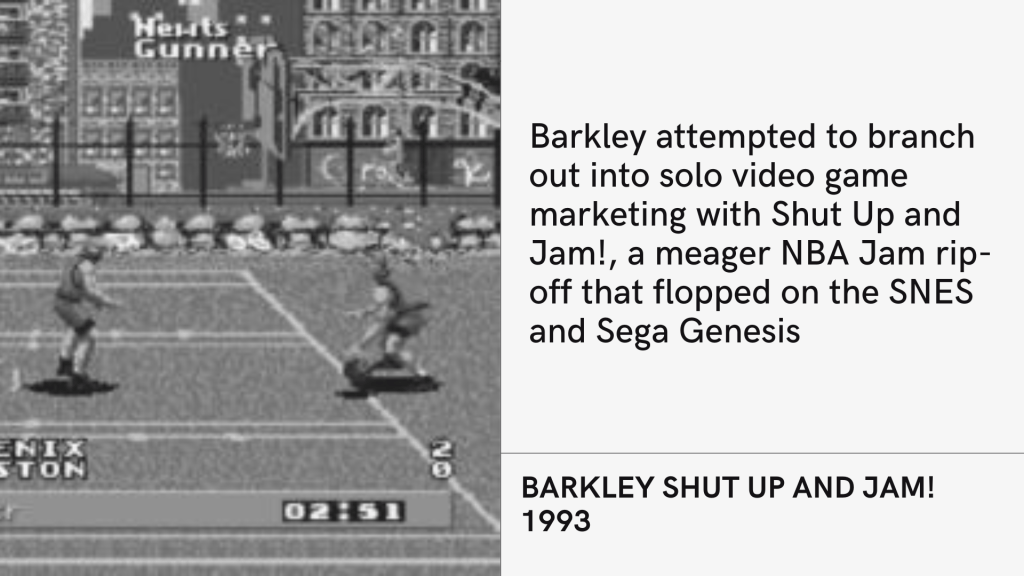
A mainstay of the Tecmo and EA basketball games in the first half of his career, Barkley began opting out of licensing just as he became league MVP and arguably the game’s biggest star. His stance has continued to this day (his contention has always been that the NBPA isn’t routing enough funding from licensing to retired players), even refusing to be included as an analyst in recent NBA 2K titles, but the “Round Mound of Rebound” did make a go at solo video game stardom. Following in the footsteps of Michael Jordan and Magic Johnson, Barkley lent his name to a title that featured no other NBA or NBPA licensing, the 1993 SNES and Genesis release “Shut Up and Jam!” Modeled after “NBA Jam,” “Shut Up and Jam!” was a two-on-two game with unique outdoor locales and even looser enforcement of rules. Though it wasn’t a disaster by any means, “Shut Up and Jam!” was also not nearly as big a success as “NBA Jam” and Barkley’s days as a solo video game licensee came to a quick end.
14) NBA Live 95 (1994)
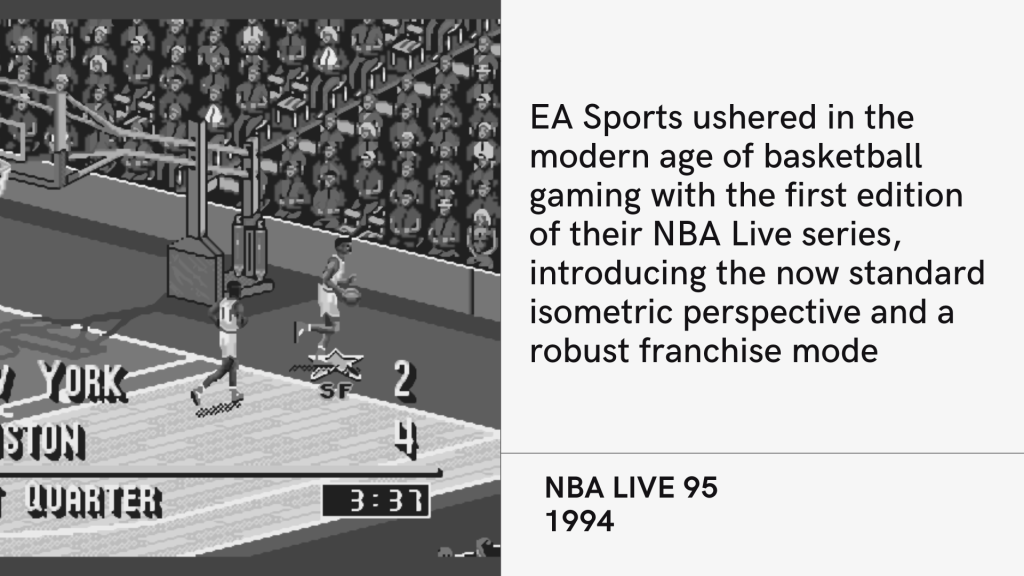
Disappointed with the public response to “NBA Showdown,” the underwhelming continuation of their popular “NBA Playoffs” series, EA went back to the drawing board. They returned with “NBA Live 95,” an evolutionary leap forward that ushered in the modern age of basketball gaming. Borrowing heavily from the game engine of their recently launched “FIFA” series, “NBA Live” was the most realistic video game representation of basketball to date, with sharp graphics, intuitive controls, and the isometric (behind the player) perspective. It was also the first EA title to feature every NBA team (27 at the time) and player (with the exception of Charles Barkley), and the first basketball game to introduce free agency and a create-a-player option (where Barkley and the recently retired Michael Jordan could be manually generated). EA effectively locked down the basketball video game market for several years thanks to this release.
15) NBA 2Ball (1998)
How did a borderline unplayable Playstation promotional demo based on a forgettable, short-lived NBA All-Star Weekend event become one of the most valuable video games in the world today? As with most financial outcomes, it comes down to scarcity, as less than 1,000 copies of “NBA 2Ball” were distributed to fans during the 1998 All-Star Weekend in New York. Of those 1,000 or so discs only a few survived, as one can imagine that most fans just immediately trashed them. There are only four known copies out there today, and it has retailed on eBay for hundreds of dollars. Using the much-maligned game engine from the recently released “NBA Jam: Extreme” and the 2Ball event that was added to All-Star Saturday Night in 1998 to replace the on-hiatus dunk contest, “NBA 2Ball” was an obvious rush job that left no impression on late ’90s gamers. But over two decades later it’s become a collector’s item thanks to its novelty and rarity.
16) NBA 2K (1999)
As the console wars heated up in the late ’90s, a glut of basketball titles flooded the video game market but the “NBA Live” series reigned supreme. Its first real challenge didn’t come until 1999, when Visual Concepts developed “NBA 2K.” Released only on the Sega Dreamcast and featuring Allen Iverson on the cover, “2K” immediately rivaled “NBA Live” in graphics and gameplay, though it was initially lacking in franchise mode (“NBA Live 99,” released around the same time, became the first NBA game ever to feature multi-season play). This kicked off one of the biggest video game rivalries of the 21st century, with both franchises attempting to outdo each other year-to-year. Notable innovations have included online play, the “Live” freestyle control system, general manager modes, curated game soundtracks, increasingly realistic television-style presentation, and the vaunted “Jordan Mode” in “2K11,” where players could attempt to recreate Michael Jordan’s most memorable performances.
17) NBA Street Vol. 2 (2003)
A perfect marriage of “Live” or “2K” realism with “NBA Jam” cartoonish fun and the hip-hop/NBA cultural nexus, the “NBA Street” series is a beloved line and peaked in 2003 with “Vol. 2.” Originally considered just a fun side project at EA, “Street Vol. 2” has since become widely acclaimed as the peak of basketball video gaming. With a 3-on-3 format, convivial graphics, and simplistic gameplay, “Street” could easily picked up by novices and even non-basketball fans, but still packed enough realism (especially in the roster construction, featuring current NBA players and numerous legends, as well as playground greats and rappers) to excite “2K” and “Jam” aficionados.
18) NCAA Basketball 10 (2009)
College basketball video games have a long and storied history, especially after EA entered the genre with “Coach K College Basketball” in 1995. Porting their “NBA Live” engine to a college game was an instant hit and became a yearly tradition. They soon after added the popular dynasty mode, where gamers took over all aspects of a program and recruited new players year-to-year, commentary from Dick Vitale and Brad Nessler, plus a host of increasingly intricate details, from the mascots, band, and cheerleaders, to authentic court and crowd designs. Visual Concepts launched its own popular 2K series of NCAA games as well, starting in 2003, but “NCAA Basketball 10” from EA in 2009 was the last college basketball game on the home console market. Why? Because the NCAA was sued by former UCLA star Ed O’Bannon and 19 others for licensing their likeness in a video game without compensation. Rather than do the right thing and begin compensating both current and former student-athletes, the NCAA did its typical thing and just pulled its licensing agreement from EA and Visual Concepts, marking the end of NCAA basketball video games. With the NCAA recently finally lifting some regulations on amateur compensation, it gave hope that we may be playing college hoops in video game form again soon.
Next up in Media and Entertainment
- Dead air: Eight legendary NBA players who struggled as television broadcasters
- Primetime players: 14 notable NBA crossovers with Saturday Night Live
- Won’t see my picture on the cover: 10 NBA Finals that weren’t featured on a Sports Illustrated cover
- Faces in the crowd: 12 NBA celebrity superfans
- Boomshakalaka!: Ranking the 27 rosters from the original NBA Jam (1993 arcade edition)
- Soles power: 16 notable signature basketball shoes
- Media matters: A history of the NBA in 12 television rights contracts
- Golden voices: Eight NBA announcers with retired microphones
Next up in Julius Erving
- Separated laundry: 18 NBA players with a jersey retired by multiple franchises
- You’re the best around: 80 greatest NBA players of the 1980s
- Can’t blame me: 15 greatest individual NBA Finals performances in a losing effort
- Digital dunks: 18 great, influential, outrageous, or otherwise notable basketball video games
- Joy of six: 13 notable facts about jersey #6 and the players who have worn it
- Noms de plume: 75 greatest NBA and ABA player nicknames
- Basket-brawl: 26 memorable on-court fights in NBA games
- Hollow trophies: 14 early playoff exits by reigning league MVPs
 Basketball, Listed