1) Golden State Warriors (Philadelphia, Oakland)
When the Warriors began play at the glitzy Chase Center in San Francisco, it was a notable shift from the franchise’s much more nomadic and much less glamorous past. Considering that Philadelphia is now one of the basketball hotbeds of the world, it’s hard to believe that the city once struggled to support an NBA franchise. But that was the reality for the Warriors, who started play in Philly in ’46-’47, the inaugural NBA season, but skipped town for the West Coast in 1962. Even while they were in Philadelphia, the Warriors would often contest games in neutral sites, sometimes due to scheduling complications and sometimes due to lack of fan interest in their home arena. The most famous example was Wilt Chamberlain’s 100 point game in 1962, which took place 100 miles away from downtown Philly in Hershey, PA. Even though they won two NBA titles in Philadelphia and Chamberlain was on the roster, owner Ed Gottlieb sold the team to a joint venture headed by Franklin Mieuli, who moved them to San Francisco. Well, close to San Francisco anyway, as the Warriors played two seasons in nearby Daly City at the Cow Palace before moving into the San Francisco Civic Auditorium. True to their peripatetic nature, they didn’t stay long, soon adapting the newly built Oakland Coliseum as their most common home in 1968. Because they were still hosting some games in San Francisco, as well as San Diego and Long Beach, they reflected this reach across California by changing their name to Golden State starting in the ’71-’72 season.
2) Philadelphia 76ers (Syracuse)
Even though the Warriors had struggled financially there before leaving for California, it was still conventional wisdom in the early ’60s that Philadelphia deserved an NBA franchise. It had also become apparent throughout the ’50s that small and medium sized cities just didn’t have the built-in fan base to support teams as the league was expanding its business model. Thus, the Lakers moved out of Minneapolis, the Royals left Rochester, the Hawks abandoned Milwaukee, and the Pistons ditched Fort Wayne. The last small market team standing was the Syracuse Nationals, who had joined the NBA as part of the 1949 BAA/NBL merger. Their success was due entirely to results on the court, spurred by star forward Dolph Schayes. They reached at least the Conference Finals in eight of their first 11 NBA seasons, won the title in 1955, and were still a contender in the early ’60s even though Schayes was quickly aging out of relevance. But the Warriors moving to San Francisco in 1962 opened up an opportunity for the final small market hold-out to move into an available large city. A pair of former high school classmates at South Philadelphia, one a paper company magnate and the other Wilt Chamberlain’s lawyer, purchased the Nationals in 1963 and immediately relocated them to Philadelphia, where they became the 76ers.

Our fifth volume will be published throughout the ’22-’23 NBA season
3) Los Angeles Clippers (Buffalo, San Diego)
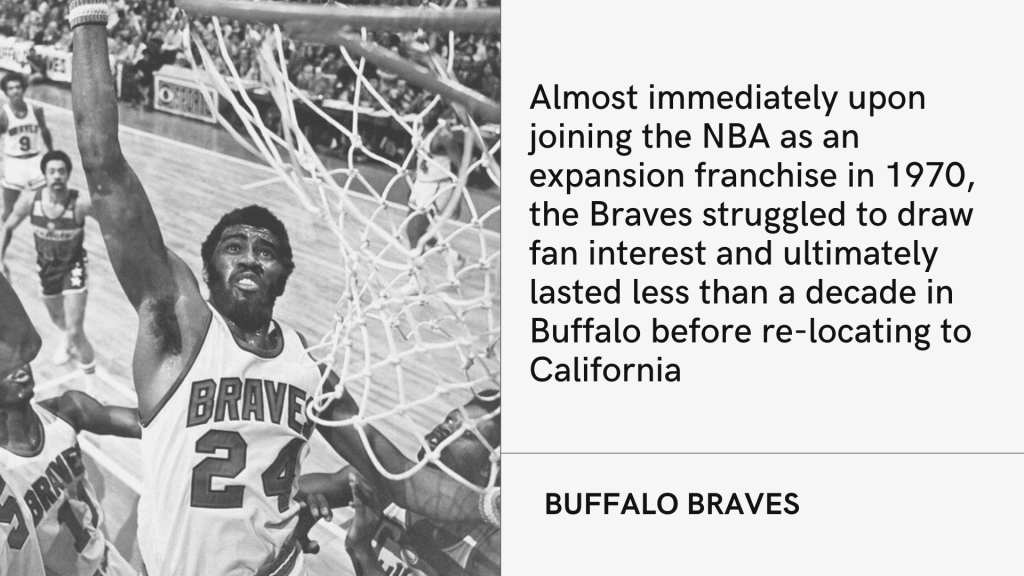
Following in the footsteps of the Rochester Royals, who left for Cincinnati in 1957, and the Syracuse Nationals, who moved to Philadelphia in 1963, Buffalo became the third upstate New York city to receive an NBA franchise. The Buffalo Braves began play in ’70-’71 and soon proved why the area was such a difficult place for an NBA team to find success. Even as the Braves became a contender in the mid ’70s, complete with an MVP winner in Bob McAdoo, attendance floundered. Ownership was in a near constant battle with the Buffalo Sabres of the NHL and the Canisius Golden Griffins of the NCAA for scheduling priority in the Buffalo Memorial Auditorium, and the imbalanced schedule cost the Braves any momentum in building a consistent fanbase. When a move to Miami was blocked by a lawsuit from the city of Buffalo, owner John Brown took unprecedented measures, essentially trading the Braves to Irv Levin for the Celtics. Because attendance had dipped to the point where the Braves were able to break their lease with the arena, Levin was then able to move the franchise to San Diego and rename them the Clippers. In their six years in San Diego, the Clippers failed to make the playoffs and finished above .500 just once, with a 43-39 record in ’78-’79. Levin sold the franchise to real estate mogul Donald Sterling, who moved them 120 miles north to his hometown of Los Angeles. The NBA sued Sterling to block the move, but he countersued and eventually won, allowing the Los Angeles Clippers to begin play in ’84-’85.
4) Los Angeles Lakers (Minneapolis)
5) Utah Jazz (New Orleans)
Easily the two most ironic team names in the NBA, the Lakers and Jazz have become such institutions that their joke monikers hardly even resonate anymore. The Lakers actually started life as the Detroit Gems in the NBL, then became the Minneapolis Lakers in 1947, just after signing George Mikan. After one year of dominating the NBL, the Lakers switched to the NBA and did more of the same, winning five championships in their first six years in the league until Mikan’s 1954 retirement. They played one more NBA Finals in Minneapolis in ’58-’59, Elgin Baylor’s rookie year, before owner Bob Short moved them to Los Angles in 1960. It was a somewhat curious move, as Short had spent his entire life in the Twin Cities up to that point and the franchise seemed to be successful there. It’s long been assumed that the NBA pressured Short to make the move out of a desire to expand the league to the West Coast. No matter the motivation, the Lakers quickly became an L.A. staple, eventually winning 11 championships in their adopted town, which famously has no natural lakes. As for the Jazz, they started life in New Orleans in ’74-’75 but the city was obviously not ready for them. They played in numerous arenas in the area, none of which were well-suited for NBA play, had to spend an entire month on the road every year due to Mardi Gras festivities, and struggled to make any inroads with local fans, who were more interested in college sports. To make matters worse, the Jazz were a joke on the court, failing to build around their oft-injured, malcontent star Pete Maravich, and engaging in a series of disastrous transactions that cost them a chance to suit up Moses Malone and Magic Johnson. They moved to Salt Lake City in 1979 and for some reason the Jazz named followed them. Owner Sam Battistone supposedly wanted to rename them the Utah Stars in honor of the former ABA franchise in the city, but feared a lawsuit from a local hockey team, so he stuck with Jazz.
6) Memphis Grizzlies (Vancouver)
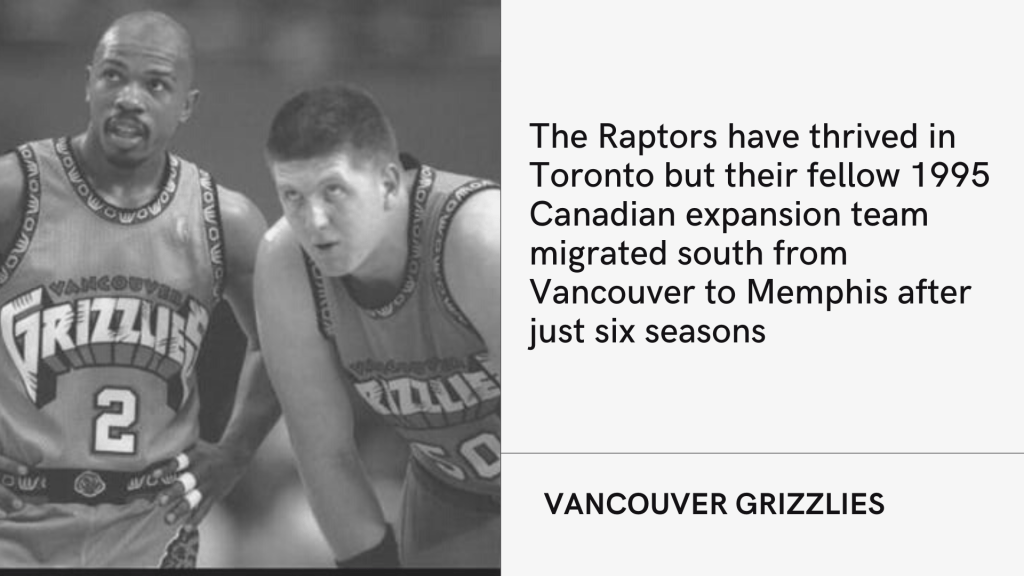
Maybe an NBA franchise in Vancouver seems like a pipe dream in retrospect, but the metropolitan area is currently the third largest in North America without an NBA, MLB, or NFL team (trailing only Montreal and California’s Inland Empire). Though the city did fail to fully embrace pro basketball, it only deserves some of the blame for the franchise’s relocation to Memphis after just six seasons in Canada. The biggest culprit was ownership. Original owner Arthur Griffiths couldn’t even make it to the inaugural game, as his other financial interests, the Vancouver Canucks and the building of Rogers Arena, were bleeding him dry in the winter of 1995. He sold the team to John McCaw, who in turn almost immediately began exploring other cities for relocation, as the late ’90s collapse of the Canadian dollar was creating even greater financial burdens. A sale and subsequent move to St. Louis was scuttled by the league office in 1999 but two years later David Stern relented, allowing a sale to new owner Michael Heisley, who began essentially soliciting offers from various cities. Memphis beat out former NBA sites New Orleans and Buffalo, as well as Las Vegas, Louisville, and Anaheim. It was the first NBA franchise relocation in 16 years, a milestone that Stern bemoaned publicly and privately. Things were rough at first in Memphis but the fanbase eventually grew and the franchise has gained solid footing. Vancouver is still bandied about as a potential landing place for an NBA relocation or expansion, and as recently as 2012, the latest Canucks ownership was rumored to be bidding on the then-for-sale Hornets and Kings with an eye towards moving them up North.




7) Washington Wizards (Chicago, Baltimore, Landover)
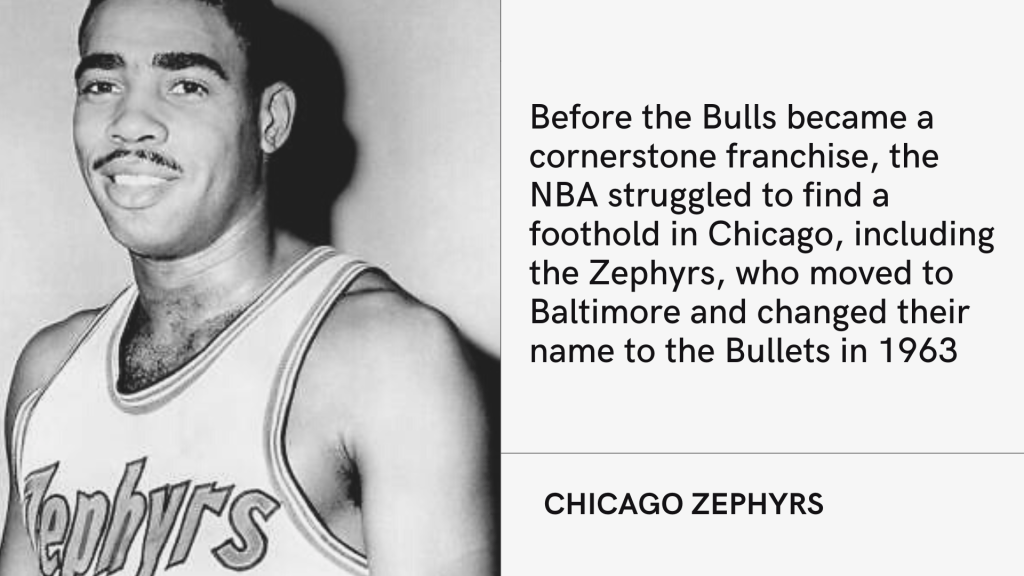
While pro football, baseball, and hockey have all thrived in Chicago since the late 1920s, pro basketball waited a lot longer to take hold. A franchise called the Chicago Stags reached the inaugural NBA Finals in 1947, but folded just three years later due to languid ticket sales. The NBA tried its luck again in the Windy City in 1961, with the league’s first expansion franchise, the Chicago Packers. They struggled immensely in the standings and at the box office, and after just two seasons ownership was already in a bind. They jumped at an attractive offer from the Baltimore Civic Center, which was significantly larger and newer than their home arena in Chicago, the International Amphitheater. The team renamed themselves the Baltimore Bullets, in honor of a previous NBA franchise that had won a title in 1948 and folded in 1955. Despite increased fan interest and a rapidly improved roster that reached the NBA Finals in 1971, the Bullets still struggled in Baltimore, leading to the dissolution of their ownership structure. One remaining owner, Abe Pollin, commissioned a brand new arena called the Capital Centre in the D.C. suburb of Landover, Maryland, and moved the team there, rebranding them as the Capital Bullets. He changed it again to Washington Bullets just one year later, but the team didn’t play in D.C. proper until 1997, with the opening of their current home, the MCI Center (now the Capital One Arena). Chicago eventually did get its own successful pro basketball franchise, with the Bulls joining the NBA in 1966 and eventually winning six championships.
8) Brooklyn Nets (Teaneck, Long Island, Piscataway, East Rutherford, Newark)
Joining the NBA from the ABA was hard enough for the Nets in 1976, but contending in the new league became near impossible when they were forced to pay $4.8 million to the Knicks for “infringing” on New York. It was a familiar situation for the Nets, who intended to begin play in the ABA as the New York Americans in 1967 but were forced out of their Manhattan home by the Knicks before the season even started, and instead took the floor as the New Jersey Americans in Teaneck. They eventually found a stable home in Long Island, and remained there for their first NBA season before returning to their roots in Jersey in 1977, first in Piscataway on the campus of Rutgers, then 60 miles north to East Rutherford in 1981, at the newly opened Brendan Byrne Arena. When the franchise was sold to Bruce Ratner in 2005, he immediately announced plans to build a new arena in Brooklyn and move there. It took seven years, multiple lawsuits, and a two-year stopover in Newark to get there, but the Brooklyn Nets finally did take the court in ’12-’13, in what was technically the franchise’s fifth relocation.
9) Atlanta Hawks (Moline, Milwaukee, St. Louis)
Even before they joined the NBA in 1949 as part of the NBL merger, the Hawks had already moved and changed names once. They started as the Buffalo Bison in 1946 in the NBL before moving to Illinois and becoming the Tri-Cities Blackhawks. “Tri-Cities” in this context referred to the cities of Moline (where they played most of their home games), Rock Island, and Davenport, which sit along the Illinois/Iowa border. Unlike other small market NBL franchises like the Sheboygan Redskins and Waterloo Hawks, who folded after just one season in the NBA, the Blackhawks managed to survive long enough to move (supposedly forced by the league) to a bigger market in Milwaukee in 1951. Since Blackhawks was a specific nod to the Native American history of the tri-cities area, the name was shortened to Hawks upon relocation to Milwaukee. Though they now played in a much bigger city, the Hawks still struggled to attract fans, thanks in large part to their poor performance on the court. They finished in last place in the Western Conference in all four years in Milwaukee, including ’54-’55 when they were led by Rookie of the Year Bob Pettit. When a neutral site game in St. Louis during the ’54-’55 season drew a huge crowd, owner Ben Kerner took it as a sign that it was time to move again. Things went much better for the Hawks in St. Louis, with Pettit leading the way to an NBA title in 1958, plus three other Finals appearances. Attendance started to lag in the late ’60s, due in part to Pettit’s retirement but also the newly formed St. Louis Blues of the NHL and newly relocated St. Louis Cardinals of the NFL drawing away fan attention. Kerner sold the team to a group of Atlanta investors, and in 1968 the franchise made its fourth and final move, becoming the first Southern NBA team. St. Louis has long been a rumored destination for other potentially relocating franchises, but has now gone over a half-century and counting without an NBA team.
10) New Orleans Pelicans (Charlotte, Oklahoma City)
11) Oklahoma City Thunder (Seattle)
According to official NBA records, the franchise we now call the Pelicans have always resided in New Orleans but those of us paying attention know better. They were originally the Charlotte Hornets, who started play in 1988 and were usually competitive but by the late ’90s were already struggling financially due to mismanagement by owner George Shinn. He tried to move them to Memphis in 2001, but lost out on the bid to the Grizzlies. St. Louis, Louisville, and Norfolk were also considered, with New Orleans ultimately winning out. The New Orleans Hornets started play in ’02-’03 and landed a coup in Chris Paul in the 2005 Draft but also struggled in the wake of Hurricane Katrina, which forced them to temporarily play in Oklahoma City. One year after the Hornets returned to New Orleans, Oklahoma City got its own NBA franchise when the SuperSonics controversially moved there, ending a forty year run in Seattle. Meanwhile, Shinn was finally forced to sell the Hornets in 2010 and after some time under control of the league office, Saints owner Tom Benson swooped in and bought them. Wanting to rebrand, Benson changed the team name from Hornets to Pelicans, and the Charlotte Bobcats, in turn, took back the name Hornets for the city of Charlotte. The NBA then made an unprecedented move, reconstituting the Pelicans as an expansion franchise that started in 2002 and stitching together the various Charlotte franchise iterations as one. Will they make a similar decision with Oklahoma City if Seattle ever gets another team? For now, the Thunder are technically considered an extension of the SuperSonics, though the 1979 championship banner and trophy remained in Seattle, where it’s displayed at the Museum of History and Industry.
12) Detroit Pistons (Fort Wayne)
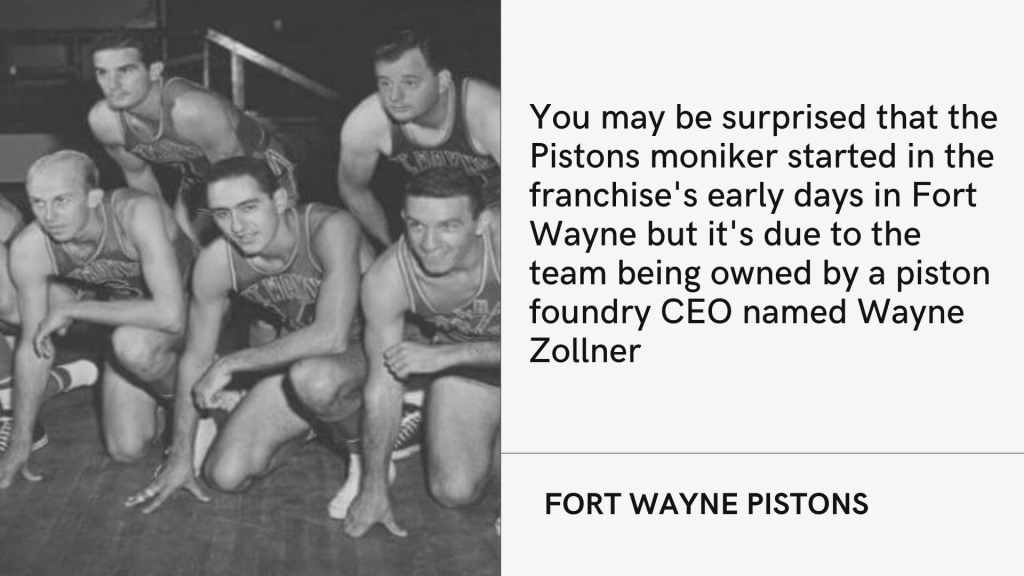
Long before the Pistons moved to the city in 1957, Detroit’s first NBA franchise was the Falcons, who competed in the inaugural ’46-’47 season before folding. The second attempt at an NBA franchise in the Motor City was obviously much more successful, with the Pistons winning championships in 1989, 1990, and 2004, and recently celebrating their 60th season in the city. It all started for the Pistons in Fort Wayne, where an auto parts magnate named Fred Zollner, owner of Zollner Pistons, started his own corporate basketball team to take on other automative Midwest titans like Goodyear and Chevrolet. The Pistons started play in the NBL in 1941 and won two championships before moving on to the NBA in 1948. Though they remained successful in the NBA, reaching the Finals in back-to-back seasons in 1955 and 1956, it quickly became apparent that Fort Wayne wasn’t big enough to support a major pro franchise. Thus, like the Rochester Royals and Syracuse Nationals, the Pistons traded up to Detroit. Luckily, the world capital of auto manufacturing was still a perfect place to retain the name Pistons. Though Fort Wayne has never received another NBA team, the state of Indiana has had three other ones, with the Indianapols Jets and Indianapolis Olympians folding in the early days, followed by the Indiana Pacers merging from the ABA in 1976. Fort Wayne does now host the Mad Ants, a G-League affiliate of the Pacers.
13) San Antonio Spurs (Dallas)
One of the original 11 ABA franchises in ’67-’68, the Dallas Chaparrals became the first major pro basketball team in Texas, predating the Houston Rockets by four years. Though they were only competing with the Cowboys for pro sports dominance in the city at the time, the Chaparrals struggled to draw fans, and ownership attempted to rebrand as a team representing all of Texas, scheduling games all across the state. One the sites that occasionally hosted contests was San Antonio, where a group of businessmen teamed up in 1973 to purchase the team and permanently place them in the city. Initially called the Gunslingers, their name was changed to San Antonio Spurs right before the ’73-’74 ABA season and though they never won a league title, the Spurs were one of four franchises that joined the NBA after the 1976 merger. Dallas would soon after get its own NBA franchise in 1980, when the Mavericks joined as an expansion team.
14) Sacramento Kings (Rochester, Cincinnati, Kansas City, Omaha)
After 35 seasons and counting in Sacramento, the Kings have no NBA Finals appearances to show for it, let alone a title. In fact, they’ve reached the playoffs just 10 times, advanced past the first round just four times, and have yet to produce a single legendary player. Casual fans may think they’re a relatively recent expansion franchise that’s failed to ever build a contender but they are in actuality the oldest active franchise in pro basketball, and were once a powerhouse team. They were originally a corporate semi-pro team called the Rochester Seagrams, as in Seagram’s whiskey, starting play in 1923 and regularly playing high-profile matches against the likes of the Harlem Globetrotters and New York Rens. They changed the name to Rochester Royals upon joining the NBL in 1945, where they reached the Finals three times but failed to win a title. In 1948 they joined the NBA and soon after won a championship in 1951, thanks in large part to an injury to George Mikan that kneecapped their biggest rivals, the Lakers. It would turn out to be the only NBA Finals appearance and championship in franchise history. With the NBA shifting away from small markets, the Royals moved to Cincinnati in 1957 but were able to retain their name in the “Queen City.” Even though they landed Oscar Robertson in the 1960 Draft, the Royals failed to build much fan interest in Cincinnati, especially after the Bengals were established in 1967. They moved to Kansas City in 1972 and renamed themselves the Kings, splitting home games with Omaha while waiting for K.C.’s new Kemper Arena to be built. There were some successes in Kansas City, but fan interest waned quickly. While the NFL edged them out in Cincinnati, it was a more embarrassing fate for the Kings in K.C., where they were regularly outdrawn by the Comets, an indoor pro soccer team. New owners from Sacramento bought the team in 1983 and two years later, when lease was up on Kemper Arena, they moved to the Golden State. When the Kings were back up for sale in 2013, there were rumors they might move yet again to Anaheim, Seattle, or Norfolk, but Silicon Valley billionaire Vivek Ranadive purchased the team and vowed to keep it in Sacramento.
Next up in Franchise Events
- Foundational pieces: 30 notable NBA expansion draft picks
- All over the map: Eight times that the NBA realigned teams across conferences
- Golden voices: Eight NBA announcers with retired microphones
- The name game: 13 current NBA franchises that have changed names
- Don’t you forget about me: 80 basketball moments from the ’80s that changed the sport forever
- We built this city for pick and roll: 10 cities that have been rumored NBA franchise destinations
- Heart of the deal: 10 notable NBA franchise ownership changes
- Brand disloyalty: 12 ill-fated NBA arena naming rights deals
Next up in Geography
- All over the map: Eight times that the NBA realigned teams across conferences
- We built this city for pick and roll: 10 cities that have been rumored NBA franchise destinations
- Lonely travelers: 27 countries that have produced only one NBA player
- Heading on down the highway: 14 current NBA franchises that have re-located
- Keep your enemies closer: Nine geographically adjacent NBA rivalries
- Draft dodgers: Eight NBA players who refused to suit up for the team that drafted them
- Far from home: Nine notable NBA games played at a neutral site
- The court is flat: 11 significant NBA games played outside the United States
 Basketball, Listed