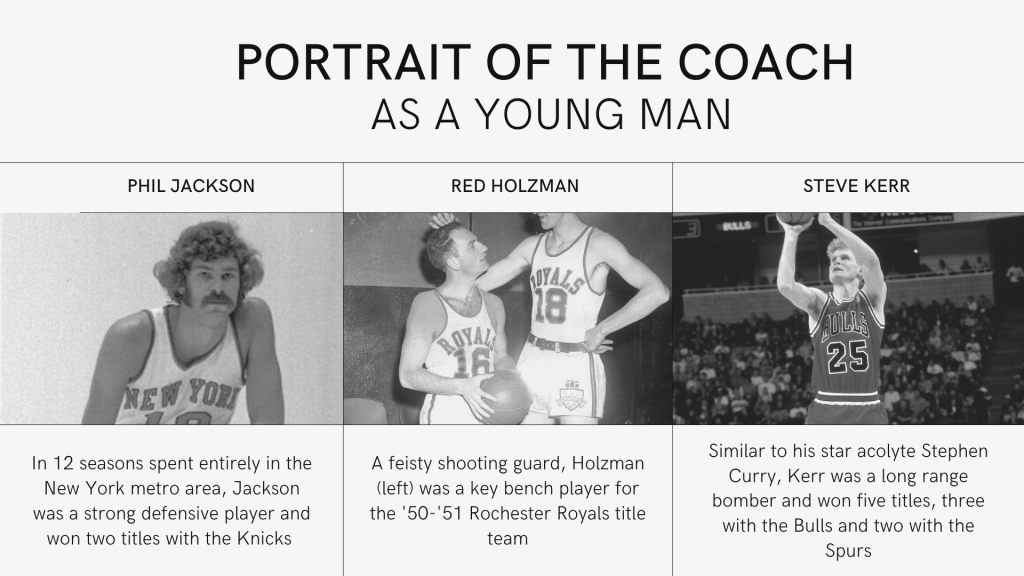
1) Phil Jackson
There doesn’t seem to be much correlation between a person’s style as a basketball player and their later success as a coach but we’ve all been trained to recognize the proper temperament. Like many of the players on this list, Jackson was known more for his intelligence and unselfishness on the court than any raw ability, which is not to say that he wasn’t a great pure athlete. Even though he attended the far-flung University of North Dakota, Jackson was sought after by many NBA teams for his quick hands, solid footwork, and wingspan, and he was drafted #17 overall by the Knicks. He had spent his entire life up to that point in rural Montana and North Dakota, with an upbringing that sounded like it was the inspiration for the movie “Footloose” (his parents were both ministers who banned their children from things like dancing and TV), but was a surprisingly natural fit amongst the other eccentric intellectuals in New York. A solid performer off the bench at power forward in New York’s golden age from 1967 to 1974, Jackson was renowned for his defensive intensity and leadership. Inspired by the legendary Bill Fitch, who was his coach in both high school and college, Jackson transitioned immediately into coaching after retiring as a player in 1980. Perhaps deterred by his outgrown hair, full beard, and carefree style, NCAA and NBA teams seemed to overlook his obvious acumen and leadership skills and he was forced to take his first coaching jobs in the CBA and Puerto Rican National Superior Basketball League. His first shot at the big league came as Doug Collins’ assistant in 1987 in Chicago, and he then took the reins in 1989 when Collins was fired. Jackson wrote at length in his books about how he successfully changed the Bulls’ culture to allow more autonomy to his young players like Scottie Pippen and Horace Grant, whereas Collins was totalitarian and dismissive of everyone except Michael Jordan. He also hit a goldmine by retaining fellow former assistant Tex Winter, whose triangle offense would serve as a cornerstone of Jackson’s six titles with Chicago, then five more with the Lakers. After two retirements followed by comebacks in 1999 and 2005, Jackson called it quits for good in 2011, as his failing body could no longer handle the rigors of coaching and travel.

Our fourth volume will be published throughout the ’21-’22 NBA season
2) Steve Kerr
Though he finished his playing career with averages of just 6.0 points and 1.8 assists per game, Kerr did win five NBA titles as a backup point guard, three on Phil Jackson’s Bulls and two on Gregg Popovich’s Spurs. After carefully studying the divergent styles of those two coaching legends, Kerr wisely melded them into his own coaching technique. He retired as a champion in 2003, after 16 seasons in the league, and immediately became a color analyst alongside Marv Albert on TNT. Looking to return to the competitive aspects of the game, Kerr served as general manager (and partial owner) of the Suns from 2007 to 2010, then, after another broadcasting gig, took over as head coach of the Warriors, succeeding his fellow former analyst, Mark Jackson. Blending elements of Jackson’s triangle offense and Popovich’s spacing techniques, Kerr was an instant success in Golden State, guiding the team to an NBA championship in his first season, then leading them to a record 73 regular season wins in his second (breaking the record of a team Kerr played on, the ’95-’96 Bulls). In addition to utilizing in-game concepts that he learned from his own former coaches, Kerr also deployed much of Jackson and Popovich’s most successful interpersonal approaches, especially their trusting, laissez-faire manner with veterans. This has been a large part of allowing a team featuring certified superstars Stephen Curry, Klay Thompson, Draymond Green, and Kevin Durant to succeed for several seasons with minimal personality-related incidents.
3) Red Holzman
Unless you were closely following the early days of the NBA, you may not even realize that Holzman played. The legendary Knicks coach, who led the team to three NBA Finals and titles in 1970 and 1973, spent six solid if unspectacular seasons as a player in the league, from 1948 to 1954. Prior to that, Holzman was a solid player for CCNY and then the Rochester Royals in their early NBL days (of Jewish/Romanian lineage, he was supposedly signed by Royals management mainly in an attempt to appeal to the Jewish population in upstate New York). As the Royals migrated into the NBA, Holzman retained his crucial role as the first guard off the bench, helping the team win its only championship in franchise history in 1951 (they’re now the Sacramento Kings). His first foray into coaching came as a player-coach for the Hawks in ’53-’54 and after a stint as a scout for the Knicks (during which he notably convinced the franchise brass to draft Willis Reed and Walt Frazier), Holzman took over as New York’s coach during the ’67-’68 season. Bringing a sense of community and autonomy to the roster, Holzman secured his spot as easily the greatest coach in franchise history, compiling 613 wins over two separate stints as coach. He was inducted into the Hall of Fame as a coach in 1985, and in 1996 the NBA named him one of the 10 greatest coaches of all-time, alongside his disciple, Phil Jackson.
4) George Karl
Lacking elite athletic skills but sporting a solid basketball IQ and willing to do dirty work, Karl was the right man for the job in the ABA. Over three ABA seasons with the Spurs, he averaged just 7.0 points and 3.2 assists per game but was considered one of the league’s most reliable bench options. When the Spurs merged into the NBA, Karl struggled to maintain speed with the leveled up play and retired after two seasons to take an assistant coach gig with the franchise. His first head coaching job came with the Montana Golden Nuggets of the CBA in 1980, followed by a chance with the Cavaliers in ’84-’85. Setting a motif for the remainder of his career, Karl immediately dragged an underachieving Cavs team to a surprise playoff appearance but soon after lost control of the locker room due to his totalitarian style and propensity for finger pointing when things went wrong. Despite his lack of bedside manner, Karl had later successful coaching stints with the Warriors, SuperSonics (whom he led to the 1996 NBA Finals), Bucks, and Nuggets, eventually becoming just the seventh coach in NBA history to compile over 1,000 career wins.
5) Rick Carlisle
Though his NBA career lasted just five seasons, four of them partial, and his career averages as a shooting guard were just 2.2 points and 1.1 assists per game, Carlisle does have a playing claim to fame. He logged one full season and 10 playoff games for the ’85-’86 Celtics, league champions and unquestionably one of the greatest teams in modern history. He even got to start one game that season, an April affair against the Bucks when coach K.C. Jones let all five bench guys start while the normal starters rested for the postseason. It’s even more notable for Carlisle, who fell to Boston in the third round in 1984, that he made the team over their first round pick, Michael Young (who was cut and eventually signed with Phoenix), and their second round pick, Ronnie Williams (who never logged a minute in the NBA). According to his longtime friend Larry Bird, this happened due to Carlisle’s dedication and insight, traits that would color his coaching career, which started with the Nets as an assistant in 1989, and peaked with the Mavericks, winning the NBA title in 2011. In between, Carlisle worked twice for Bird, first as an assistant from 1997 to 2000 when Bird was head coach of the Pacers, then as Indiana’s head coach from 2003 to 2007 when Bird took over as President of Basketball Operations (during the interim, Carlisle had a tumultuous stint as coach of the Pistons). Along with Phil Jackson, Pat Riley, and Red Holzman, Carlisle is one of just 10 men to win NBA championships as a player and as a head coach.
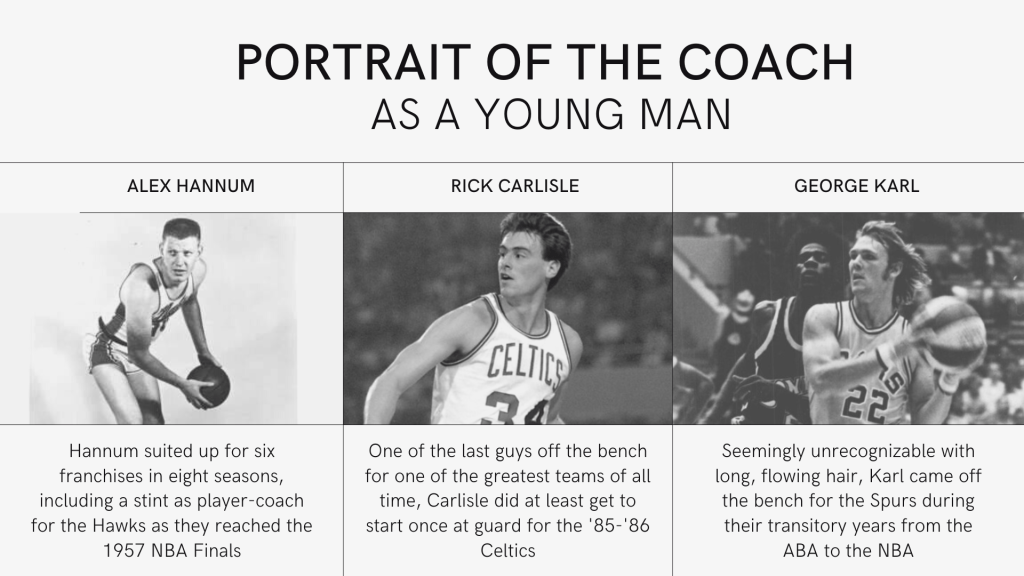
6) Alex Hannum
When the Hawks fired Red Holzman during the ’56-’57 season, they replaced him with newly acquired All-Star Slater Martin as a player-coach. But even Martin himself recognized that the true best candidate for the job was Hannum, a veteran journeyman forward. Hannum had averaged just 6.3 points and 4.7 rebounds per game up to that point and played for five franchises in seven seasons (which was unprecedented in those pre-free agency days) but was renowned at each stop for his leadership and organization skills. After a few games in which Martin was the coach in theory but Hannum was actually running the show from the sidelines, franchise leadership made it official, turning over the coaching job to him. The floundering Hawks turned things around immediately, eventually reaching the NBA Finals and pushing the Celtics to seven games. This was just the beginning of Hannum’s coaching success, with his ultimate superlative being the head coach of the only two teams to defeat Bill Russell and the Celtics in the postseason: the ’57-’58 Hawks (in the NBA Finals) and the ’66-’67 76ers (in the Conference Finals). He also stands as the only coach to lead championship squads in the NBA and ABA, achieving the latter with the Oakland Oaks in 1969. Inducted into the Naismith Hall of Fame in 1998, Hannum was once singled out by Wilt Chamberlain as the greatest coach he ever played for, and his hard working, mentoring style was a heavy influence of several of his own players who went on to successful coaching careers, such as Doug Moe, Billy Cunningham, and Larry Brown.
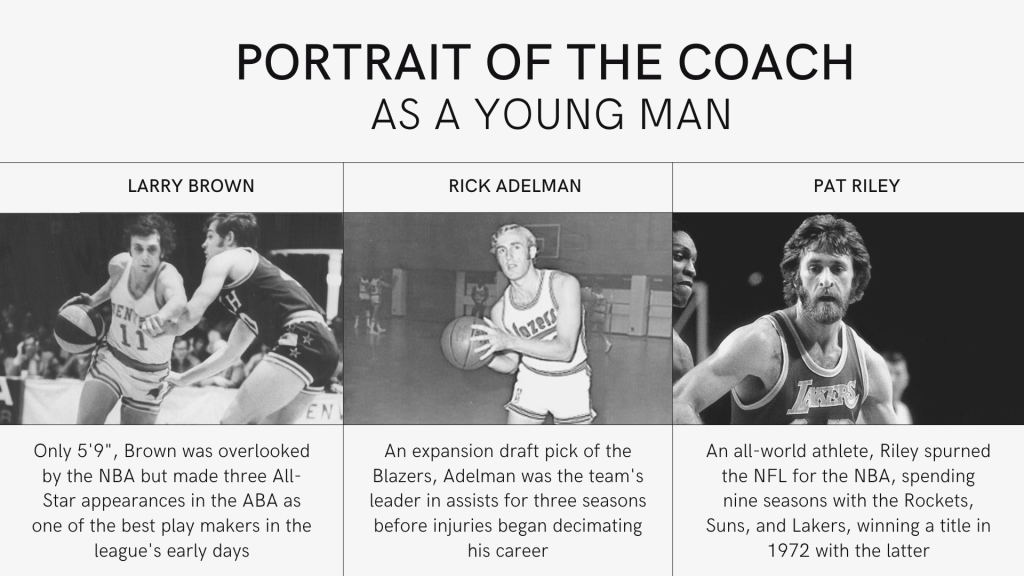
7) Pat Riley
An incredible all-around athlete, Riley was drafted not just by the Rockets in the first round in 1967 but also by the Dallas Cowboys as a wide receiver. He opted for a career in basketball and 55 years later is still a force of nature in the sport. Riley never quite lived up to expectations as a player, averaging 7.4 points per game over nine seasons with the Rockets, Lakers, and Suns. He did develop a taste for championships in those days, as a role player on the ’71-’72 Lakers who won 33 straight games and the NBA Finals. Upon retiring in 1976, Riley became a television color analyst for the Lakers alongside Chick Hearn before getting plucked out of the broadcast booth and onto the sidelines, first as an assistant coach and then as the head coach in 1981 when Paul Westhead was fired. Riley led the Lakers to the title that year, kicking off a nearly unparalleled run of coaching success, with seven NBA Finals appearances over eight years, including four championships. With his trademark slicked-back hair, ostentatious Armani suits, and composed demeanor, Riley was a perfect steward of the glitz and glamor “Showtime” Lakers that dominated Los Angeles during his rein. His success during that tenure was easily matched by his audacity, personified by his shrewd decision to copyright the term “three-peat” when he considered Los Angeles’ third straight title in 1989 a foregone conclusion (they were ultimately swept in the NBA Finals that year by Detroit). After stepping aside for a couple years, Riley returned to coaching with a brand new approach in the ’90s, leading tenacious, defensive-minded teams in New York and Miami. By the time he was finished with coaching in 2008, Riley had over 1,200 wins (good for third all-time at the time), three Coach of the Year trophies, five NBA championships (including one with Miami in 2006) and had been named to the NBA Top 10 Greatest Coaches list.
8) Rick Adelman
A sly and plucky point guard, Adelman started his career on the Rockets (as a teammate of Pat Riley) before getting selected by the Trail Blazers in their 1970 expansion draft. His first two seasons in Portland were a statistical peak, averaging 11.4 points and 4.9 assists per game before injuries started to affect his career. After brief stints with the Bulls, Jazz, and Kings, Adelman retired in 1975 and returned to the Pacific Northwest to take a head coaching job for a community college in Oregon. Dr. Jack Ramsay eventually brought Adelman onto his Blazers staff in 1983 and late in the ’88-’89 season, he got his chance in the top spot. Bringing a measured, cerebral, and detail-oriented approach, Adelman guided Portland to NBA Finals appearances in 1990 and 1992. This was just the start of a career eventually spanning a quarter century, with Adelman gaining a reputation as an all-time offensive savant in stops with the Warriors, Timberwolves, Kings, and Rockets.
9) Larry Brown
It’s only appropriate for Brown, a coach with a career-long reputation for frequent and abrupt position changes, that his playing career took place in the capricious ABA. Listed at just 5’9″ (and likely even shorter), his NBA prospects were dim coming out of Dean Smith’s North Carolina program in 1963 and Brown spent several years playing semi-pro ball before the ABA revived his career. Despite playing in five different cities (New Orleans, Oakland, Washington, Roanoke, and Denver) over five seasons due to re-locations and trades, Brown was a steady force in the early days of the upstart league, leading the ABA in assists per game three times and making three All-Star appearances. The physical toll was too much however and Brown retired as a player in 1972 to take up his real calling as a coach. It started with immediate success, as Brown led immediate turnarounds in stops with the ABA’s Carolina Cougars and Denver Nuggets. It became a familiar timbre for Brown’s career: blow into town, immediately improve the team by preaching defensive intensity and offensive intelligence, then leave just as quickly for the next challenge. This mantra carried Brown from Denver to UCLA (led them to the 1980 Final Four), to the Nets (instant 20-win improvement), to Kansas (led them to the 1988 NCAA title), to the Spurs (set the franchise record for total wins in ’89-’90), to the Clippers (led them to back-to-back playoff appearances for the first time in franchise history), to the Pacers (led them to their first NBA Conference Finals appearances), to the 76ers (led them to the 2001 NBA Finals), to the Pistons (led them to the 2004 NBA title), to the Knicks (even Brown’s reclamation reputation couldn’t overcome the executive presence of Isiah Thomas and James Dolan), to the Bobcats (led them to their first playoff appearance in franchise history). Along the way Brown placed himself eighth on the all-time NBA coaching wins list, was inducted into the Hall of Fame, and became the only coach ever to win NBA and NCAA championships.
Next up in Coaches
- Thanks for your service, we got it from here: 13 NBA coaches fired mid-season with a winning record
- Larry Bird isn’t walking through that door: 14 successful NCAA coaches who struggled at the NBA level
- Meet the new boss, same as the old boss: 22 NBA coaches who had multiple stints with the same franchise
- Line of succession: 20 NCAA coaches who replaced departing legends
- Those who can’t do, teach: Nine non-star players who became legendary coaches
- We’re not gonna take it: Eight NBA teams that openly rebelled against their head coach
- Costs of being the boss: 13 Hall of Fame players who struggled as coaches
Next up in Phil Jackson
- Those who can’t do, teach: Nine non-star players who became legendary coaches
- Summer reading list: 11 essential books about the NBA or ABA
- Bulls on parade: Ranking the 30 players who won a championship as Michael Jordan’s Bulls teammate
- Making a list, checking it twice: 11 notable NBA games on Christmas Day
 Basketball, Listed