70) LSU (#11) over Purdue, 1986
69) Loyola Marymount (#11) over New Mexico State, 1990
68) VCU (#11) over Georgetown, 2011
67) Loyola-Chicago (#11) over Miami (FL), 2018
66) George Mason (#11) over Michigan State, 2006
We start with five games that were hardly shocking upsets on their own merits, but are otherwise notable as catalysts to some of the most scintillating Cinderella runs in March Madness history. Since the NCAA tournament expanded to 64 teams in 1985, #11 seeds have won just 36.5% of their first round games against #6 seeds. But in the first expanded tournament in 1985, three of the four #11 seeds won that match-up, and two, Auburn and Boston College, reached the Regional Semifinals. LSU took it several steps further the next year, becoming the first double-digit seed to reach the Final Four, a feat that wouldn’t be matched until George Mason two decades later. In 1990, Loyola Marymount was overcoming the recent death of their star player Hank Gathers to upset New Mexico State in the first round. It was a feel good story, as the Lions players shot their first free throws lefty in honor of Gathers, and used an up-tempo full court press to make it all the way to the Regional Finals as a #11 seed before losing to UNLV. Coach Paul Westhead eventually took his run-and-gun strategy to George Mason but when it didn’t work out there he was soon replaced by Jim Larranaga. Under Larranaga in 2006, the Patriots made the most shocking Final Four appearance in modern tournament history, and it all started with a first round stunner for perennial powerhouse Michigan State. VCU and Loyola-Chicago have since followed in George Mason’s footsteps as 11 seeds. VCU utilized a pressure defense similar to Loyola Marymount to take down Georgetown on their way to the Final Four. For Loyola-Chicago, their incredible run started with a last-second shot by Donte Ingraham that broke a late tie and propelled them to victory over Miami.
Our fourth volume will be published throughout the ’21-’22 NBA season
65) College of Charleston (#12) over Maryland, 1997
64) Murray State (#12) over Marquette, 2019
If you ignored the seeding and team names here, these were actually hardly an upset at all. Charleston finished the ’96-’97 season with a 28-2 record and ranked #17 in the AP poll, but were saddled with a 12 seed in the tournament’s Southeast region. Maryland, which started off the season as a Final Four contender, had dropped seven of their final 12 games to limp into the tournament as a #5 seed. The Cougars’ star senior center Thaddeous Delaney, nicknamed “Shaq of the TAAC” (in reference to the then named Trans America Athletic Conference, which eventually became the Atlantic Sun), led a well-balanced Cougars attack with 12 points, eight rebounds, and six blocks, while Charleston’s pressure defense forced 18 Maryland turnovers in a 75-66 win. Charleston played well again in the second round, but came up just short in a 73-69 loss to the eventual national champions from Arizona. Delaney went un-drafted in the summer of 1997, but did play professionally for many years in Europe and Asia.
Murray State was technically an underdog against Marquette in their 2019 first round match-up, but the Racers easily proved what many already understood, which is that they were the superior team. Sophomore sensation Ja Morant actually scored below his season average of 24.5 points per game but became just the ninth player in the modern era to tally a triple-double in March Madness, with 17 points, 16 assists, and 11 rebounds. Freshman guard Tevin Brown led Murray State with 19 points, one of four players on the team in double figures along with Morant, and they easily cruised past the Golden Eagles, 83-64. It was Murray State’s 12th straight win, while Marquette officially closed out their season with six losses in their final seven games. Despite 28 points from Morant in round two, Murray State lost in a blowout to #4 seed Florida State.
63) Southwest Missouri State (#12) over Wisconsin, 1999
A surprise addition to the 1999 tournament as an at-large from the Missouri Valley Conference, Southwest Missouri State (now known as just Missouri State) was led by coach Steve Alford, who was part of the ’86-’87 championship team at Indiana. Those same Hoosiers with Alford had been stunned the year prior by Cleveland State in the first round, so the coach knew a thing or two about March Madness upsets. This one was a real slugfest, with Wisconsin scoring the program’s lowest point total in 51 years in a 43-32 loss. The Badgers shot just 25.5% from the field, including just 2-of-16 from three-point range. It was the lowest combined score in a tournament game in the shot clock era, as Missouri State also made just 39.4% of their shots. Only three players in the game scored in double digits, with Missouri State’s Danny Moore leading all scorers with 12, while two Wisconsin starters, Ty Calderwood and Mike Kelley, went scoreless, shooting 0-for-11 combined. The Bears then exploded for 81 points in a second round upset of Tennessee, before falling to top seeded Duke in the Regional Semifinals. Alford left that offseason for a position with Iowa, and Missouri State has not returned to the tournament since.
62) Cornell (#12) over Temple, 2010
Once a regular producer of first round tournament upsets, the Ivy League had a 12-year victory drought heading into 2010, when Cornell won its first tournament game in school history. It was a culmination of years of work from coach Steve Donahue, who took over a program in 2000 that was almost five full decades removed from its last NCAA Tournament appearance, and led it to the tourney in his final three years as coach, including a Sweet 16 berth in 2010. Though Temple was the far superior team on paper, this game wasn’t even close, with Cornell shooting 56.3% from the field, including 9-of-23 on three-pointers, to assault the Owls in a 78-65 win. The Big Red won in another blowout two days later over #4 seed Wisconsin before dropping their Regional Semifinals match-up against Kentucky.
61) Detroit (#12) over UCLA, 1999
Already stunned by Princeton as a #5 seed in the first round in 1996, UCLA repeated the feat three years later against Detroit. This ’98-’99 Bruins team was the first to field no members of the 1995 championship squad, with a rotation fully stocked by coach Steve Lavin. The biggest talent on the roster was Baron Davis, who led UCLA with 16 points in this game, but missed large stretches of the second half due to foul trouble. Detroit was the more experienced team and it showed, as senior guard Jermaine Jackson (who would later spend five seasons in the NBA) led the way with 17 points to a 56-53 win. Davis would soon end his collegiate career by declaring for the NBA draft.
60) Hawaii (#13) over California, 2016
This wasn’t a big upset on paper, as California was missing its leading scorer Tyrone Wallace, who had broken his hand earlier in the week in practice, and the program was distracted by a scandal involving sexual harassment allegations against assistant coach Yann Hufnagel (he was dismissed of his duties just days before the game). But it was notable as the first tournament win in Hawaii program history, after first round losses in 1972, 1994, 2001, and 2002. The Rainbow Warriors program was embroiled in a controversy of its own at the time of this game, as NCAA sanctions had just been handed down for a recruiting violation, from which the school is still trying to recover. For this one day though, things went the way of the Warriors, as they cruised to a 77-66 win, ending the collegiate career of California’s future NBA star Jaylen Brown, who scored just four points in the game while committing seven turnovers.
59) Liberty (#12) over Mississippi State, 2019
Ever since their surprise run to the Final Four in 1995, things have not gone well for Mississippi State in March Madness. They were upset as the higher seed in the first round or second round for three straight years starting in 2002, and have overall fallen short of the Sweet 16 in their last seven appearances. The latest disappointment came just last a couple years ago, as the culmination of coach Ben Howland’s first full recruiting class paid off with a #5 seed in the tournament. But it was the same old Bulldogs result come tournament time, building a 10-point lead with under seven minutes to go only to be outscored 27-13 down the stretch. Their upset came at the hands of Liberty, which took home its first NCAA Tournament win in school history, after three previous attempts as a #16 seed.
58) Eastern Michigan (#12) over Mississippi State, 1991
57) Ball State (#12) over Oregon State, 1990
Though the conference has ebbed-and-flowed as a mid-major powerhouse over the years, the early ’90s were an especially good time for the Mid-American Conference (MAC). Powerhouse programs began to fear MAC opponents in 1989, when #9 seed Ball State, coached by Rick Majerus, provided a minor first round upset over Pittsburgh. Though Majerus then departed for Utah, the Cardinals, under new coach Dick Hunsaker, were back in the tournament a year later as a #12 seed and pulled off a shocker over #5 seed Oregon State, led by Gary Payton. The game ended on a sequence that felt like it was out of a movie, when senior forward Paris McCurdy hit a buzzer beating jumper to tie the game at 53-53, and was fouled, sending him to the line. He calmly sank his one free throw, sending Ball State to the second round where they upset Louisville before losing to UNLV in the Regional Semifinals. One year later Eastern Michigan, a school with only one previous tournament appearance (a first round loss), came into the first round and absolutely dominated the #5 seed, Mississippi State, in a 76-56 victory. It was a devastating loss for the Bulldogs, who were making their first appearance in the big dance after a 28-year drought. The Hurons (they later became the Eagles) then defeated fellow Cinderellas Penn State in round two before capitulating to North Carolina in the Sweet 16. Their coach, Ben Braun, quickly became a hot commodity and soon left for the head gig at California.
56) Yale (#12) over Baylor, 2016
Similar to Cornell six years prior, Yale’s upset was all-the-more surprising due to it being the first tournament win in program history. It was actually the Bulldogs’ first tournament appearance in 54 years and it was the culmination of coach James Jones’ 16 seasons in charge of the squad. Sophomore guard Makai Mason was essentially unstoppable in the game, scoring 31 points along with six rebounds as Yale led for essentially the entire time in a 79-75 win. For coach Scott Drew and Baylor it was a second consecutive season getting upset in the first round, having done so as a #3 seed against Georgia State the year prior. 2015 had also been a rare season in which no #12 seed had pulled a first round upset, so Yale was the first in two years to do so.
55) Buffalo (#13) over Arizona, 2018
The ’17-’18 season was a disappointing one for Arizona, to say the least. Featuring freshman sensation Deandre Ayton, the Wildcats were considered a leading title contender but some early shocking losses and some later injury troubles had them heading into the tournament as a #4 seed (they also had to deal with a federal investigation into recruiting practices). They drew a dangerous Buffalo squad in the first round, and sure enough the Bulls pulled off the first tournament win in school history. It wasn’t even close, as Buffalo shot 19-of-32 (59.4%) from three-point range to run away with it 89-68. Ayton finished with 14 points and 13 rebounds but it wasn’t enough to keep Arizona competitive, and a few months later he was headed to the NBA as the #1 overall draft pick.
54) UC Irvine (#13) over Kansas State, 2019
Arguably the biggest upset of a 2019 tournament that was bereft of them, UC Irvine pulled off its first March Madness win in school history with a stunner over Kansas State. Perhaps even more shocking is that the Anteaters became the only school from the state of California to advance to the second round of the tournament, as UCLA, USC, Cal, and Stanford all failed to qualify while Saint Mary’s lost in round one. It was only the second tournament appearance in school history for UC Irvine, and their first attempt at an upset had been a memorably close one in 2015. Kansas State entered the tournament as regular season champions in the Big 12 for just the second time in school history, but they were hampered in this game by foul trouble to their star guard Barry Brown, who finished with just five points on 2-of-9 shooting.
53) Penn State (#13) over UCLA, 1991
Football has been virtually the only game in town for many years now in Happy Valley, but it wasn’t necessarily always that way. Basketball was just as popular on campus in the early ’50s as the Nittany Lions reached as far as the Final Four in 1954. Their tournament appearance in 1991 as a #13 seed was their first trip in 26 years, and Penn State marked it with their first tournament win in 36 years. UCLA, led by future NBA players Tracy Murray and Don MacLean, jumped out to a big early lead in this one, but their shooting went cold in the second half as Penn State came from behind to win 74-60. Senior power forward James Barnes led the way with 19 points and eight rebounds.
52) Wyoming (#12) over Virginia, 1987
The University of Wyoming has a surprisingly rich basketball history, going back to the ’40s and ’50s, when the legendary Everett Shelton coached the team to seven NCAA Tournament appearances in a 12 year span, including a national championship in 1942. The program was revived in the ’80s by coach Jim Bradenburg, and making its third tournament appearance of the decade in 1987. Led by a powerful frontline of Fennis Dembo, who netted 16 points and eight rebounds, and Erick Leckner, who led all scorers with 22, the Cowboys took down Virginia, 64-60. Dembo then caught fire in the second round, scoring 41 points in an upset of #4 UCLA. Expectations were high for Wyoming to build on their Sweet 16 success in ’87-’88, and Dembo was even featured on the cover of the annual Sports Illustrated season preview. But the Cowboys were shocked by Bradenburg departing for a higher profile position with San Diego State, and they couldn’t make it past the first round of the 1988 tournament.
51) Miami (OH) (#12) over Arizona, 1995
Four years before reaching the Sweet 16 thanks to huge performances from their star forward Wally Szczerbiak, the other Miami put itself on the map with a 1995 upset of Arizona. Based out of Oxford, in southwest Ohio near Cincinnati, the Redhawks did have some previous prestige before 1995, with Regional Semifinals appearances in 1958, 1969, and 1978. But this was their first tournament win of the modern era and it was a relatively dominant one, 71-62 over an Arizona team that featured future Tournament Most Outstanding Player Miles Simon and future NBA Rookie of the Year Damon Stoudamire. Miami lost in the second round to Virginia, and one year later Herb Sendek left the program to coach at N.C. State.
“When his son, R.J., capped a 12-point comeback in the final three minutes with a go-ahead three-pointer in the waning seconds, the elder Hunter literally fell out of his chair with excitement and had to be helped up by players and assistant coaches.”
50) Indiana State (#13) over Oklahoma, 2001
Once a powerhouse program when Larry Bird roamed the home court, Indiana State broke a 21-year tournament drought in 2000 when they made a cursory appearance as a #12 seed, getting blown out by Texas in the first round. The Sycamores came back stronger and more experienced the next year, and this time pulled off the upset over a teetering Oklahoma squad. Senior forward Matt Renn was the hero for the Sycamores, finishing with 22 points and five rebounds despite having to temporarily leave the game late in the second half when an errant elbow knocked out three of his teeth. Indiana State was still able to force overtime, where Renn made a Willis Reed-esque return from the locker room to lead them to a 70-68 victory, as Oklahoma’s Nolan Johnson missed a desperation jumper at the buzzer.
49) Cleveland State (#13) over Wake Forest, 2009
In 43 years of Division I basketball, Cleveland State has reached the NCAA Tournament just twice, and both times pulled off improbable first round upsets. Their take down of Indiana in 1988 is the far more memorable instance, but it’s notable that they repeated the feat in their next appearance 21 years later. Led by future Heat point guard Norris Cole, the Vikings were a surprise champion in the Horizon League, and a dangerous match-up for a young Wake Forest team that had been ranked #1 at one point in the AP poll but was making its first tournament appearance in four years as a #4 seed. Cole completely outplayed Wake Forest’s point guard Jeff Teague, with 22 points and four assists, as Cleveland State jumped out to a 9-0 lead then cruised to a 84-69 win.
48) San Diego (#13) over Connecticut, 2008
This was the first time in Jim Calhoun’s reign as coach that Connecticut lost a first round game, breaking a streak of 14 straight wins. It came at the hand of a San Diego team securing its first-ever tournament win in school history. Junior center Gyno Pomare led the way for the Toreros with 22 points, even as he matched up against future #2 overall pick Hasheem Thabeet. But sophomore guard De’Jon Jackson was the hero, hitting the game-winning jumper with 1.9 seconds left in overtime then stealing the ensuing inbounds pass to seal San Diego’s 70-69 victory. It was a tough loss for UConn, who lost their star point guard A.J. Price early in the game with an ACL tear, but both Price and the team came back strong in 2009, reaching the Final Four. San Diego lost to #12 seed Western Kentucky in the second round and haven’t returned to the big dance since.
47) Ohio (#13) over Michigan, 2012
Two years removed from a more shocking upset of Georgetown (which comes in much higher on this list), Ohio was back at it again in 2012, taking down another traditional power. This time it sparked the school’s first Sweet 16 appearance of the modern era, as the Bobcats then upset South Florida in the second round. Their star player was junior point guard D.J. Cooper and he didn’t disappoint in this game, with 21 points and five assists to lead Ohio to a 65-60 win. It was a young Wolverines team that took the loss, headlined by underclassmen Tim Hardaway and Trey Burke, who would lead a run to the Final Four the next season. But this game ended with a result any sports fan from the Buckeye state, regardless of school affiliation, could always appreciate: Ohio beats Michigan.
46) Siena (#13) over Vanderbilt, 2008
A small liberal arts school in uptown New York, Siena was transformed into one of the country’s best mid-major programs by coach Fran McCaffrey in the late ’00s. Their first tournament appearance under McCaffrey came in 2008 as a #13 seed and a heavy underdog against Vanderbilt, which had spent most of the season firmly planted in the AP top 20. But Siena looked like the Goliaths in this contest, running away with an 83-62 win, led by 30 points from junior guard Kenny Hasbrouck. The 21-point margin of victory was the second-largest in first round tournament history for a #13 seed, trailing only Navy’s 23-point win over LSU in 1985. The Saints lost in round two to Villanova, but pulled off another first round upset in 2009, this time as a #9 seed defeating Ohio State.
45) Middle Tennessee State (#13) over Florida State, 1989
This shocker was almost overlooked at the time it happened, and wasn’t even the story of the day involving a school from Tennessee. Just moments before this game went final, East Tennessee State fell just one point short of becoming the first #16 seed to ever win a tournament game, losing 72-71 to Oklahoma. But the Red Raiders win was still stunning, as they trailed by as many as 17 points early in the second half, but still won by 14 thanks to a 21-0 run to end the game. Senior forward Randy Henry led the way with 26 points and 10 rebounds, but freshman Mike Buck won the day. The first-year guard had averaged just 6.1 points per game in the ’88-’89 season, but against Florida State scored 26 off the bench, with 23 coming in the second half, including a stretch when he scored 15 straight for Middle Tennessee.
44) Kent State (#13) over Indiana, 2001
This one would seem less surprising in retrospect a year later, when Kent State reached the Elite Eight as a #10 seed. But it was a real shocker at the time for the Golden Flashes, who had made their first tournament appearance in program history two years prior and were now securing their first win. Indiana was making its 16th consecutive tournament appearance, but its first without Bobby Knight as coach, who had been fired and replaced by Mike Davis coming into the ’00-’01 season. Though Davis brought a new culture to the Hoosiers program, he continued Knight’s late career tradition of blowing early round games against lesser opponents, and Kent State capitalized, thanks to 24 points from junior point guard Trevor Huffman. After a blowout loss to Cincinnati in the second round, Huffman led the way in 2002 as Kent State became the first, and still only, MAC team to reach the Regional Finals.
43) Morehead State (#13) over Louisville, 2011
This was a chic upset pick heading into the 2011 tournament, but rates high on this list thanks to the game having a little bit of everything, including future NBA star Kenneth Faried making a brilliant defensive play to clinch it. Based in northeastern Kentucky, Morehead State headed into this in-state battle as a #13 seed but confident after winning 12 of their final 13 games. They got the game-winning shot from an unlikely source, Demonte Harper, a sophomore guard who had just five points in the game at that point, but hit the clinching jumper with 4.3 seconds left. Even more improbable, Harper’s shot was a play call that reportedly had come to coach Donnie Tyndall in a dream the night before. Terrance Hill led Morehead State with 23 points, while Faried added 13 points, 17 rebounds, and a block of Mike Marra’s jumper at the buzzer that clinched the 62-61 win. Louisville had led for most of the game, but fell apart late after their top scorer, Preston Knowles, went down with an ankle injury. It marked the first time in Rick Pitino’s coaching career that he lost back-to-back first round games, but the Cardinals turned things around quickly, reaching the Final Four in the next two seasons.
42) UNC-Wilmington (#13) over USC, 2002
When they made their NCAA Tournament debut in 2000, UNC-Wilmington was so unknown that the airplane sent to transport them to their opening round game showed up at the wrong airport in Wilmington, Delaware. Two years later, the Seahawks made sure everyone knew their identity with a stunning upset of a USC team that was a popular pick as a Final Four dark horse. Junior point guard Brett Blizzard (who has since become a star playing professionally in Italy) led the way with 18 points as UNC-Wilmington opened up a 19-point lead, then held on for dear life late for a 93-89 win. The loss was the beginning of the end for USC coach Henry Bibby, who was fired just a couple years later, while UNC-Wilmington coach Jerry Wainwright leveraged the win into a more high profile job at Richmond. The Seahawks have made it back to the tournament four times since, losing in the first round in a close game each time, including on a buzzer beater by Maryland in 2003.
41) Xavier (#14) over Nebraska, 1991
There’s an old adage amongst college basketball fans that traditional football programs making a rare basketball tournament appearance are especially prone to early upsets. One of the most prominent examples was Nebraska in ’90-’91, who couldn’t pull off the first tournament win in school history despite entering as a #3 seed. Their first round opponent was hardly a conventional #14 seed. Xavier had reached the Sweet 16 in 1990 as a #6 seed, and had capped a rebuilding year in ’90-’91 by running the table in the Midwestern Collegiate Conference Tournament to secure an automatic bid. A pair of freshman were the stars here for Xavier, with guard Jamie Gladden leading the team with 20 points, and center Brian Grant finishing with 15 points and 10 rebounds. Rich King, a soon-to-be NBA first round pick, had 25 points and 12 rebounds for the Cornhuskers, but freshman star Eric Piatkowski struggled, shooting 3-of-10 from the field, and Xavier prevailed, 89-84. Nebraska has still never won a tournament game, losing in the first round in 1992 as a #8 seed, in 1993 as a #10 seed, in 1994 as a #6 seed, in 1998 as a #11 seed, and in 2014 as a #11 seed.
40) Southern (#13) over Georgia Tech, 1993
The #4 seed in 1993 was likely a little too high for Georgia Tech, who had finished the regular season with a 16-10 record but impressed tournament committee members by stunning Duke and North Carolina en route to an ACC Tournament title. It certainly showed in their first round match-up, as they were blown away by the #13 seeded Jaguars out of the SWAC, 93-78. Southern was making its sixth NCAA Tournament appearance and came away with their first win in impressive fashion, forcing 23 turnovers and outscoring the Yellow Jackets 54-34 in the second half. Junior forward Jervaughn Scales was the best player on the floor for Southern, finishing with 27 points and 18 rebounds, eight of them on the offensive end. The win was somewhat bittersweet for Southern coach Ben Jobe, who was a longtime mentee and friend of Georgia Tech’s Bobby Cremins. Scales eventually went on to a star career in Argentina, where he now holds dual citizenship.
39) Murray State (#13) over Vanderbilt, 2010
After a shocking take-down of N.C. State as a #14 seed in 1988, Murray State lost 10 straight NCAA Tournament games, giving a good scare to powerhouse programs like Michigan State, Duke, and North Carolina, but always falling short. They finally broke the streak in 2010, when they were relegated to a #13 seed despite finishing the season with a 30-4 record. Vanderbilt had been blown out of the first round two years prior by Siena as a #4 seed, and found themselves on the losing end again here, albeit in a much closer game. After a pair of clutch free throws by senior guard Jermaine Beal gave the Commodores a 65-64 lead with 4.2 seconds left, Murray State coach Billy Kennedy sketched out a play that the team had never run before. It was intended to create a shot for Isaac Miles, who led all scorers in the game with 17 points, but Miles drew a double team and passed to senior Danero Thomas, who nailed a game-winning jumper at the buzzer. The Racers got a similar chance to upset #5 seed Butler in the second round, but this time the final play ended with Miles’ pass getting deflected, preserving a win for the Bulldogs, who were en route to the Final Four.
38) UAB (#14) over Iowa State, 2015
UAB was making its 11th tournament appearance in 2015, in the 30 years since the tournament expanded to 64 teams, and the #14 seed was the lowest in school history. But the plucky team gave the school one of its most memorable moments, stunning an Iowa State team that won the Big 12 tournament and came into this game ranked in the AP top 10. Though the Cyclones had the decided size advantage, the Blazers dominated the boards, 51-34 and made all the big plays down the stretch, including a three-pointer by leading scorer Robert Brown that gave them the lead for good. The win was especially rewarding for UAB fans coming on the heels of the school announcing that it was shutting down its football program as a cost-cutting measure (it has since been re-instated). The loss turned out to be Fred Hoiberg’s final coaching performance for Iowa State, as he took over the Chicago Bulls that summer.
37) Bradley (#13) over Kansas, 2006
This game certainly looks surprising based on the teams and the seeds, but this Bradley team was no pushover, anchored by future lottery pick Patrick O’Bryant at center and one of three Missouri Valley teams to get an at-large bid in 2006. Plus, this was a bit of a rebuilding year (as it were) for Kansas, which featured two freshman in the staring back court in Mario Chalmers and Brandon Rush. Probably the most shocking aspect of this outcome was that it marked the second straight tournament in which Kansas lost in the first round, breaking a streak of 19 straight tournament opening wins from 1984 to 2004. Inexperience was certainly a factor for the Jayhawks in this one, as they turned the ball over 18 times and committed 25 fouls, leading to 30 free throws for Bradley. O’Bryant finished with eight points and 10 rebounds, while senior forward Marcellus Sommerville was the leading scorer with 21, as Bradley prevailed 77-73. The Braves followed it up with an upset of Pittsburgh to clinch the school’s only Sweet 16 appearance in the modern era. Few tears were shed for Bill Self and Kansas, who were led by Chalmers and Rush to a national championship two years later.
36) Richmond (#13) over Indiana, 1988
Leave it to a Bob Knight coached team to sandwich a national championship in 1987 in between infamous first round upsets in 1986 and 1988. Though the Hoosiers falling to Cleveland State in 1986 is the much more notable example, Indiana’s loss at the hands of Richmond in 1988 had its own brand of notoriety as well. Indiana became the first defending champ of the modern era to lose in the tournament’s first round the next season, a fate that only two teams have matched since (UCLA in 1996 and Connecticut in 2012). #13 seed Richmond likely had a lot of bandwagon fans that day, not just as the underdog but thanks the recent bestselling book “Season on the Brink” that had turned public opinion against the ill-tempered Knight. After Richmond took the lead in the final minute thanks to a jumper by senior guard Rodney Rice, 1987 Final Four hero Keith Smart had a chance to shine again for the Hoosiers. But this time Smart missed his potential game-winner, allowing Richmond to ice the game with free throws for a final of 72-69.
35) Southwestern Louisiana (#13) over Oklahoma, 1992
34) Manhattan (#13) over Oklahoma, 1995
Though football still dominated campus life, Oklahoma also had one of the premier basketball programs in the country during the ’80s, reaching seven straight tournaments, never losing in the first round, and reaching the Final Four in 1988. Though the team was still successful in the ’90s, things took a turn in the tournament, starting with a second round upset in 1990 as a #1 seed that kicked off a six-game tourney losing streak. There were two major first round upsets in that stretch, both times as a #4 seed. In 1992 it came against Southwestern Louisiana (now known as just Louisiana), whose only previous tournament wins in school history, which had come in 1972 and 1973, had been vacated due to recruiting violations. The Ragin’ Cajuns are also winless in their five NCAA Tournament appearances since, but in this one game they played near perfectly, defeating Oklahoma 87-83 thanks to 21 points from Byron Starks. Three years later, Oklahoma had changed coaches from Billy Tubbs to Kelvin Sampson, but their performance as a #4 seed remained the same. This time they fell at the hands of Manhattan, who entered the tournament as a #13 seed despite being granted an at-large bid. Sporting a balanced attack coached by Fran Fraschilla, the Jaspers got double-digit scoring from four different players en route to a 77-67 upset. Sampson would finally guide Oklahoma to a tournament win in 1999, as a #13 seed themselves, upsetting Arizona, and later a Final Four in 2002.
33) Southwest Missouri State (#13) over Clemson, 1987
Led by All-American senior Horace Grant and star freshman recruit Elden Campbell, Clemson was making its first tournament appearance in seven years in 1987. It turned out to be a short-lived one against a Southwest Missouri State team making its first ever tournament appearance in just its sixth season in Division I. While Clemson seemed like a Final Four dark horse heading into the tournament, as their only four regular season losses had all come against Duke and North Carolina, the Bears were completely overlooked despite the presence of young, hotshot coach Charlie Spoonhour and future NBA point guard Winston Garland. Grant finished the game with 17 points and seven rebounds, but Missouri State held him to just two points in the second half while Garland took over, leading all scorers with 24 in a 65-60 come-from-behind win. The Bears came up just short against Kansas in the second round and have won just one tournament game since, an upset of Wisconsin in 1999.
32) Georgia State (#14) over Baylor, 2015
Forced to coach the team from a rolling chair on the sidelines after tearing his Achilles celebrating a conference tournament win, Georgia State’s Ron Hunter provided one of the most endearing moments in NCAA Tournament history with another celebration late in this one. When his son, R.J., capped a 12-point comeback in the final three minutes with a go-ahead three-pointer in the waning seconds, the elder Hunter literally fell out of his chair with excitement and had to be helped up by players and assistant coaches. Baylor’s Tareaun Prince subsequently missed a half-court desperation heave at the buzzer, ending a 57-56 win for the Panthers in which they scored the final 13 points of the game, 12 of them from Hunter. Prince led all scorers with 18 points off the bench in a losing effort, while Hunter finished with 16. It was actually the second tournament win in Panthers school history, as the Hall of Fame coach Lefty Driesell had led them to an upset of Wisconsin as a #11 seed in 2001.
31) Ohio (#14) over Georgetown, 2010
We’ve detailed lots of MAC upsets on this list already, but Ohio broke a major losing streak for the conference in 2010. It was seven years removed from a tournament win, going back to Central Michigan upending Creighton in the first round in 2003. This Ohio team hardly seemed like a prime candidate to turn things around. They had finished in ninth place in the MAC before making a surprise run through the conference tournament to secure an automatic bid as a #14 seed. Georgetown had just reached the Final Four in 2007 and featured future NBA lottery pick Greg Monroe, but the Bobcats looked like the far superior program in this one. The game was never really close, as Ohio shot 57% from three-point range and got 32 points from Armon Bassett in a 97-83 win. They easily broke the record for both biggest margin of victory for a #14 seed (which has since been tied by Stephen F. Austin in 2016) and most points scored by a #14 seed.
By the numbers: NCAA Tournament first round upsets
| Record of #16 seeds | 1-127 (UMBC made history in 2018, breaking a 135 game losing streak for #16 seeds) |
| Record of #15 seeds | 7-121 (this occurred just four times in the first 25 NCAA Tournaments of the modern era, but has since happened four more times in the last eight years) |
| Record of #14 seeds | 18-110 (the current four year drought for #14 seeds is the second longest in tournament history; the longest was a five year drought from 1999-2004) |
| Record of #13 seeds | 28-100 (a #13 seed won in the first NCAA Tournament of the modern era (Navy in 1985) and in 24 of the 35 tournaments since) |
30) Stephen F. Austin (#14) over West Virginia, 2016
In a strategy that many underdogs have employed over the years to even the playing field, Stephen F. Austin, knowing it was overmatched physically by the Mountaineers, attempted to turn the game into a knock-down, drag-out battle. It certainly worked, with pressure defense from the Lumberjacks forcing 22 turnovers and West Virginia shooting just 30.8% from the field. Meanwhile Stephen F. Austin, facing a WVU full-court pressure, turned it over just seven times in a 70-56 win, despite shooting just 30.9% from the field themselves. Senior guard Thomas Walkup, who is now playing professionally in Lithuania, led the way with 33 points, as Stephen F. Austin pulled a first round upset for the second time in three years. The score differential tied Ohio over Georgetown in 2010 as the biggest margin of victory for a #14 seed in tournament history. The Lumberjacks almost kept the party going into the Sweet 16, but were knocked off in the second round by #6 seed Notre Dame on a last-second tip-in.
29) Siena (#14) over Stanford, 1989
The circumstances of this game sound like the rejected script of an inspirational sports movie. Siena, who had just changed the school mascot from the Indians to the Saints, were certainly blessed just to make this tournament appearance, the first in school history. Due to a measles epidemic on campus, the team had to play their final nine games in front of an empty arena, as the entire student body had been quarantined. The sequestration was lifted just on time for several buses of students to drive down to Greensboro, North Carolina to witness this upset of Stanford. The Cardinal were making their first tournament appearance in 47 years but were heavy favorites here, led by All-American guard Todd Lichti. It was a back-and-forth affair, with Siena going on a 21-2 run early in the second half to take a big lead, followed by Stanford fighting back with a 21-5 run of their own to tie the game late. Marc Brown led the way for the Saints with 32 points, and hit the game winning free throws with three seconds left in a 80-78 win. Though the Saints were unable to continue their inspirational run past Minnesota, who defeated them in the second round, they did create a lifetime of unique, measles-addled memories along the way.
28) Northern Iowa (#14) over Missouri, 1990
For four weeks during the ’89-’90 season Missouri, led by All-Americans Doug Smith and Anthony Peeler, was the #1 team in the nation but they slumped down the stretch and were summarily dismissed in the first round of the tournament. Their conquerors were Northern Iowa, a #14 seed making its first tournament appearance in school history, but the markers of this upset are obvious in retrospect. The Tigers had been blown out by Notre Dame in their regular season finale, then were stunned by last place Colorado in the Big Eight Tournament quarterfinals. Meanwhile the Panthers were coached by Eldon Miller, who had previously led Western Michigan to a surprise Sweet 16 appearance before spending some time in charge at Ohio State. Northern Iowa had also played a tough non-conference schedule, including a surprising win over in-state rival Iowa. Smith was solid in the game with 20 points and 12 rebounds, but Peeler struggled, finishing with just three points, while senior center Jason Reese led the way with 18 points and 15 rebounds for Northern Iowa. With 10 seconds left and the game tied 71-71, Panthers junior Marcus Newby, who averaged just 5.5 points per game that season, was the unlikely hero, burying a long three-pointer to seal a 74-71 upset. After losing in the second round to Minnesota, Northern Iowa wouldn’t win another tournament game for 20 years, when they shocked top-seeded Kansas in the 2010 second round.
27) Richmond (#14) over South Carolina, 1998
This seemed to be a perfect convergence of a program with a history of upsets matching up against a program especially susceptible to them. This is already the second time Richmond has appeared on this list, and it certainly won’t be the last. The Spiders pulled off first round upsets in 1984, 1988, and 1991, and had a near-miss in 1986. Their appearance in 1998 snapped a seven-year drought, with new coach John Beilein immediately turning the team around. South Carolina was looking to rebound from a shocking upset in the first round in 1997 at the hands of #15 seed Coppin State. Most of that roster was back for this game and bad memories of it may have led to tentative play down the stretch of this one. With Richmond, led by 24 points from senior Jarod Stevenson, holding a 62-61 lead late, South Carolina’s B.J. McKie had not one but two spectacular looks at game winning shots, but both rolled off the rim harmlessly and the Spiders advanced. 19 years later the Gamecocks finally seemed to shed their tournament snakebite, making it all the way to the 2017 Final Four as a #7 seed.
26) Harvard (#14) over New Mexico, 2013
Under coach Tommy Amaker, who took over a moribund program in 2007, Harvard made its first NCAA Tournament in school history in 2012, then followed it up with their first tourney win in 2013. Harvard had struggled for much of the ’12-’13 season, just holding off Princeton for the Ivy title after dismissing their senior co-captains who had been implicated in an academic scandal. But their young roster showed signs of improvement down the stretch, and set them up for a stunning tournament upset. Their victim was #3 seed New Mexico, expertly coached by Amaker’s former playing rival, Steve Alford. Future first round pick Tony Snell struggled for the Lobos, scoring nine points on just 4-of-12 shooting, while the Crimson deployed the classic upset tactic of shooting lights out from long range, hitting 8-of-18 on three-pointers. Though Harvard then fell in a blowout second round loss to Arizona, they had already stamped their name in the annals of Ivy Cinderella squads, joining Cornell in 2010, Princeton in 1996 and Penn in 1994. With the same core group of players returning, Harvard pulled off another first round upset in 2014, this time as a more assured #12 seed over Cincinnati, then almost stunned North Carolina as a #13 seed in 2015.
25) Weber State (#14) over Michigan State, 1995
Having announced his retirement at the start of the season, this was the final game of Jud Heathcote’s coaching career. His prior 17 seasons at Michigan State had included only one first round tournament loss, so few considered it a possibility heading into this game. They were a highly-touted #3 seed, led by senior All-American Shawn Respert, and their opponent, Weber State, came from a Big Sky conference that was 13 years removed from its last tournament win. Heathcote had actually gotten his start in the Big Sky, coaching Montana for five seasons that included a Sweet 16 appearance in 1976. It’s oddly fitting, then, that the conference provided him both his start and his end. Ruben Nembhard, a junior college transfer and reigning Big Sky Player of the Year, led the way with 27 points and four steals, as the Wildcats pulled off a stunning 79-72 win. Respert was terrific for the Spartans, scoring 28 by shooting 7-of-17 from three-point range, but the team was done in by poor free throw shooting, hitting just five of 14 attempts. Weber State almost continued on to the Sweet 16, but were knocked out in the second round by #6 seed Georgetown on a Don Reid buzzer beater. Tom Izzo replaced Heathcote in East Lansing and led Michigan State to a national title in his fifth season.
24) Old Dominion (#14) over Villanova, 1995
Long overshadowed by the dominant women’s basketball program that resided on the same campus, Old Dominion’s men’s team made a splash in 1994 when it hired former Wake Forest assistant Jeff Capel as coach. Inheriting a solid roster from his predecessor Oliver Purnell, anchored by senior power forward Petey Sessoms, Capel led the Monarchs to a conference title and a #14 seed in the NCAA Tournament. Their first round opponent was a Villanova squad also undergoing a transformation under Steve Lapas, who had recently replaced school legend Rollie Massimino as coach. They were Big East champions in 1995 for the first time in school history, thanks to star performances from the conference’s Player of the Year, Kerry Kittles. While Kittles led the way for Villanova in this game with 22 points, he also turned it over nine times and was overshadowed by Sessoms, who finished with 35 points and eight rebounds, and hit the clutch free throws that sent the game to overtime. The game actually lasted three overtimes, with Old Dominion finally prevailing 89-81, thanks in large part to Villanova center Jason Lawson fouling out. It’s the only tournament upset to ever last for three overtimes.
23) Northwestern State (#14) over Iowa, 2006
A tiny Louisiana public school with a distinctively generic name (and no relation to Northwestern University in Illinois), Northwestern State has been in existence since the 19th century, but didn’t have a basketball program until 1976. The Demons were making just their second NCAA Tournament appearance in 2006 thanks to a deep, experienced roster, which coach Mike McConathy preferred to deploy like hockey line changes, shifting reserves in and out en masse. In retrospect they were probably under-seeded at #14, having cruised through the Southland Conference after early season upsets of Mississippi State, Oklahoma State, and Oregon State. Iowa had a distinct size and skill advantaged in this game, but Northwestern State managed to grind down the Hawkeyes with their depth and hustle. The Demons forced 18 turnovers, and though they were out-rebounded 35-26, they nabbed 12 offensive boards, including a crucial one in the waning moments. After Iowa’s star forward Greg Brunner missed a crucial free throw with 14.6 seconds left, Northwestern State’s Kerwin Forges missed a three-pointer at the other end. Jermaine Wallace tracked down the offensive rebound, then launched a prayer from beyond the arc that sailed through the basket with just one second left. Several Northwestern State players would claim after the game that they had dreamed the night before about securing the upset on a last-second shot.
22) Arkansas-Little Rock (#14) over Notre Dame, 1986
1986 was the first tournament to feature a win by a team seeded 14 or higher, and it’s no coincidence it was also the first tournament with the 45-second shot clock. This allowed undersized teams to drop into zone coverage against taller players from big name schools, forcing them to shoot over the top. Under the tutelage of Mike Newell, Arkansas-Little Rock played this strategy to perfection in engineering a first round shocker over Notre Dame in 1986, crowding the middle against Irish big men Ken Barlow and Donald Royal. There was still a severe mismatch in overall talent, but the Trojans were able to prevail 90-83 thanks to shooting an otherworldly 79% from the field in the second half. It was a bitter finish to a terrific season for Notre Dame, who was slowly rebuilding under Digger Phelps and would reach the Sweet 16 in 1987 as a #5 seed.
21) Murray State (#14) over N.C. State, 1988
One constant of N.C. State’s run to the national title in 1983, and their Elite Eight appearances in 1985 and 1986, was narrowly avoiding a first round upset. The bill finally came due in 1988, when the third-seeded Wolfpack had arguably their most talented roster under Jim Valvano but couldn’t overcome Murray State in round one. The Thoroughbreds (now known as the Racers) were making their first tournament appearance of the modern era and were led by sharpshooting guard Jeff Martin, who would soon be a second round NBA draft pick. The Wolfpack had a decided paint advantage in the game, led by center Charles Shackleford and power forward Chucky Brown, but the Racers got 23 points from Martin in a 78-75 upset, with N.C. State guard Vinny Del Negro’s potential game-tying buzzer beater just barely rolling off the rim at the end. Murray State became a mainstay in the NCAA Tournament, making 10 appearances in the next 18 seasons, but didn’t win again until upsetting Vanderbilt as a #13 seed in 2010.
20) Vermont (#13) over Syracuse, 2005
In Tom Brennan’s first two years as Vermont coach, the team won just eight total games and finished dead last each time in the now defunct Eastern Collegiate Athletic Conference North. Two decades and a lot of rebuilding later, Brennan’s players sent him into his retirement with a third straight tournament appearance and the program’s first (and still only) tournament win. It came at the expense of Syracuse and Jim Boeheim, who held a 21-3 first round record heading into this match-up. Vermont stars Taylor Coppenrath (16 points) and T.J. Sorrentine (17 points) were both solid in this game, but the unlikely hero was senior forward Germain Mopa Njila, who averaged just 5.8 points per game during the season but led the Catamounts here with 20 points on 9-of-10 shooting, including a clutch three-pointer late in overtime. Syracuse star Hakim Warrick finished with 21 points and 12 rebounds, but also turned it over 10 times. Five years later, new Vermont coach Mike Lonergan guided the Catamounts back to the big dance as a #16 seed where they faced top-seeded Syracuse, who exacted some measure of revenge with a breezy 23-point win.
19) Mercer (#14) over Duke, 2014
Two years removed from a shocking defeat at the hands of Lehigh, Coach K’s team walked right into another Bear trap, pun intended. The Mercer Bears secured their first win in tournament history, in only their third appearance, with a 78-71 defeat of the Blue Devils. Mercer was the second straight Atlantic Sun team to make a splash in the NCAA Tournament, following Florida-Gulf Coast’s incredible Sweet 16 ride the year before. This was certainly a talented Duke team at the top of the roster, featuring Wooden Award nominee Jabari Parker, and future NBA first round pick Rodney Hood, but they were also an inexperienced and shallow squad, with just two seniors in the rotation. Mercer, meanwhile, was built for pressure games, with seven seniors playing regularly, four of which scored in double digits in the game, led by forward Jakob Gollon with 20. Parker was inconsistent for the Blue Devils, finishing with just 14 points on 4-of-14 shooting. Even with their star struggling and Mercer dominating inside against the undersized Duke front line, the Blue Devils led for most of the game, until their offense completely fell apart in the final five minutes, with Mercer outscoring them 14-2 down the stretch. This may have been the tipping point for coach Krzyzewski in his roster-building strategy, as he recruited one-and-done prep stars Jahlil Okfaor and Justise Winslow the next season and Duke returned to glory with a national championship.
18) Tennessee-Chattanooga (#14) over Georgia, 1997
Tennessee-Chattanooga had a robust history in the NCAA Tournament up to this point, but not a lot of wins to show for it. After upsetting N.C. State in the 1982 tournament, the Mocs had five straight first round losses. Not many gave them a chance against Tubby Smith’s Bulldogs, but Chattanooga came out strong in this match-up, opening up a 20-2 lead in the first five minutes. Guard Michael Chadwick, who had led Georgia in scoring during the season, was especially disappointing in the game, finishing with just three points on 1-of-7 shooting. His counterpart on Chattanooga, senior guard Willie Young, was ethereal, leading all scorers with 24 points and hitting arguably the two biggest baskets of the game, a pair of jumpers in the final 90 seconds that put Georgia away. After building an early 18-point lead, the Mocs had to endure the inevitable onslaught from the favored squad, led by G.G. Smith, who finished with 18 points, but Young took over at the end to finish off the game, 73-70. They would soon become just the second #14 seed to reach the Sweet 16 (joining Cleveland State in 1986) by upsetting #6 seed Illinois in the second round.
17) Austin Peay (#14) over Illinois, 1987
Just making it to the 1987 tournament was a near miracle for Austin Peay, who finished the regular season with a 13-10 record and a fourth place finish in the Ohio Valley Conference (OVC). After falling behind by 22 points in an OVC Tournament quarterfinal match-up against Morehead State, coach Lake Kelly benched his entire starting lineup in frustration, then was stunned to watch his back-ups rally to win. The Governors then won the conference tournament final on a desperation buzzer beater by senior guard Richie Armstrong and snuck into the NCAA Tournament with an automatic bid as a #14 seed. Illinois was considered a Final Four threat thanks to their experience, depth, and the presence of All-American power forward Ken Norman. Even as Austin Peay rallied to take a second half lead in the game, ESPN analyst Dick Vitale was so confident in Illinois’ chances that he promised to stand on his head after the game if they lost. Sure enough, thanks to 24 points from senior Darryl Bedford, and a clutch pair of game-winning free throws by junior Tony Raye, the Governors pulled off a 68-67 shocker. After Norman’s desperation final shot came up short, Vitale made good on his promise, standing on his head during the postgame show, propped up by two of his fellow analysts.
16) Navy (#13) over LSU, 1985
Dale Brown made no qualifying statements about this game after his LSU team suffered the first, and still the largest, first round loss by a #4 seed. “It wasn’t a fluke,” Brown said about the 78-55 final score. “They totally dominated us.” Dominant is a term that was applied early and often to David Robinson’s basketball career, one that eventually included two NBA titles and an MVP trophy, and the legend really started in the 1985 NCAA Tournament. It was his sophomore season and Navy was making its first tournament appearance in 25 years. He finished the game with 18 points and 18 rebounds, while junior forward Vernon Butler led all scorers with 20. But coach Paul Evans deserves a lot of the credit too, deploying an unexpected 2-3 zone scheme that confused and hampered LSU’s offense. Their leading scorer, forward Nikita Wilson, had his worst game of the season, finishing with just nine points, and the Tigers collectively shot only 33.8% from the field. It was the first major upset of the 64-team era, and the only win in the 1985 tournament by a team seeded #13 or below, as Navy then lost to Maryland in round two. They came back to the tournament in Robinson’s senior year with higher expectations as a #7 seed, and made it all the way to the Regional Finals in 1986. The victim here, LSU, was the other big Cinderella story in 1986, making it all the way to the Final Four as a #11 seed thanks to huge performances from Wilson.
15) Middle Tennessee (#15) over Michigan State, 2016
Experienced, well-balanced, and expertly coached as always, Michigan State was a trendy Final Four pick heading into the 2016 tournament but instead they were handed easily the worst tournament loss of coach Tom Izzo’s career. Not only did Middle Tennessee upset Michigan State, they dominated them, jumping out to an early 15-1 advantage, then holding the lead the entire game for 90-81 final. The Blue Raiders became just the eighth #15 seed to win a first round game, and broke the record for most points scored while doing so. It was just the second NCAA Tournament win of the modern era for Middle Tennessee, who also pulled off an upset of Florida State as a #13 seed in 1989. Junior forward Reggie Upshaw led the way in this one with 21 points, and the Raiders shot 11-of-19 on three-pointers. AP Player of the Year winner Denzel Valentine had 13 points, 12 assists, and six rebounds in his final game in a Spartans uniform. This loss broke a streak of nine straight seasons where Izzo’s team had reached at least the second round of the tournament.
14) East Tennessee State (#14) over Arizona, 1992
13) Santa Clara (#15) over Arizona, 1993
Though his legacy is now secure as one of the biggest coaching legends in the college game, the tournament sure did seem like a crapshoot for a while for Arizona’s Lute Olson. Not that he wasn’t still a hero in Tucson. Olsen essentially built the program from scratch after taking over in 1983, and in 1988 the Wildcats started a streak of seven straight seasons in which they were a #3 seed or higher in the NCAA Tournament. They reached the Final Four twice during that stretch, in 1988 and 1994, but also suffered two shocking first round upsets as a heavy favorite. The first came as a #3 seed in 1992 against an East Tennessee State team finally breaking through after several previous close calls at major upsets (including almost upending Oklahoma as a #16 seed in 1989). They were surprisingly unfazed by Arizona’s depth in this game (the Wildcats roster featured seven future NBA players, including Sean Rooks, Chris Mills, and Damon Stoudamire), opening up a big early lead then hanging on late for an 87-80 win. The x-factor was the almighty equalizer, the three-pointer, as the Bucs shot 52% (13-of-25) from long range. They lost to the Fab Five of Michigan in the second round and would not return to the NCAA Tournament for another 11 years. Arizona, meanwhile, was back the next season with essentially the same roster, winning the Pac-10 and securing a #2 seed this time. Their opponent was Santa Clara, led by freshman sensation Steve Nash, who actually struggled in this game, scoring 10 points on 1-of-7 shooting, and missing a pair of clutch free throws late. It was a game of extreme runs, with Santa Clara taking an early 12-point lead, then Arizona going on a 25-0 run to lead by as much as 13. The All-American Mills then had to sit out a large stretch of the second half with foul trouble, and Santa Clara held on for a 64-61 win. It was a crushing defeat for Arizona, as they became just the second #2 seed to lose their opening round game, and Olson entered another offseason with serious outside doubts about his coaching ability. It’s a testament to his fortitude that Arizona came back strong again in ’93-’94, making it all the way to the Final Four, and in 1997 they finally won a championship.
12) Norfolk State (#15) over Missouri, 2012
There were just so many unbecoming milestones to unpack for Missouri in this game. Start with the fact that with this loss, the Tigers joined Arizona as the only schools to suffer first round tournament losses as a #2, #3, and #4 seed. They also became the first major conference school to win 30 games in a season and then lose their first tournament game (mid-majors Utah State and Belmont have also done it). That last statistic is key, because even though Missouri lacked star power and had a history of tournament disappointments that may seem like harbingers in retrospect, there was almost no consideration that they would actually lose this game. They had just enjoyed arguably their best regular season in school history, finishing 30-4 under first year coach Frank Haith and finishing #3 in the final AP poll. Norfolk State was also enjoying the greatest season in its own brief history in Division I, winning their first Mid-Eastern Athletic Conference title. Led by senior center Kyle O’Quinn (who eventually became just the fourth player in school history to get drafted in the NBA, joining a list that includes Bobby Dandridge) with 26 points and 14 rebounds, the Spartans eschewed the typical underdog strategy of slowing the game down to a crawl, instead shooting 54.2% from the field, including 10-of-19 on three-pointers, in a thrilling, up-tempo 86-84 win. A lucky thing did happen for Missouri the next day, when Duke was similarly shocked as a #2 seed, overshadowing the Tigers’ demise. According to Vegas, this was technically the biggest upset in tournament history, as Missouri was favored by 21.5 points.
11) Bucknell (#14) over Kansas, 2005
In the first 20 years of the 64-team tournament era, Kansas made 19 appearances, reaching the Final Four five times, winning the national title in 1988, and never lost a first round game. Roy Williams was the coach for the first 18 of those appearances, and when he left for North Carolina in 2003, his replacement, Bill Self, carried on the tradition with an easy first round win over Illinois-Chicago en route to an Elite Eight appearance. The top three players from that ’03-’04 team – Wayne Simien, Keith Langford, and J.R. Giddens, all returned the next season and Kansas started the year #1 in the AP poll. They struggled down the stretch of the season but were still a heavy favorite in the first round as a #3 seed, playing in nearby Oklahoma City. Their opponent was Bucknell, one of the oldest basketball programs in the country (chartered in 1896), but a school that had never won a tournament game, at least one until this fateful day. The game was a slugfest, with both teams fouling heavily (21 personal fouls by Bucknell leading to 27 Kansas free throw attempts), struggling to shoot from the floor, and battling on the boards. What the game lacked in aesthetics it made up for it in last minute dramatics. Sophomore center Chris McNaughton hit an impressive hook shot with 10 seconds left to give Bucknell a 64-63 lead. After Langford missed a shot to take the lead back, Bucknell’s John Griffin was fouled on the rebound and missed the front end of a one-and-one with 2.6 seconds left. Kansas called timeout and called one final play, a full-court heave to Simien, who got a good look at a Laettner-esque turnaround jumper, but just missed it long.
10) Lehigh (#15) over Duke, 2012
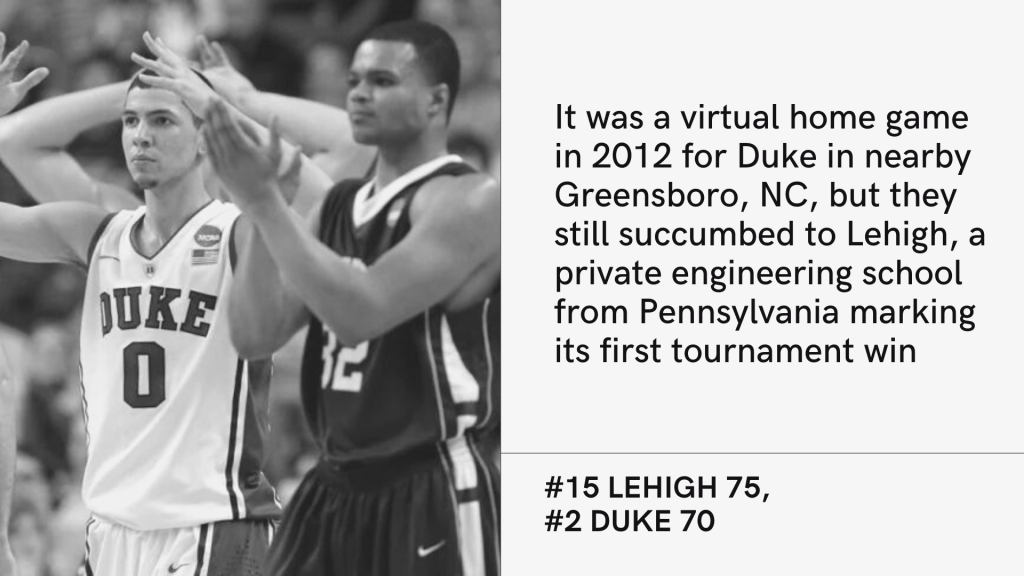
Even more so than Kansas, Duke had a well-earned reputation of avoiding first round upsets in the first three decades of the 64-team tournament era and there was scant reason to believe the ’11-’12 team wouldn’t continue the tradition. They had talent and depth, highlighted by freshman sensation Austin Rivers and the Plumlee brothers and their opponent had never won a tournament game previously. But Lehigh, a private engineering school in Pennsylvania, caught lightning in a bottle and pulled off in Greensboro no less, just an hour’s drive away from the Duke campus. Led by star C.J. McCollum, who would soon be a lottery pick and the school’s first-ever player to reach the NBA, Lehigh exploited Duke’s lack of perimeter defense. It also didn’t help that the Blue Devils shot just 6-of-26 from three-point range. Lehigh led for most of the game, and were cheered on to a 75-70 win by a bevy of North Carolina fans, who had watched their Tar Heels defeat Vermont earlier in the day and were now reveling in a historic upset of their biggest rivals. With Missouri having been stunned previously in the day by Norfolk State, it marked the only time in history that two #15 seeds won in the same tournament, let alone on the same day. As is their wont, Duke recovered just fine in 2013, reaching the Elite Eight as a #2 seed.
9) Princeton (#13) over UCLA, 1996
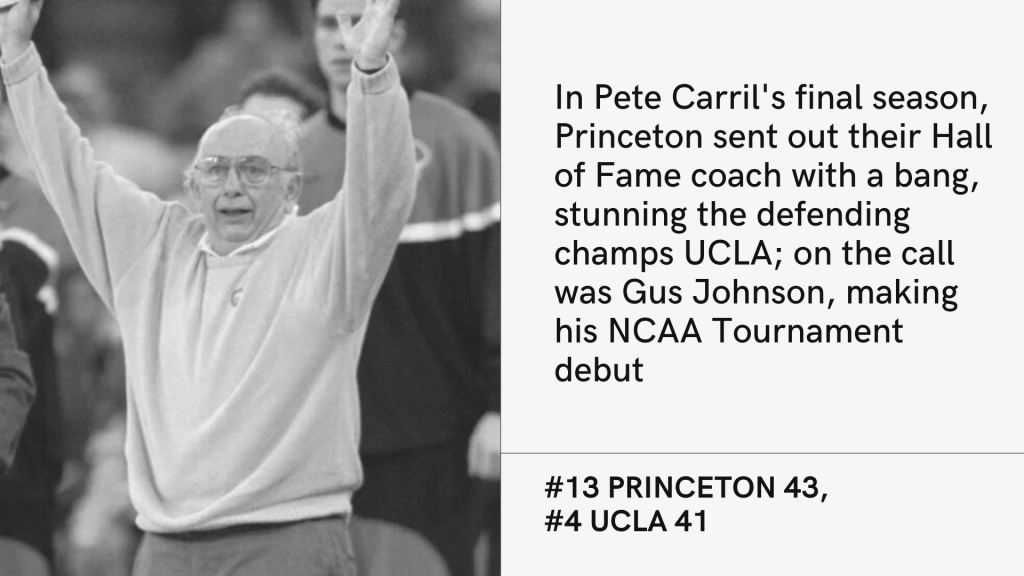
There have been plenty more surprising upsets, more dramatic ones, and a lot more exciting ones (the box score for this 43-41 game looks like a relic of the pre-shot clock era), but few upsets have aligned all those elements in such a theatrical way like Princeton over UCLA did in 1996. At the center of the glorious narrative is Pete Carril, the prickly but lovable bulldog of a coach, who had announced on the eve of the tournament that he was retiring after 28 years at Princeton, citing an increasing inability to reach his young players. They closed it out by proving him wrong, following Carril’s coaching directions to a T and stunning the defending champions from UCLA. At the last minute, Carril and his staff opted to attempt a zone defense to attempt to mitigate UCLA’s size advantage. It worked to near perfection and it was Carril’s signature backdoor cut heavy “Princeton” offense that closed out the game. Freshman Gabe Lewullis was able to take advantage of a UCLA defensive lapse, making a perfect backdoor cut to lay in the winning basket. “He got it!” was the incredulous call from Gus Johnson, who was in the midst of working his first weekend as an announcer for CBS tournament games.
8) Weber State (#14) over North Carolina, 1999
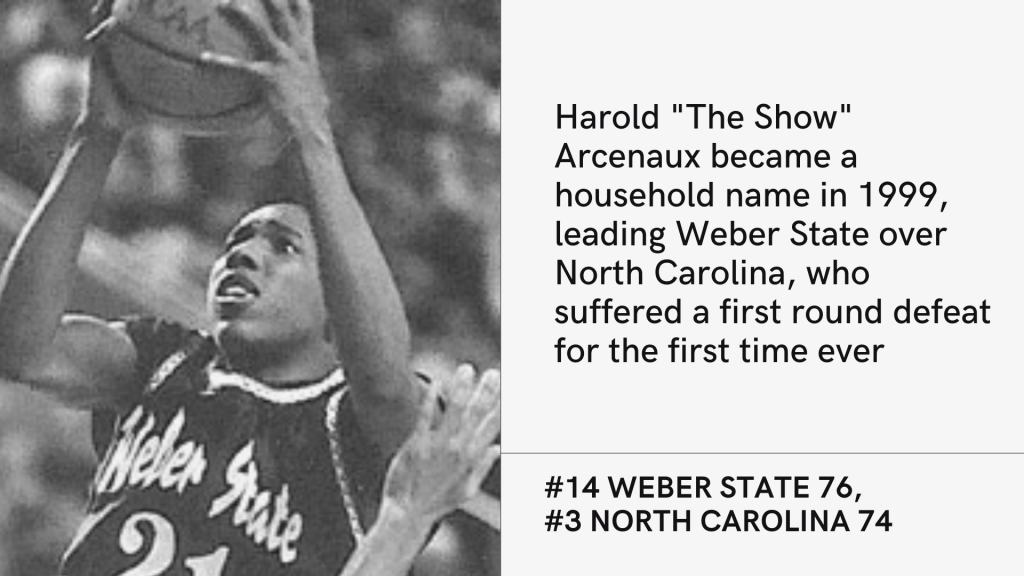
There was plenty of trepidation when Dean Smith retired in 1997 and handed things over to his longtime assistant Bill Guthridge but North Carolina silenced the doubters with a trip to the Final Four in 1998. Similar results were expected in Guthridge’s follow-up effort in 1999, with a dynamic roster centered around Brendan Haywood, but instead the real “Show” was on the Weber State side. Harold Arceneaux was a supreme talent in his native New Orleans but struggled with his schoolwork and couldn’t matriculate at any of the major colleges. He wound up at Weber State, dominating overwhelmed Big Sky competition and biding his time, waiting for a match-up like this. Nicknamed “The Show” for his highlight-reel worthy skills, Arceneaux exploded against the Tar Heels, scoring 36 points and sealing the upset at the buzzer with a last second steal. This loss still stands as the only first round defeat for North Carolina in the 64-team era. Guthridge led them back to the Final Four in 2000, but then retired himself, giving way to Matt Doherty. Arcenaux returned for his senior year, went un-drafted by the NBA, and spent the majority of his pro career in Australia, France, and Mexico.
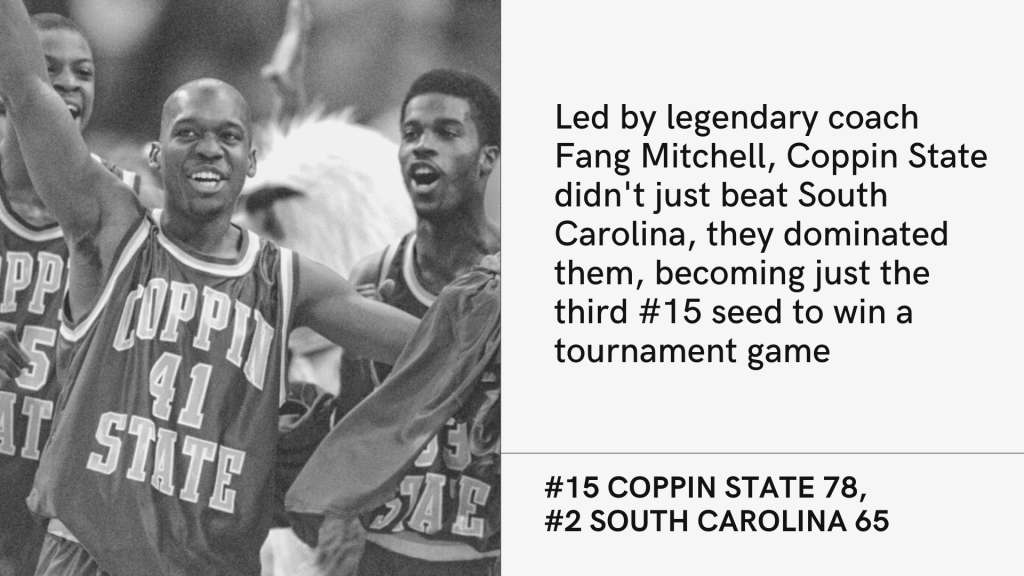
7) Coppin State (#15) over South Carolina, 1997
Up until their surprise run to the Final Four in 2017, the NCAA Tournament has not been kind to South Carolina. Their troubles started in 1974, when a team led by Alex English was stunned in the first round by Furman, a school that had never won a tournament game before that season, and has failed to win one since. The Gamecocks have reached the tournament just five times in the 64-team era, and they lost in the first round in the first four instances. The most brutal of those defeats came at the hands of Coppin State in 1997. Coached by the legendary Fang Mitchell, Coppin State sported two of the major Cinderella hallmarks: experience (two seniors and two juniors in the starting lineup) and balanced scoring (five players averaged 10+ points per game). Thus, the Eagles didn’t flail when South Carolina opened up a big lead early in the second half, instead using their pressure defense to dominate the final 15 minutes, ultimately winning by a comfortable margin, 78-65. They became the third #15 seed to win a tournament game and came quite close to being the first to reach the Sweet 16, falling just short against Texas in the second round.
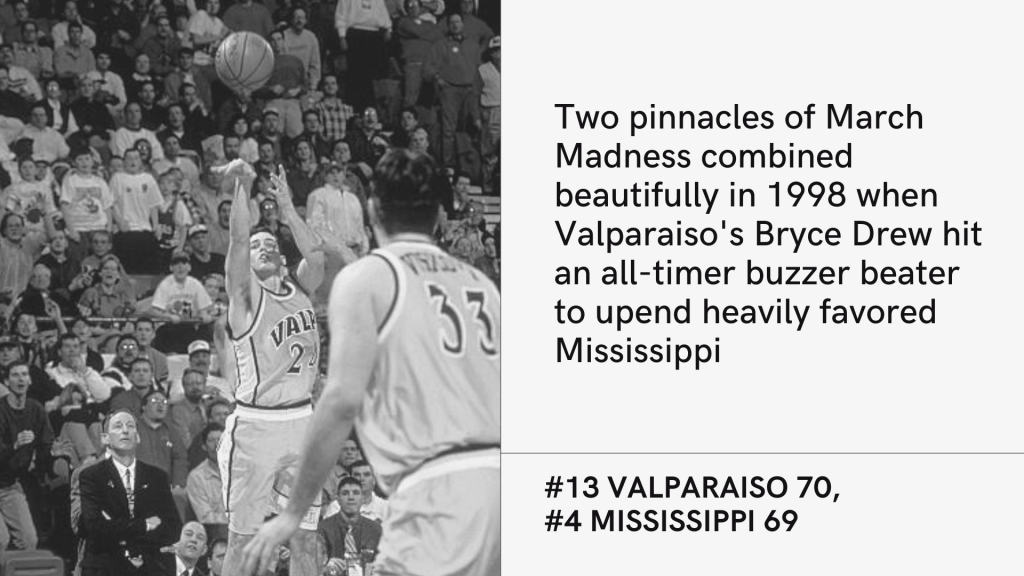
6) Valparaiso (#13) over Mississippi, 1998
It’s a game that has everything you could possibly ask for of March Madness. A likable underdog. A stunning upset. A loyal coach’s son. A legit buzzer beater. A clever final play call that took full advantage of numerous players’ skill sets. Unfortunately for Mississippi’s Ansu Sesay, there was also a goat (in the traditional sense of the word). A 79% free throw shooter for the season, Sesay inexplicably missed two in a row at the line with a 69-67 lead and 4.9 seconds left. This set up one last play for Valparaiso to tie or take the lead and in the huddle, every player knew what was coming. It was an end-of-game play they had practiced countless times, usually unsuccessfully, but this was their first attempt deploying it in an actual game setting. The inbound passer was Jamie Sykes, a center field prospect for the Diamondbacks with the obvious arm strength and accuracy to send it the length of the court. Sykes placed it perfectly into the hands of Bill Jenkins, who immediately passed it slightly back to a streaking Bryce Drew. Drew’s father, Homer, had taken the head coaching job at Valparaiso a decade earlier. Though many big programs recruited the younger Drew out of high school, he opted to play for his dad, who was watching on as Bryce caught the ball perfectly in rhythm, then launched it into the basket for the stunning win. While the coach’s son was being mobbed on the floor by his jubilant teammates, cameras caught a distraught Sesay wandering the court in disbelief. The Crusaders moved on to upset Florida State in the second round before getting eliminated in the Sweet 16. Drew was drafted that summer by the Rockets and spent six years in the NBA before returning to Valparaiso to take over as head coach for his retiring father in 2011.
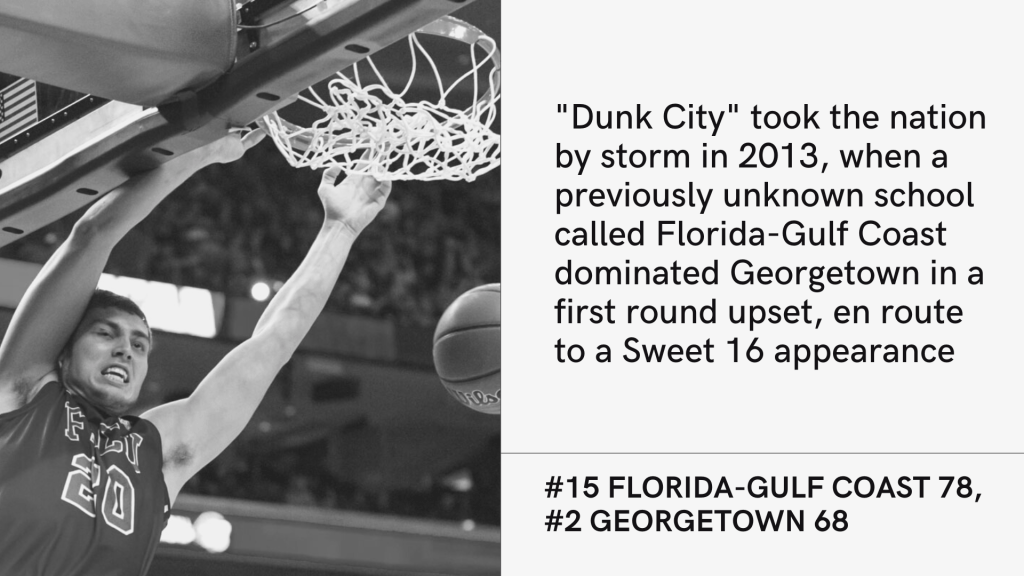
5) Florida Gulf Coast (#15) over Georgetown, 2013
Raise your right hand if you had ever heard of Florida Gulf Coast University before March of 2013, and then smack yourself with it for being a liar. A small program that had been chartered in 1991 and didn’t reach Division I until 2011, the Eagles were an unlikely choice as the first #15 seed to reach the Sweet 16. But they were the perfect candidate in the social media age, a brash, boisterous group that bestowed upon themselves the audacious nickname “Dunk City.” On a Friday night in Philadelphia, the small school with a silly name and no history converted themselves from easy fodder for an all-time elite program into a reincarnation of the heady days of Phi Slamma Jamma. Second-seeded Georgetown, led by Wooden Award finalist Otto Porter, basically had no idea what hit them. FGCU pulled away in the second half with a 21-2 run punctuated by athletic dunk after athletic dunk, turning the game into a virtual Rucker Park-style exhibition. The 78-68 final was not just one of the biggest upsets in tournament history but a sea change, proof that a #15 seed could not only beat a #2 seed, but completely outclass them athletically. The Eagles drove the point home in round two, upending #7 seed San Diego State to become the first #15 seed in the Regional Semifinals. Coach Enfield quickly departed for a higher profile position with USC, but “Dunk City” has since returned twice to the NCAA Tournament, both first round losses.
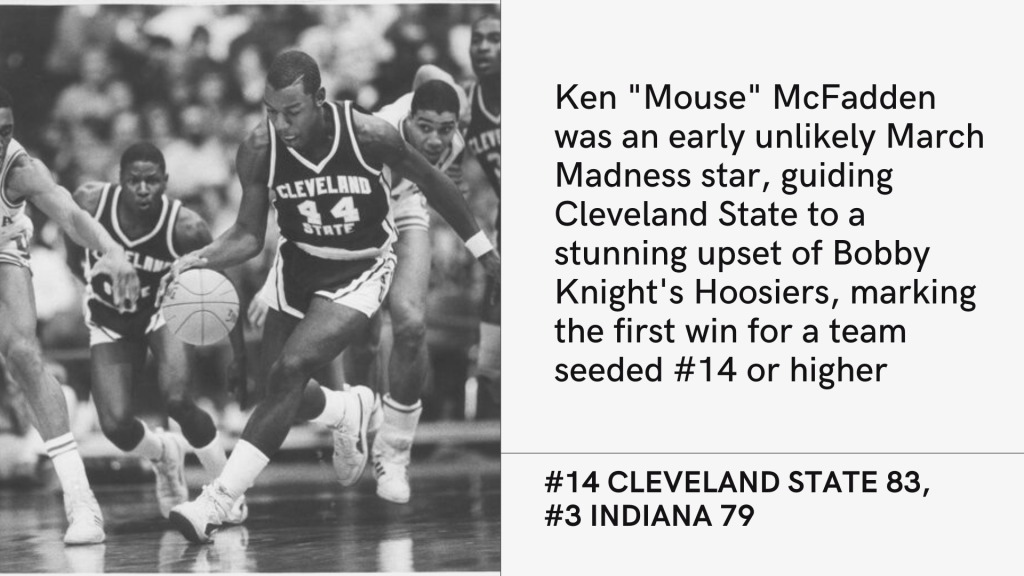
4) Cleveland State (#14) over Indiana, 1986
In a lot of ways, the other 69 upsets on this list owe a spiritual debt of gratitude to Cleveland State, who pulled the first round stunner against which all others still beg comparison. It was the first true March Madness shocker for numerous reasons, including the victims being Indiana, who were the darlings of the college basketball world at the time. Led by the legendary Bobby Knight, the Hoosiers seemed primed to avenge a disappointing ’84-’85 season with a deep run in the 1986 NCAA Tournament, led by local hero and All-American Steve Alford. Instead, they were completely outclassed by Cleveland State coach Kevin Mackey and his star point guard, Ken “Mouse” McFadden. Utilizing coach Mackey’s patented “stun-and-gun” tempo on offense and defense, the Vikings often left the Indiana players looking like they were standing still, an antiquity of a previous black-and-white era. Clinton Ransey led the way with 26 points and Cleveland State shot 58.9% from the field in an 83-79 win. Though the loss was a crushing end to a tumultuous season that would be later immortalized in the book “Season on the Brink,” Indiana bounced back in ’86-’87, winning their third and final championship of the Knight era.
3) Hampton (#15) over Iowa State, 2001
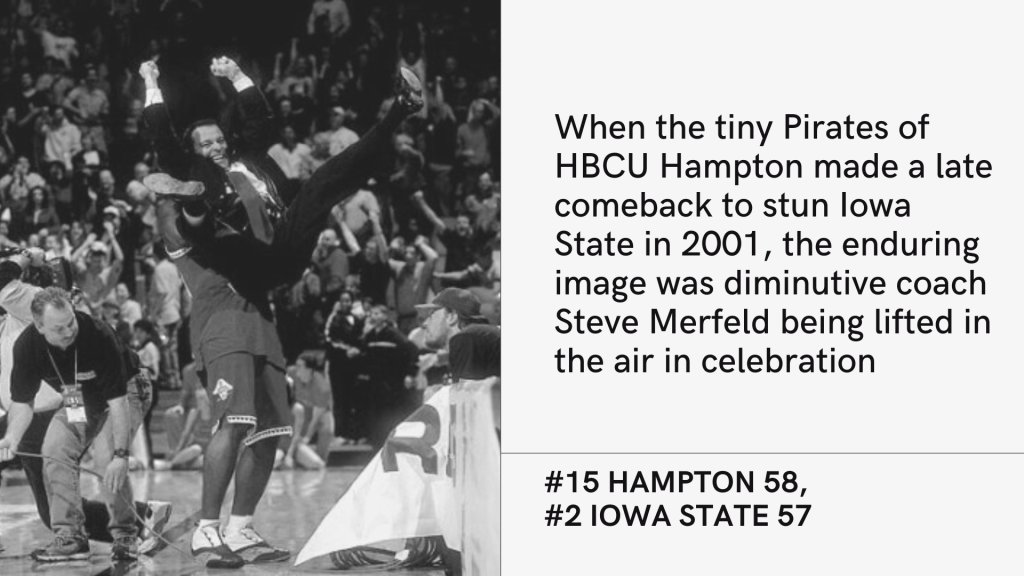
More so than anything else about this game, what endears is the image of Hampton’s diminutive coach Steve Merfeld, a look of unfiltered glee on his face, being lifted in the air like a teddy bear by forward David Johnson in celebration after the tiny school from southern Virginia pulled off one of the greatest upsets in tournament history. There are some qualifiers on this upset that need to be mentioned. Iowa State was most definitely over-seeded at #2. Sure, they were led by future NBA first round pick Jamaal Tinsley, and finished the season 25-4, but they were also embarrassed by Baylor in the Big 12 Tournament quarterfinals and were a popular pick to get upset in the second round. Hampton was about as improbable of a giant killer as we’ve ever seen. Though the Hampton Roads region of Virginia has long been a high school hoops hotbed, it rarely translated to success for the local colleges. Hampton had just joined Division I in 1995, and had never even come close to a tournament berth before their 2001 MEAC title. Tinsley struggled in the game (finishing with nine points, eight assists, and five turnovers) but the Cyclones still methodically opened up a 55-44 lead midway through the second half. Things seemed dire for the Pirates but senior forward Travis Williams sparked a 14-2 run to end the game. With 6.9 seconds on the clock, he hit the game winner, a short jumper that gave Hampton its first lead since early in the first half. Tinsley had one last chance, taking the ball the length of the court trying to forge a buzzer beating end-to-end winner, but instead his driving lay-up fell helplessly off the rim and bedlam ensued, ending with Merfeld getting literally carried over to the announcer’s desk to give a postgame interview amid the jubilation. The win lived on in infamy for a long time, as it would take 11 years for another #15 seed to win a first round game.
2) Richmond (#15) over Syracuse, 1991
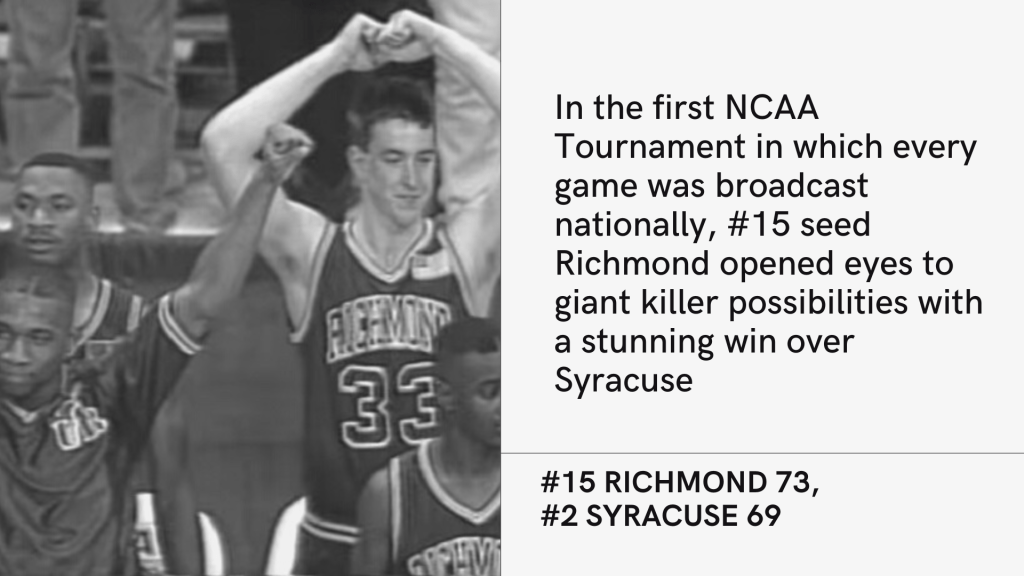
The magnitude of this upset cannot be overstated, as not only was Richmond the first #15 seed ever to win an NCAA Tournament game, they did so in the first tourney ever to be fully broadcast on CBS. Thus, a national audience witnessed the demise of Syracuse and their reigning Big East Player of the Year, Billy Owens. It was hardly Owens’ fault that the Orange fell short here, as he finished the game with 22 points and seven rebounds. But the remainder of Syracuse’s roster struggled while the Spiders shot 61.5% from the field in the first half, then nailed a series of clutch free throws late to hold on for the victory. Lightly used freshman guard Eugene Burroughs was the biggest hero, serenely sinking two free throws with 21 seconds left to extend Richmond’s lead to 72-69. The Spiders knew the ball was going to Owens for the potential game-tying response, and their pressure defense forced the All-American into a tough three-point shot that fell harmlessly off the rim The loss seemed especially devastating at the time for Syracuse, who knew that Owens was destined for early entry in the NBA that summer, that NCAA sanctions against the program were imminent for improprieties unearthed early in the season, and that coach Jim Boeheim was likely on his way out the door in the wake of those revelations. Owens did leave as expected (he was the #3 overall pick) but the NCAA punishment for the program was relatively minor and Boeheim stayed on board, eventually leading the Orange back to the Final Four in 1996. As for Richmond, they lost to Temple in the second round but accomplished something much larger. By becoming the first #15 seed to upset a #2 seed, the Spiders not only made history, they also laid down the blueprint for any would-be David looking to slay a Goliath. Every pebble lifted and every slingshot loaded since started with this prototype.
1) UMBC (#16) over Virginia, 2018
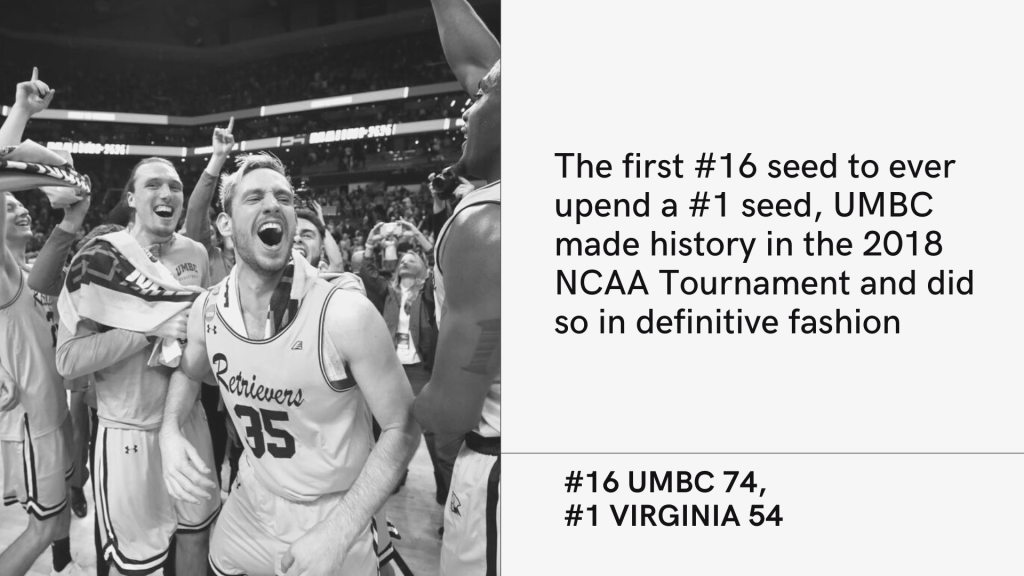
It always seemed inevitable in the abstract, but the number of close calls over the years lent it an air of Sisyphean fatalism. There was Princeton in 1989, of course, but also East Tennessee State that same year, Murray State in 1990, and Western Carolina in 1996, all coming within a basket of being the first #16 seed to upset a #1 seed. Then Maryland-Baltimore County, making just their second NCAA Tournament appearance, changed things forever in 2018. The unwitting victim was Virginia, who had just set the school record for wins with 31 in ’17-’18. Though the Cavaliers had a history of being first round upset casualty, with losses in 1986, 1987, and 2001 as a #5 seed, they also had traditionally comported well as a top seed, reaching the Final Four in 1981, the Elite Eight in 1983, and the Elite Eight again in 1986. It was supposed to be a rebuilding year for Virginia, and their lack of star power and experience is ultimately what cost them in this game. Coached by Ryan Odom, son of former Virginia assistant coach Dave Odom (Ryan attended the 1984 Final Four with his dad), UMBC was relentless in the second half, outscoring the Cavaliers 53-33 over the final 20 minutes. Senior guard Jairus Lyles led the way with 28 points, and the Retrievers made history in an authoritative manner, by a final score of 74-54. It broke a streak of 135 straight first round wins by #1 seeds, and set the stage for a new era in the NCAA Tournament, where any team is seemingly vulnerable against any other team.
Next up in Upsets and Cinderellas
- Saving the best for last: 21 most exciting NCAA Tournament National Finals
- Extra sweet 16: 23 significant NCAA Tournament Regional Semifinal upsets
- Don’t you forget about me: 80 basketball moments from the ’80s that changed the sport forever
- Clock strikes midnight: 21 Cinderella NCAA Tournament runs that ended just short of the Final Four
- Hail Mary’s Madness: 26 greatest NCAA Tournament buzzer beaters
- No one believed in us: 14 biggest upsets in NBA Finals history
- One shining moment: 70 greatest NCAA Tournament first round upsets
- Dark horses: 16 greatest NBA Conference Finals upsets
- Hollow trophies: 14 early playoff exits by reigning league MVPs
- Comeback kids: 12 NBA playoff series in which a team overcame a 3-1 series deficit
Next up in March Madness
- Saving the best for last: 21 most exciting NCAA Tournament National Finals
- Extra sweet 16: 23 significant NCAA Tournament Regional Semifinal upsets
- Don’t you forget about me: 80 basketball moments from the ’80s that changed the sport forever
- Clock strikes midnight: 21 Cinderella NCAA Tournament runs that ended just short of the Final Four
- Hail Mary’s Madness: 26 greatest NCAA Tournament buzzer beaters
- Uncut nets: 25 greatest NCAA programs without a Final Four appearance (since 1985)
- One shining moment: 70 greatest NCAA Tournament first round upsets
- Dance card unpunched: 24 notable programs without an NCAA Tournament appearance in the modern era
- March sadness: 28 greatest NCAA teams that fell short of reaching the Final Four
- April madness: 19 surprise Final Four appearances (since seeding was introduced in 1979)
 Basketball, Listed