23) World B. Free (1982-1986)
The late ’70s through ’80s were a wasteland for the Cavaliers franchise, mired in mediocrity thanks to horrendous mismanagement from owner Ted Stepien. One bright spot came in ’84-’85, when the Cavs made a surprise playoff appearance (after a 2-19 start) and almost pulled off a stunning first round upset over the defending champion Celtics, all thanks to Free. Traded from the Warriors to Cleveland in 1982, Free was the team’s leading scorer in all four seasons he played there. He was near unstoppable in that series against Boston, averaging 26.3 points and 7.8 assists per game, arguably matching Larry Bird blow-for-blow. The Celtics won the series in four games but each of Boston’s wins came down to the final possession. Free also topped 30 points twice in that series, something that only three other players in Cavs history have done since: Brad Daugherty, LeBron James, and Kyrie Irving. Though Free would play just one more season with the Cavs, a disappointing ’85-’86 campaign that ended with 53 losses, he re-injected much needed excitement into the Cleveland basketball world, setting the stage for a late ’80s revival built around Mark Price and Brad Daugherty. Free’s 23.0 points per game is second in Cavaliers career history behind James,
22) Chris Mills (1993-1997)
’93-’94 seemed like a potential breakthrough for the Cavaliers in the wake of Michael Jordan’s retirement, but instead it was the same old story in the postseason. Missing its entire starting front court (Larry Nance, Hot Rod Williams, and Brad Daugherty) due to injury, the Cavs were swept by the Bulls in the first round, signaling an end to the Mark Price/Daugherty era. One bright spot in that series was the emergence of Mills, a rookie forward who played sparingly in the regular season but stepped up in the playoffs, finishing second on the team in scoring and rebounding, while providing admirable defense on Scottie Pippen. When Nance retired in the offseason, Mills stepped up as the new starting small forward, averaging 13.6 points and 5.4 rebounds per game over the next three seasons. Cleveland managed to stay in playoff contention those years under Mike Fratello but never past the Conference Quarterfinals. When the team looked to rebuild in 1997, Mills signed as a free agent with the Celtics, then finished out his career with the Knicks and Warriors.
21) Drew Gooden (2004-2008)
If there was one constant in Gooden’s career, it was consistent flux. He was traded six times in his first eight years in the NBA and ultimately played for 10 franchises in 14 seasons. His longest stint came with the Cavaliers, who acquired him from the Magic in 2004 (packaged with Anderson Varajeo) and held on to him for three-and-a-half seasons. It was a golden opportunity for Gooden, who paired with a young LeBron James as the starting forwards. Gooden had his career peak statistically with Cleveland in ’04-’05, averaging 14.4 points and 9.2 rebounds per game, and was third in both scoring and rebounding on the ’06-’07 Cavs team that reached the NBA Finals. But he was traded to the Bulls at the ’07-’08 deadline (in the deal that brought in Ben Wallace to Cleveland), setting up a three year period where he suited up for seven different teams. One frivolity worth noting: while in Cleveland, Gooden became the first player in NBA history to wear jersey #90, as his typical #0 was already held by Jeff McInnis, who refused to switch.
Our fourth volume will be published throughout the ’21-’22 NBA season
20) Tyrone Hill (1993-1997, 2001-2003)
Ohio born and bred (in Cincinnati), Hill returned to his home state in 1993, when the Warriors traded him to the Cavaliers following his third NBA season. A lottery pick disappointment early in his career with Golden State, Hill arguably reached his full potential under Mike Fratello in Cleveland, vacillating between a bench power forward spot and an undersized starting center. Over four seasons, Hill averaged 11.7 points and 9.2 rebounds per game and made his lone All-Star appearance representing the Cavs in 1995. His 60.0% shooting from the field in ’96-’97 was the second best mark in the NBA that year and stood as Cleveland’s single season all-time record until ’21-’22 when Jarrett Allen broke it. Hill’s time with the Cavaliers was also marked by injuries and in 1997 he was traded as part of the deal that brought Shawn Kemp to Cleveland. After some time with the Bucks and 76ers, which included a trip to the 2001 NBA Finals, Hill came back to the Cavaliers via trade in ’01-’02. The veteran big man found his minutes exponentially decrease on a rebuilding (i.e., tanking) Cavs roster and in 2003 he was waived when the Cavaliers couldn’t find a willing trade participant at the deadline. His rebound percentage of 19.1% remains the franchise career record.
19) Danny Ferry (1990-2000)
His time with the Cavaliers is considered a flop, especially in the context of the team imprudently trading Ron Harper to acquire him, so it’s easy to forget that Ferry spent an entire decade with the club. In fact, by the time he left Cleveland to sign with the Spurs in 2000, Ferry had set the franchise record for games played with 723 (he’s now third behind Zydrunas Ilgauskas and LeBron James), He certainly never lived up to his status as the #2 overall pick, averaging 10+ points per game just twice in his career, peaking for Cleveland in ’95-’96 with 13.3 points per game, and four-plus rebounds per game just once, despite standing 6’10”. But Ferry hung around with the team long enough to play in the Mark Price/Brad Daugherty era, the Terrell Brandon era, and the Shawn Kemp era. Though his time with the Cavaliers was marked by playoff disappointments, Ferry eventually won a title with the Spurs in 2003. He returned to Cleveland in 2005 as the general manager and made a series of questionable decisions that many blame for James’ free agency departure in 2010.
18) Jim Chones (1974-1979)
Chones clocks in as the first player on our list who was part of the famed ’75-’76 “Miracle on Richfield” Cavaliers team but also as the most tragic. He was the starting center, leading scorer, and second leading rebounder for Cleveland in that stirring Conference Semifinals upset of the Bullets but then broke his foot in a subsequent practice and missed the entire Conference Finals loss to Boston. Chones bounced back strong from that injury, ultimately averaging 14.3 points and 9.5 rebounds per game in his five seasons in Cleveland. In ’75-’76, he became the first Cavaliers player to finish in the top 10 in MVP voting and was the only one for over a decade until Mark Price finally matched the mark in ’88-’89. Though he was still in his prime heading into the ’79-’80 season, Chones was traded in a classic Ted Stepien move, exchanged for Dave Robisch and a third round pick to the Lakers, with whom he won the championship in 1980 as the starting power forward. Chones is still eighth in Cavaliers history in total rebounds and fifth in total blocks.
17) Craig Ehlo (1987-1993)
In the same season the Cavaliers hired Lenny Wilkens as coach and brought in rookies Ron Harper, Mark Price, Brad Daugherty, and Hot Rod Williams, they made a crucial, under-the-radar, mid-season acquisition in signing Ehlo as a free agent. A former third round pick of the Rockets, Ehlo was part of Houston’s ’85-’86 NBA Finals team but logged limited minutes off the bench and was waived on the eve of the ’86-’87 season. When Price had emergency appendectomy surgery in January of 1987, the Cavs signed Ehlo, first as a stopgap depth chart filler on a 10-day contract and soon after on a permanent basis. A versatile, oversized guard at 6’6″, Ehlo did a little bit of everything on the court for Cleveland, at his peak averaging 13.6 points, 5.4 rebounds, 4.6 assists, and 1.6 steals per game in ’89-’90. His defense was the most renowned part of his game but also the cause of his most infamous moment, when he was the hapless victim of “The Shot,” Michael Jordan’s series clinching buzzer beater against the Cavaliers in the 1989 playoffs. It’s worth noting that Ehlo was also Cleveland’s leading scorer in that game, with 24 points off the bench.
16) Campy Russell (1974-1980, 1984)
Though his college days came at arch rival Michigan, Russell was a popular player in Cleveland immediately after the Cavs drafted him in the first round in 1974. Nicknamed “Mr. Moves” for his bevy of fake-outs and stutter steps, Russell averaged 16.1 points per game in his seven seasons with the Cavs, peaking at 21.9 per game in ’78-’79, when he was named an All-Star. He was then an early casualty of the Ted Stepien era, getting traded to the Knicks in 1980 for pennies on the dollar. Russell is still in the top 10 in Cavaliers history in field goals and free throws and he was the first Cleveland player to score 30 or more points in a playoff game, doing so in a Conference Quarterfinals match-up against the Knicks in 1978. Despite his deep ties to the state of Michigan, where he starred in high school and college ball, Russell was inducted into the Ohio Sports Hall of Fame in 2013 and has further endeared himself to Cavaliers fans in recent stints in the organization as a Director of Alumni Relations, and a longtime host of the local TV pre-game show.
15) J.R. Smith (2015-2019)
Say this about Smith’s time in Cleveland: There was hardly ever a dull moment. Acquired via trade from the Knicks during the ’14-’15 season to provide long range shooting, play making, and a fearless attitude in the biggest moments, he gave all that and more over the next three seasons. Another way to summarize Smith’s Cavaliers years are he giveth and he taketh away. On the taketh end was his defensive lapses, his propensity for backbreaking turnovers, and, of course, his ultimate blunder, dribbling out the clock to end regulation in a tied game one of the 2018 NBA Finals. But Smith was also a clutch defender when called upon, especially in the postseason, and hit numerous big shots, most notably in the third quarter of game seven of the 2016 NBA Finals upset over the Warriors. He also endeared himself to fans with his shirtless antics, celebrating that 2016 championship throughout the summer and fall in unique fashion, including at the World Series. One of four Cavaliers (along with LeBron James, Tristan Thompson, and Kevin Love) to play in four consecutive NBA Finals from 2015 to 2018, Smith also holds the franchise record for three-point field goals in a season, with 204 in ’15-’16.
14) Mo Williams (2008-2011, 2015-2016)
Only three Cavaliers played in the All-Star Game during the ’00s: LeBron James five times, Zydrunas Ilgauskas twice, and Williams, who made the lone appearance of his career representing Cleveland in 2009. It was certainly a career peak for the high scoring combo guard, who was originally drafted in the second round by the Jazz in 2003. He was traded to the Cavaliers in 2008, in one of several blockbuster deals swung by general manager Danny Ferry in desperate attempts to build on-the-fly contenders around James. While Williams didn’t exactly become the Scottie Pippen to James’ Michael Jordan, he was arguably the second best overall player of James’ first Cleveland stint, averaging 16.9 points and 4.6 assists per game in the ’08-’09 and ’09-’10 seasons, making that All-Star appearance, and providing some much needed leadership and clutch playoff performances. Williams endeared himself to Cleveland fans even more in the wake of LeBron’s first departure, taking over as a vocal, passionate team leader in ’10-’11. Even Williams getting traded was a boon for the franchise, as it netted Cleveland a first round pick which was used on Kyrie Irving. After brief, semi-successful stints with the Clippers, Jazz, Trail Blazers, Timberwolves, and Hornets, Williams returned to the Cavs as a free agent in ’15-’16, earning a long awaited championship as a bench play making specialist before appropriately retiring as a Cavalier.
13) Bingo Smith (1970-1979)
In 1970, the newly chaptered Cavaliers were part of an expansion draft (along with the Trail Blazers and Braves) to seed their roster with veterans left unprotected by existing teams. Of the 11 players selected by the Cavaliers, eight of them lasted one season or shorter with the team but Smith hung around for a decade in Cleveland, eventually becoming just the second player to have his jersey retired by the franchise. Though he was the sixth overall pick (out of Tulsa) of the (then San Diego) Rockets, Smith was made available in the expansion draft after a disappointing rookie season. He thrived in the egalitarian Cleveland system, thanks largely to his long range shooting, an under-appreciated skill in the ’70s NBA. Smith never rounded into an All-Star level player or a leading scorer but did compile 9,513 points for the Cavs, which still places him sixth in franchise history. He was also one of main heroes of the “Miracle at Richfield” postseason upset of the Bullets in 1976, hitting the game winning shot in game two of that series.
12) Terrell Brandon (1991-1997)
Between the heyday of the Mark Price/Brad Daugherty era and the embarrassment of the Shawn Kemp era and subsequent tanking, the Cavaliers had a brief stretch of unlikely success thanks to Brandon. A lottery pick of the Cavs in 1991, Brandon spent his first four seasons on the bench learning under Mark Price before taking over in ’95-’96. In an era of increasingly dynamic and athletic point guards, Brandon was a bit of a throwback, an undersized (5’11”) Swiss army knife who could score (19.5 points per game in ’96-’97), make plays, defend, and even rebound. Brandon was without a doubt the best player on the ’95-’96 Cavs that made a surprise playoff appearance and the ’96-’97 team that won 42 games and almost repeated the feat. When the All-Star Game came to Cleveland in 1997, Brandon was the only Cavaliers player on the roster, making his second consecutive appearance. He was traded to the Bucks in 1997 as part of the Shawn Kemp deal and put up several solid seasons in Milwaukee and Minnesota before being forced to retire at age 31 due to a knee injury. His 2,235 assists are the fourth most in Cavaliers history and his 621 steals are fifth.
11) Anderson Varejao (2004-2016, 2021)
With his signature Sideshow Bob hairstyle, constant motor, and rebounding and defensive prowess, Varejao was a fan favorite for his entire span with the Cavaliers. Cleveland fans appropriately bestowed him with the nickname “Wild Thing,” a moniker with a weighty status in the city’s sports history. The Brazilian big man started his career backing up Zydrunas Ilgauskas, providing instant energy off the bench. Around the time he replaced Ilgauskas in the starting lineup is also when Varejao started dealing with near constant injury issues which left him averaging just 34 games per season in his last four full seasons in Cleveland. Varejao’s statistical prime came in ’12-’13, when he averaged 14.1 points and 14.4 rebounds per game, which would have led the NBA if he hadn’t missed 57 games due to a blood clot in his knee. After sitting out the 2015 NBA Finals due to an Achilles injury, Varejao was traded during the ’15-’16 season and wound up on the other side in 2016, losing to his former Cavaliers teammates in the NBA Finals as a member of the Warriors. He did subsequently earn a championship ring with the Warriors in 2017 but wasn’t on the roster at the time, as they cut him in February of the ’16-’17 season. After a few seasons playing professionally in Brazil, Varejao signed with the Cavaliers in May of 2021, closing out his career in Cleveland with five appearances. He sits in the top 10 in franchise history in rebounds, blocks, steals, and defensive win shares.
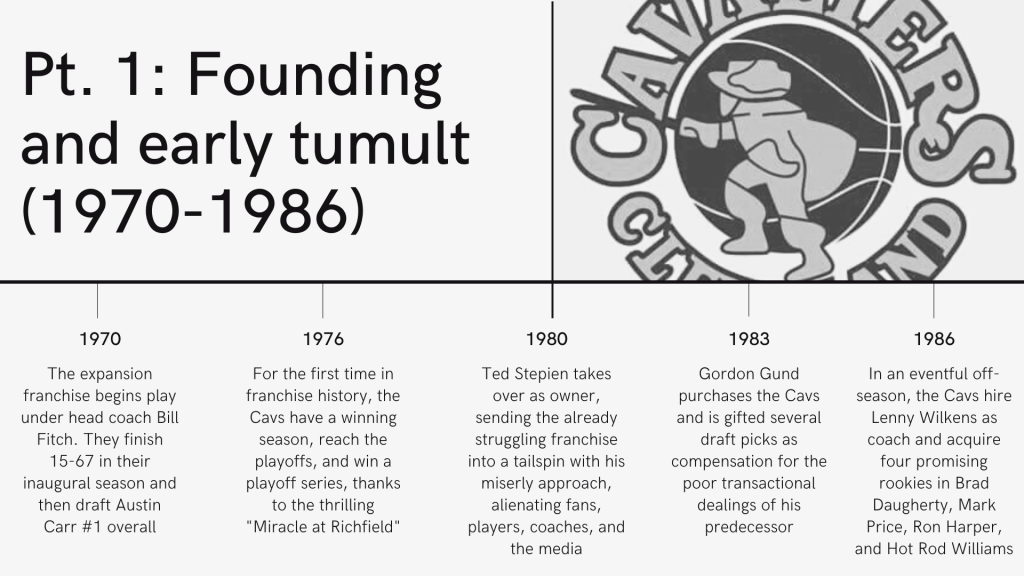
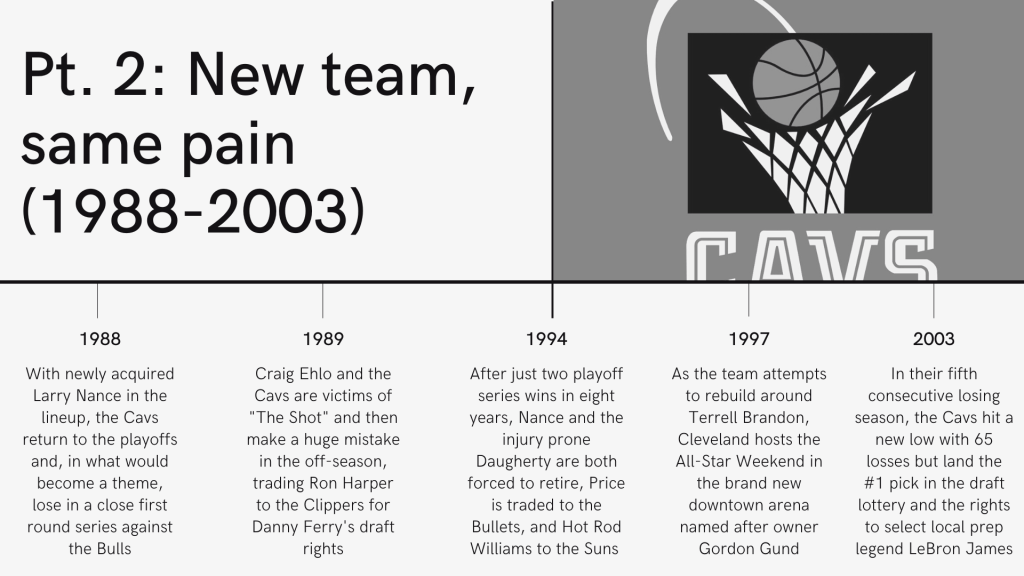
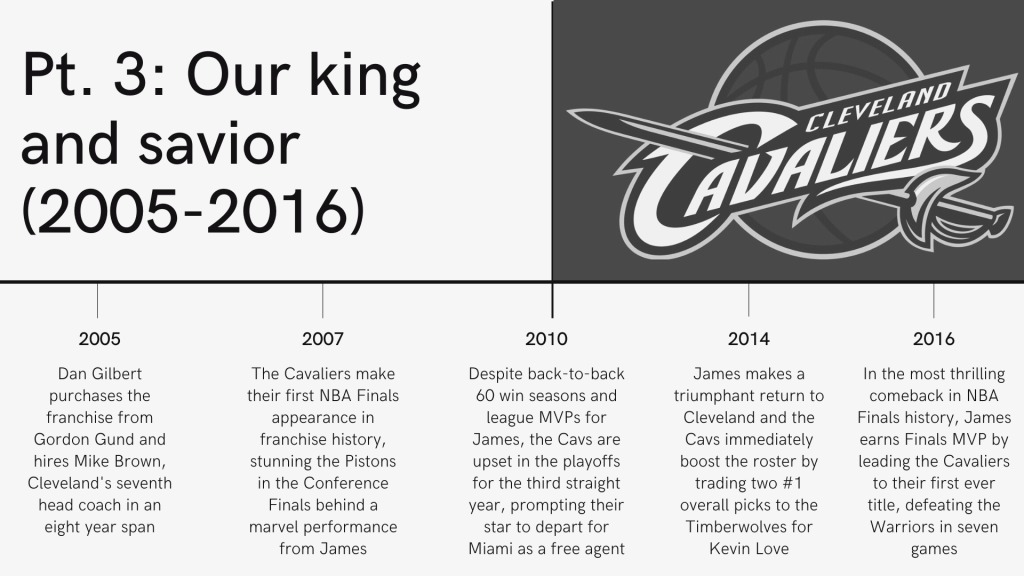
A timeline of Cavaliers franchise history
10) Austin Carr (1971-1980)
When the Cavaliers finished 15-67 in their inaugural season, there was one silver lining. Landing the top pick in the 1971 NBA Draft meant they could draft Carr, a surefire megastar from Notre Dame who still holds the NCAA Tournament record for points scored in a game (61). Despite some early foot trouble, Carr lived up the hype in his first three seasons, averaging 21.2 points per game and becoming just the fourth ever Cavs All-Star in 1974. But not only did Carr struggle with the linger effects of his rookie season foot surgery, he also quickly developed issues with his knees and by his fourth NBA season was already a shell of the unstoppable college athlete he once was. Fans loved him anyway, allotting him the nickname “Mr. Cavalier,” anointing him as the franchise’s first superstar player, albeit a limited one. Though he finished his playing career with brief stints in Dallas and Washington, Carr eventually returned to Cleveland, first in a front office role and later as the team’s longtime television broadcast color commentator. He sits fourth in scoring in Cavaliers history, is also top 10 in games played, field goals, free throws, and assists, and in 1981 his jersey #34 was retired by the franchise (it was later stolen in a still unsolved mystery).
9) Hot Rod Williams (1986-1995)
Though the Cavaliers drafted him in the second round in 1985, Williams couldn’t suit up for a year due to a trial for alleged point shaving at college (he was ultimately found not guilty). He instead joined Mark Price, Brad Daugherty, and Ron Harper in the all-time great ’86-’87 rookie class. Williams averaged 14.6 points and 7.9 rebounds per game out of the gate and was named 1st-Team All-Rookie (alongside Harper and Daugherty). That would turn out to be the only major solo accolade of his career but Williams was a star amongst Cleveland fans for his consistency and workmanlike approach over a decade with the franchise. When Harper was traded or Price and Daugherty were missing extended time with an injury, it was Williams stepping up with his post scoring, his rebounding, his defense, and his willingness to vacillate between the starting lineup and a sixth man role. In his nine seasons with the Cavaliers, Williams set the franchise record for total blocks (he’s now second, behind only Zydrunas Ilgauskas) and is still in the top 10 in points, rebounds, steals, and defensive win shares. According to our metrics, he’s the greatest all-time non-active Cavaliers player whose jersey has not yet been retired by the franchise.
8) Tristan Thompson (2011-2020)
He recently courted controversy and some mockery for suggesting the Cavaliers should retire his #13 jersey but maybe Thompson had a point? According to our metrics, he is undeniably one of the 10 greatest players in franchise history, and we’re talking about a team that retired the number of Nate Thurmond, who played just two seasons in Cleveland. Drafted by the Cavaliers with the fourth overall pick in 2011, Thompson never lived up to lofty expectations but did develop into a reliable rebounder and defender who was a cornerstone of the teams that reached four consecutive NBA Finals between 2015 and 2018. Thompson was second in rebounding and fifth in scoring on the ’15-’16 championship Cavs team, while providing crucial defense in those NBA Finals on Draymond Green. By the time he left as a free agent in 2020, Thompson had reached third in franchise history in total rebounds, sixth in blocks, and eighth in win shares. He was also one of the most tabloid ready athletes in Cleveland sports history, with a high profile relationship (and subsequent messy break-up) with Khloe Kardashian.
7) Larry Nance (1988-1994)
With their young core of Mark Price, Brad Daugherty, Hot Rod Williams, and Ron Harper coming along quickly, the Cavs swung big at the trade deadline in 1987 to supplement them with the veteran Nance. No one in Cleveland would regret the acquisition of Nance, who was a core component of the Cavs lineup for the next few seasons, averaging 16.8 points per game, making two All-Star Games, and getting named All-Defensive three times. But the trade is still controversial, as the centerpiece of the package in return was a then rookie Kevin Johnson. Nance was third in scoring and second in rebounding on the ’91-’92 Cavaliers team that reached the Conference Finals and is top 10 in franchise history in points, rebounds, blocks, PER, and win shares. The Cavs raised his #22 jersey to the rafters almost immediately after he retired but brought it back down in 2018, when they traded for his son, Larry, Jr., who wore the number in Cleveland for three-and-a-half seasons (with permission from dad, of course).
6) Zydrunas Ilgauskas (1996-2010)
He came from a distant land, Lithuania, never won a championship in Cleveland, and was never really amongst the NBA’s best players, but Cavaliers fans will forever love the man they affectionately call “Z.” Ilgauskas was there for one of the franchise’s all-time low points, the 17-65 season in ’02-’03, and some of the all-time highs, like the surprise NBA Finals appearance in 2007. No matter what was going on with the team overall, Ilgauskas was a model of consistency, averaging 15.2 points and 8.1 rebounds per game over a six year prime before various foot injuries began to waylay him. In the franchise’s lowest point, between 1998 and 2003, Ilgauskas was their lone All-Star, making an appearance in 2003 and then again alongside LeBron James in 2005. In 2009, he broke Danny Ferry’s franchise record for games played and is still second on this list behind James. Ilgauskas is also the all-time franchise leader in blocks and is top five in points, rebounds, field goals, and win shares.
5) Kyrie Irving (2011-2017)
Things obviously didn’t end well between Irving and the fans of Cleveland but we’re here to honor his time with the Cavaliers not bemoan his terms of departure. Born in Australia to American parents, Irving grew up in New Jersey, played his college ball at Duke, then landed in Cleveland with the top pick of the 2011 NBA Draft. The Cavaliers secured that pick in the lottery after finishing with the second worst record in the NBA in ’10-’11, their first season without LeBron James, and the Irving selection was the first domino placed in a turnaround that culminated in the 2016 championship. Lightning quick and possessing an seemingly impossible array of below-the-rim finishes, Irving became just the second Cavs player to earn Rookie of the Year (after James) and was the team’s first post-James All-Star in 2013, his first of four appearances representing the Cavs. When James returned, Irving’s scoring averaged actually increased, eventually peaking at 25.2 points per game in ’16-’17. He missed almost the entire 2015 NBA Finals with a knee injury but made a glorious, conquering return the next year. Irving and James became the first teammates ever to both score 40+ in a Finals game in game six against the Warriors in 2016, then hit the series winner in game seven, a clutch, last minute, go-ahead three-pointer that Cleveland fans dubbed “The Shot.” Though he played just six seasons with the Cavs, Irving is still top 10 in franchise history in points, assists, steals, and three-point field goals. Unfortunately, things ended acrimoniously, with Irving demanding a trade in the summer of 2017, seeking a new environment in which to escape James’ shadow.
4) Kevin Love (2014-2022)
Who would have though that Love would endure years later as the lingering memory of Cleveland’s 2016 championship? The son of an NBA player and a superstar at UCLA, Love seemed like a potentially transcendent player when the Timberwolves landed him via draft day trade in 2008. He did quickly develop into one of the league’s best players but there always seemed to be a ceiling, personified by Minnesota’s inability to even reach the playoffs with Love as their best player. When the Cavs traded for him in 2014, right after LeBron James’ free agency return, Love had to adjust his game, sacrificing his scoring and play making in a tertiary role. There were ups and downs in the first two years, with some untimely injuries and near constant trade rumors, but Love was an invaluable contributor to the 2016 title run. When James joined the Lakers in 2018, both Love and Cleveland made a surprising decision: agreeing to a large scale, long-term contract to keep the then 30-year-old in town indefinitely. He’s certainly continued to struggle with injuries and now aging but his leadership is a huge part of Cleveland’s ’21-’22 turnaround that may lead to the first playoff appearance since James skipped town. Love is second behind James in franchise career three-point field goals and recently moved into the top 10 in points and rebounds.
3) Mark Price (1986-1995)
LeBron James passed him as the all-time Cavaliers franchise leader in assists and steals (he’s still second in both categories) but Price stands alone as the only Cleveland member of the 50/40/90 club. In ’88-’89, Price shot 52.6% from the field, 44.1% from three-point range, and 90.1% from the free throw line, becoming just the second player ever to achieve a 50/40/90 season (following Larry Bird). Price also made his first of four All-Star appearances that season, became the first player in franchise history named to an All-NBA team (3rd-Team) and led the Cavaliers to the #3 seed in the East. Unfortunately, as was so often the case, they ran into Michael Jordan and the Bulls in the postseason and that was that. In fact, in his eight seasons as Cleveland’s starting point guard, Price made seven playoff appearances, five of which ended with a loss to the Bulls, including the 1992 Conference Finals. Part of the famed Cavaliers class of 1986 with Ron Harper, Hot Rod Williams, and Brad Daugherty, Price led the franchise’s turnaround into respectability after a long, dark period under Ted Stepien. Though they didn’t reach the NBA Finals during that era, Price won over lifelong fans with his leadership, ball handling skills, and intensity.
2) Brad Daugherty (1986-1994)
Pretty impressive placing for Daugherty, a guy who suffered from back issues his entire career and wound up playing his last game at age 28. Though maybe it says more about the Cavaliers franchise history than it does about Daugherty that he’s #2 here. The second of (an NBA record) six players that the Cavs had drafted #1 overall, Daugherty came to Cleveland via North Carolina as the top pick in 1986 and was an instant star. Starting in his second season, ’87-’88, he averaged 19.5 points and 9.8 rebounds for the remainder of his career, was named to five All-Star Games (the first Cavaliers player ever to do so), and gathered a reputation as one of the league’s best centers. He also suffered a major back injury in ’89-’90 that hampered him the rest of his playing days, causing him to eventually retire after two years of inactivity. Daugherty stepped down as the all-time leading scorer and rebounder in franchise history, though he’s since been bumped to third and fourth, respectively, in those categories. A terrific passer for his size, he is also top 10 in team history in assists, averaging 3.7 per game for his career.
1) LeBron James (2003-2010, 2014-2018)
Consider this: James has been named 1st-Team All-NBA as a Cavs player eight times. Over the franchise’s 52 year history, only one other time has a different player been 1st-Team All-NBA: Mark Price in ’90-’91. How about this? Before James the Cavaliers had four total playoff series victories. With James, they won 21 series, including the 2016 NBA Finals. Yes, there was no doubt who would sit atop this list. Bellyache all you want about his departures to greener pastures in Miami in 2010 and Los Angeles in 2018 but James is and likely always will be synonymous with Cleveland basketball. The “Kid from Akron” was an instant revelation when he joined the team out of high school in 2003, immediately transforming the moribund franchise into a consistent contender. Things ended on a sour note with “The Decision” in 2010 but James came back as the conquering hero in 2014, leading the Cavs to the only Cleveland major pro sports title of the last 58 years and counting. He’s the only MVP in team history, the only Finals MVP, the only scoring champion (’07-’08), the only player with six or more All-Star appearances (he has 10), and he annihilated the all-time franchise records in points, rebounds, assists, steals, field goals, three-point field goals, and free throws. All hail the king of Cleveland.
Next up in Cavaliers
- Thanks for your service, we got it from here: 13 NBA coaches fired mid-season with a winning record
- Foundational pieces: 30 notable NBA expansion draft picks
- Won’t see my picture on the cover: 10 NBA Finals that weren’t featured on a Sports Illustrated cover
- Lucky ticket: 12 unlikely NBA Draft Lottery winners
- Golden voices: Eight NBA announcers with retired microphones
- Testing the waters and creating a ripple: 15 free agency signings that changed the NBA
- Keep your bags packed: 15 legendary players who switched NBA teams twice or more in their prime
- Larry Bird isn’t walking through that door: 14 successful NCAA coaches who struggled at the NBA level
- Meet the new boss, same as the old boss: 22 NBA coaches who had multiple stints with the same franchise
- Heart of the deal: 10 notable NBA franchise ownership changes
Next up in Franchise Legends
- Mamba’s den mates: Ranking the 31 players who won a title as Kobe Bryant’s Lakers teammate
- Itttttttt’s Showtime!: Ranking the 30 players who won a title as Magic Johnson’s Lakers teammate
- Bird is the word: Ranking the 21 players who won a championship as Larry Bird’s Celtics teammate
- Sonic boom: Ranking the 23 greatest players in Seattle SuperSonics history
- Dream weavers: Ranking the 16 players who won a title as Hakeem Olajuwon’s Rockets teammate
- Cleveland’s rocks: Ranking the 23 greatest players in Cavaliers franchise history
- Heat check: 23 greatest players in Suns franchise history
- Bad boys for life: Ranking the 15 players who won a title as Isiah Thomas’ Pistons teammate
- King of the hill, top of the heap: 29 greatest players in Knicks franchise history
- Bulls on parade: Ranking the 30 players who won a championship as Michael Jordan’s Bulls teammate
 Basketball, Listed