1) 1891: James Naismith is tasked with inventing a new game to distract college track athletes at YMCA International during the winter
Like most great inventions, basketball was born out of necessity. A physical education teacher at the time at the YMCA International Training School in Springfield, Massachusetts, Naismith was called into his boss’ office one night and assigned a task. The school needed an “athletic distraction” for its track athletes, something that could be played indoors during the upcoming harsh New England winter, specifically in the school’s hardwood-floored gym. Thinking back on a childhood game called “duck on a rock,” Naismith eventually nailed up two peach baskets to the wall and gave the kids a soccer ball to try to toss in. 130 years later, many of the world’s greatest athletes now earn millions and gain acclaim across the globe playing this simple game invented as a temporary lark.
2) 1935: Firestone, General Electric, and Goodyear form the National Basketball League (NBL)
For the first few decades after the sport’s invention, professional basketball was mainly composed of independent, barnstorming teams or regional squads sponsored by a local company. In 1935, a group of those corporations, led by Firestone, General Electric, and Goodyear, formed the National Basketball League (then called the Midwest Basketball Conference). It was a freewheeling, loose collection at first, with 12 teams scattered across the Midwest setting their own schedules and making up many of the regulations as they went along. But the league exploded in the ’40s, collecting almost all of the country’s top amateur basketball talent and eventually merging with the Basketball Association of America in 1949 to form the NBA.
3) 1945: World War II ends
While the NBL, AAU, and barnstorming teams (like the Harlem Globetrotters) found some success in the first half of the 20th century, it wasn’t until after V-Day when pro basketball truly exploded in America. The end of World War II in the summer of 1945 set the stage for a successful new pro basketball league in two ways. First, an entire generation of young, potential players came home from military service and second, so did a huge population of potential fans with new levels of leisure time and spending money. From there, it was only a matter of time for an enterprising set of entrepreneurs to combine those two factors into the modern age of professional basketball.
4) 1946: Basketball Association of America (BAA) is formed
It all started with an empty hockey arena. Walter Brown had inherited the Boston Garden from his father, George. When its main tenant, the Boston Bruins, were out of season or on a road trip, Brown was often scrambling to try to fill the venue with wrestling or boxing events. He vowed to eventually put a pro basketball team in Boston and in 1945 found a willing partner in Maurice Podoloff, then the president of the American Hockey League (AHL). Together with 10 other pro hockey franchise or arena owners, they commissioned the BAA at a meeting in New York on June 6, 1946. Podoloff was named as the first commissioner, while Brown founded the Boston Celtics. The owners and Podoloff scrambled over the next few months to build out scheduling, marketing, and rosters, drawing in elite players with the competitive advantage of playing in big East Coast cities like New York, Boston, and Philadelphia, as opposed to the NBL and ABL, which were mostly confined to the Midwest.
5) 1949: BAA and NBL merge to become the NBA
While the NBL was able to maintain much of its superior talent advantage over the BAA through the late ’40s, thanks in large part to its decades-long institutional history, it was suffering financially. This was especially true after it lost its best team and biggest star in 1948, when George Mikan and the Minneapolis Lakers defected for the BAA. Not that the BAA was sitting pretty either. Top talent like Dolph Schayes was still picking the NBL and many franchises like the St. Louis Bombers and Chicago Stags were struggling to stay afloat. In August of 1949, at the Empire State Building in New York, the owners and commissioners of the two leagues met and agreed on a merger. 11 of the 12 remaining BAA teams (minus the Indianapolis Jets) and six of the nine remaining NBL teams (minus the Oshkosh All-Stars, Dayton Rens, and Hammond Calumet Buccaneers) formed the NBA, starting with the ’49-’50 season. They opted to maintain the BAA history as NBA history, which is why the ’46-’47 Philadelphia Warriors of the BAA are still considered the first NBA champions.
6) 1949: Red Auerbach resigns as coach of the Washington Capitols
7) 1950: Earl Lloyd is drafted by the Washington Capitols
When the BAA started in 1946, Auerbach was not on the sidelines for the Boston Celtics, the team he would eventually guide to 16 championships as a coach and/or executive, but for the Washington Capitols. He was hired by Capitols owner Mike Uline, an ice machine magnate who knew little about sports and gave Auerbach lots of autonomy after watching him expertly coach a U.S. Naval team while stationed in Norfolk, VA during World War II. The Capitols slowly rounded into a contender, cresting with reaching the 1949 BAA Finals where they put up a fight against George Mikan and the Lakers, but that summer Auerbach found out the limits of his self-determination. When the BAA-NBL merger was completed that August, the coach knew he had to think outside-the-box to keep the cash-strapped Capitols competitive, so he asked Uline to be the first NBA owner to sign a black player. When Uline balked, Auerbach fled for a job at Duke. Perhaps sensing his folly and the writing on the wall (he had also recently finally given in on de-segregating his arena for fans), Uline became one of three owners to draft a Black player in 1950. That player, Lloyd, took the court on Halloween night in 1950 in Washington’s season opener, officially becoming the first Black player in NBA history. One night later, with Auerbach as coach, the Celtics also broke the color barrier by suiting up Chuck Cooper.
8) 1950: NBA starts tracking rebounds
Almost everything NBA players do on the court during a game these days is immediately tracked, collated, and filtered into historical context. This was certainly not the case in the early days of the league, when only a player’s scoring, assists, field goal shooting, free throw shooting, and personal fouls were logged. The first major stat revolution came in the ’50-’51 season, when the NBA started to track rebounds. Dolph Schayes was the first rebounding leader, with 16.4 per game that season, while Bill Russell and Wilt Chamberlain would soon come along and set the standard bearing for rebounding for decades to come. In ’72-’73, the NBA finally added steals and blocks to official stat tracking, solidifying the modern statistical standards.
9) 1951: Maurice Podoloff suspends 32 players for life for their role in the NCAA point shaving scandal
Led by former Kentucky All-Americans Ralph Beard and Alex Groza, the Indianapolis Olympians were one of the top teams in the first two post-merger NBA seasons. They almost upset George Mikan and the Lakers in the 1951 playoffs and were looking to build on that success in ’51-’52 until a scandal came to light that rocked the college basketball world and had major repercussions in the pro ranks. 32 players from seven colleges would eventually plead guilty to accepting bribes to shave points in NCAA games, including Beard and Groza and their Wildcats teammates Bill Spivey and Dale Barnstable. Then NBA commissioner Maurice Podoloff wasted no time reacting by suspending all 32 of those players for life. Groza and Beard, who were both 1st-Team All-NBA in ’50-’51, were by far the highest profile affected players. It sent a serious message and had a major impact on the Olympians, who struggled for the subsequent couple of seasons before the franchise eventually folded in 1953.
10) 1955: Bob Cousy founds the NBA Players Association
Though the NFL, MLB, and NHL all pre-date it by a decade or more, the NBA broke ground in one distinct way in 1955, when it became the first American pro league with a players union. The Players Association was started by Cousy, who was arguably the best player in the sport at the time and therefore gave the union some clout. His demands were straightforward: less exhibition games, higher meal per diems, and ending the practice of referees levying in-game fines. Most star players, like Dolph Schayes and Paul Arizin, were immediately on board but the owners, especially the notoriously anti-union Fred Zollner of the Pistons, attempted to shirk engagement. Commissioner Maurice Podoloff was willing to negotiate with Cousy and the Players Association won some concessions, but it wasn’t bold enough for most members, especially the lower paid role players. Frustrated by the lack of progress on one end and the lack of support on the other, Cousy stepped down as president in 1958 and was replaced by the much more aggressive Tom Heinoshn.

Our fourth volume will be published throughout the ’21-’22 NBA season
11) 1954: 24 second shot clock invented by Dan Biasone and Leo Farris
Just like goaltending, defensive three seconds, and a wider paint area, the shot clock’s invention can be directly tied to the dominance of George Mikan. While the unstoppable big men was leading the dominant Lakers to five titles in six years, opposing teams started to get creative in slowing him down. Often, the strategy of choice was just to stall by having your guards pass the ball around well outside the paint, running clock that could otherwise be used by Mikan and the Lakers to rack up points. The most notable example came early in the ’50-’51 season, when the Pistons filibustered their way to a 19-18 victory over the Lakers. A solution came from Syracuse Nationals owner Danny Biasone and general manager Leo Farris, and was supposedly deduced on the back of a napkin in a bowling alley. Biasone, who had been instrumental years earlier in the BAA/NBL merger, and Farris did a simple calculation: the average thrilling game featured about 60 shots from each team, or 120 total. Divide that number from 2,880 seconds (or 48 minutes, the total length of a game) and you get 24 seconds. Thus, the 24-second shot clock was born and soon after adopted by the league’s owners. This boost of excitement arguably saved a league that in 1954 had dwindled from 18 franchises to just nine and was entering an uncertain future after the retirement of Mikan.
12) 1954: Baltimore Bullets fold
In the turbulent early days of the BAA and NBA, 15 teams ultimately folded over a 10 year stretch. This included small market franchises like the Providence Steam Rollers and Sheboygan Red Skins that just couldn’t compete with the big cities, and also major market teams like the Chicago Stags and Washington Capitols who just couldn’t make inroads against other popular pro sports teams with whom they shared a city. The Bullets were notable amongst those 15 in two ways: they were the final NBA franchise to ever officially fold, doing so on Thanksgiving Day of 1954, and they were the only modern era team in any major U.S. sports league that folded after winning a championship. That title came in ’47-’48, Baltimore’s first year in the BAA after joining from the ABL. Led by legendary player-coach Buddy Jeannette, the Bullets stunned the Philadelphia Warriors in six games in the 1948 BAA Finals. Stunted by the erratic behavior of owner Clair Bee, they would never reach the postseason or even finish above .500 again, eventually shuttering early in the ’54-’55 season due to financial insolvency.
13) 1956: Hawks draft Bill Russell and trade him to the Celtics
If you believe Red Auerbach, the Ice Capades were also involved here as well. On the day of the 1956 NBA Draft, the Rochester Royals had the first pick, followed by the St. Louis Hawks at #2 and the Celtics at #6. Boston waived its first round pick to use a territorial selection on Tom Heinsohn, who had just graduated from nearby Holy Cross. But their real target for the day was Russell. The San Francisco star was obviously a once-in-a-lifetime talent but he was also a potentially risky and expensive one. Russell was fielding a significant offer from the Harlem Globetrotters and teams were wary of drafting him only to lose him to the barnstorming circuit. The cash-strapped Royals, who also already had a franchise center in Maurice Stokes, used the first pick on Si Green. According to Auerbach, they were going to take Russell but Celtics owner Walter Brown, who was also president of the Ice Capades, offered the show to Royals owner Les Harrison in exchange for passing on Russell. This is likely apocryphal, as financial straits seem like the far more likely explanation. The Hawks took Russell with the second pick but then traded him to the Celtics for Cliff Hagan and Ed Macauley.
14) 1959: Philadelphia Warriors are allowed to use their territorial draft pick on Wilt Chamberlain
Instituted in 1949, the territorial draft pick allowed NBA teams to lay claim to players out of order. If a player had attended college within 50 miles of an NBA team, that team was allowed to forfeit their first round pick and use a territorial selection on that player. It was used in an attempt to drum up fan interest by stacking teams with local stars and was used notably by the Warriors on Paul Arizin in 1950 and by the Celtics on Tom Heinsohn in 1956. Chamberlain’s school, Kansas, was nearly 300 miles away from the closest NBA franchise, the St. Louis Hawks, but he had previously been a prep star at Overbrook High School in Philadelphia. The Warriors lobbied the league to allow them to use a special territorial pick on Chamberlain and commissioner Maurice Podoloff agreed. It turned out that local ties didn’t matter anyway as Chamberlain instantly became the league’s biggest star, winning both Rookie of the Year and MVP in his first season and drawing huge crowds across the country in away games. The territorial pick hung around until 1966, when the NBA finally opted to modernize its draft process, with Chamberlain standing as the only player to get a special waiver for high school location.
15) 1961: Chicago Packers are chartered as the first expansion franchise
Following its inaugural ’46-’47 season, the NBA had 12 new franchises join over the next three years but all of them came from another league (and seven of them subsequently folded). It took 15 years for the NBA to add an actual expansion franchise and it was the league’s second attempt at placing a team in Chicago. The Windy City-based Stags were one of the 11 franchises that played in the inaugural ’46-’47 BAA season and even reached the first BAA Finals (where they lost to the Warriors) but folded in 1950 due to lack of local interest. Thanks to an influx of star players like Bill Russell and Wilt Chamberlain, the NBA was exploding in popularity in the early ’60s and opted to take another chance on Chicago. The expansion Packers started play in the ’61-’62 season and featured eventual Rookie of the Year winner Walt Bellamy. But they were mired at the bottom of the standings and ticket sales flagged as the losing season dragged. Management attempted to lure fans in with a name change, from the Packers (which may have been reminding Chicagoans too much of their Green Bay NFL rivals) to the Zephyrs, which is an archaic term for wind. It didn’t work and in 1963 Chicago lost its second NBA franchise, as the Zephyrs packed up and moved to Baltimore, where they became the Bullets. The third time turned out to be the charm for pro basketball in Chicago in 1966, when the Bulls were one of eight expansion franchises that joined the league over a five-year stretch.
16) 1962: Philadelphia Warriors relocate to San Francisco
17) 1963: Syracuse Nationals relocate to Philadelphia (and change name to 76ers)
Of the 30 current NBA franchises, 14 have, at some point, moved. The league’s first relocation came in 1951, when the Tri-Cities Blackhawks bucked the trend of small market franchises folding by instead moving to Milwaukee and shortening their name to the Hawks. Several other teams followed suit over the next decade, including the Pistons moving from Fort Wayne to Detroit, the Royals from Rochester to Cincinnati, the Lakers from Minneapolis to Los Angeles, and the Hawks again, this time from Milwaukee to St. Louis. Perhaps the most shocking team transfer in NBA history was the Warriors packing up and departing Philadelphia in 1962 for San Francisco. This happened despite the team having won two titles in Philly and, with star Wilt Chamberlain on the roster, coming up just short of reaching the 1962 NBA Finals. Owner Ed Gottlieb sold the team nonetheless in 1962 to a consortium of Bay Area investors, who immediately moved them out West. This left a giant East Coast city without a team, and the last small market hold-out quickly took advantage. The Syracuse Nationals also had a history of success, including an NBA title in 1955, but couldn’t pass up an opportunity to move into a bigger city. They were sold in 1963 to two owners from Philadelphia (one of whom was Chamberlain’s lawyer), who restored pro basketball to their city.
18) 1963: Marv Albert fills in as a radio announcer for a WCBS Knicks broadcast
On January 27, 1963, the Knicks were set to play a Sunday night game against the Celtics in snowy Boston. Due to the weather conditions, the WCBS radio play-by-play announcer, Marty Glickman, was unable to fly back to Boston from a brief vacation in Europe. In his stead, he recommended Albert, a young former ball boy who had bootstrapped himself into basically becoming Glickman’s on-air protege. In a broadcast that was tape delayed, as the last-place Knicks couldn’t take precedence over a Metropolitan Opera performance, the then 21-year-old Albert made his on-air debut. Four years later he took over as the full-time play-by-play man, kicking off a 50+ year career with a cadence and delivery that’s become synonymous with many of the biggest games and stars of NBA history.
19) 1963: J. Walter Kennedy takes over as commissioner
While the original NBA commissioner, Maurice Podoloff, was instrumental in the 1949 merger that created the league and the massive growth it undertook in the late ’50s and early ’60s, it was Kennedy’s stewardship that truly marked the beginning of the modern NBA. As a former publicity director for the BAA and Harlem Globetrotters, Kennedy (who was no relation to the political family) understood marketing and growth, and as a former mayor of Stamford, Connecticut, he understood negotiations and veneration. One of his first major acts as commissioner was handing out the largest fine in league history to Celtics coach Red Auerbach for a seemingly benign preseason game infraction. Though his iron fist rule was noteworthy, perhaps Kennedy’s greatest contribution was his understanding that television saturation was key to the league’s longevity. He negotiated increasingly robust TV deals for the NBA early in his commissionership, which would prove crucial soon after as the league expanded (from nine teams when Kennedy took over to 18 when he left in 1975) and held off challenges from the nascent ABA.
20) 1964: Bill Russell, Tom Heinsohn, and Oscar Robertson almost spur an All-Star boycott
As mentioned above, the NBA Players Association won some small concessions from the league in its early days under president Bob Cousy but were not officially recognized by the owners. It became more aggressive when Tom Heinsohn took over in 1958, pushing in particular for a player’s pension, but still found the ownership group indifferent, at best. With the 1964 All-Star Game in Boston set to become the first to be television nationally, several prominent players sensed an opportunity to strengthen the union. With Heinsohn, Bill Russell, and Oscar Robertson as the main catalysts, the 20 All-Stars (13 of which are now in the Hall of Fame) voted on whether to boycott the game unless the owners acknowledged the players association. 11 voted yes and nine no, with Wilt Chamberlain the most notable amongst the defectors, but all 20 stood strong, sitting in the locker room and waiting for a response. Commissioner Kennedy conferred with the owners and then reportedly bursted into the locker room and notified the players that they were willing to set up a pension if the game was played. The Players Association was finally recognized, the pension system was soon after established, and the relationship between players and owners was forever changed.
21) 1967: Rick Barry signs with the Oakland Oaks of the ABA
When the ABA announced it would begin play in 1967, the NBA owners certainly took note but were mostly unmoved. The new league was struggling to attract top talent and seemed years away from even beginning to challenge the pre-eminent pro basketball association. Then Barry, always a loose cannon, shook things up completely by signing with the ABA’s Oakland Oaks. Fresh off winning a scoring title in his second NBA season and leading the Warriors to the NBA Finals, Barry claimed that he was unhappy with his contract and using the only leverage he had to improve it due to the reserve clause. There were likely other factors at play though, as the Oaks had also promised Barry an ownership stake, and the team was coached by his father-in-law, Bruce Hale. The Warriors immediately sued for breach of contract and won, causing Barry to sit out the ’67-’68 season. He did eventually suit up for the Oaks and led them to the ABA Finals before subsequently returning to the Warriors in 1972.
22) 1969: Alan Siegel designs the NBA logo
The star himself is ambivalent about it and the NBA still refuses to officially acknowledge it but to this day, Jerry West is still recognized as “The Logo.” When NBA commissioner J. Walter Kennedy was looking to rebrand the league in 1969, one of his top concerns was a new logo. He turned to graphic design Alan Siegel, who earlier in the decade had helped design the iconic Major League Baseball logo. Kennedy requested something similar, with a player outline against a red, white, and blue background, so Siegel started digging through the pages of Sport magazine to find a perfect silhouette. He came across a dynamic shot by Wen Roberts of Jerry West dribbling the ball up the court and knew immediately that he had found his portrait. Though the logo itself has been an unmitigated success over the last half century, it’s also been a source of controversy. The league has never acknowledged that West is the inspiration for the logo, likely because they do not want to pay royalties to the Lakers Hall of Fame star. David Stern even tried to change the logo during his time as commissioner but never succeeded in doing so. As for West, he’s declared himself humbled by the honor but also avoids discussing it as much as possible, potentially due to his disappointment at never being compensated.
23) 1970: Fans can watch the NBA Finals live on television in their entirety for the first time
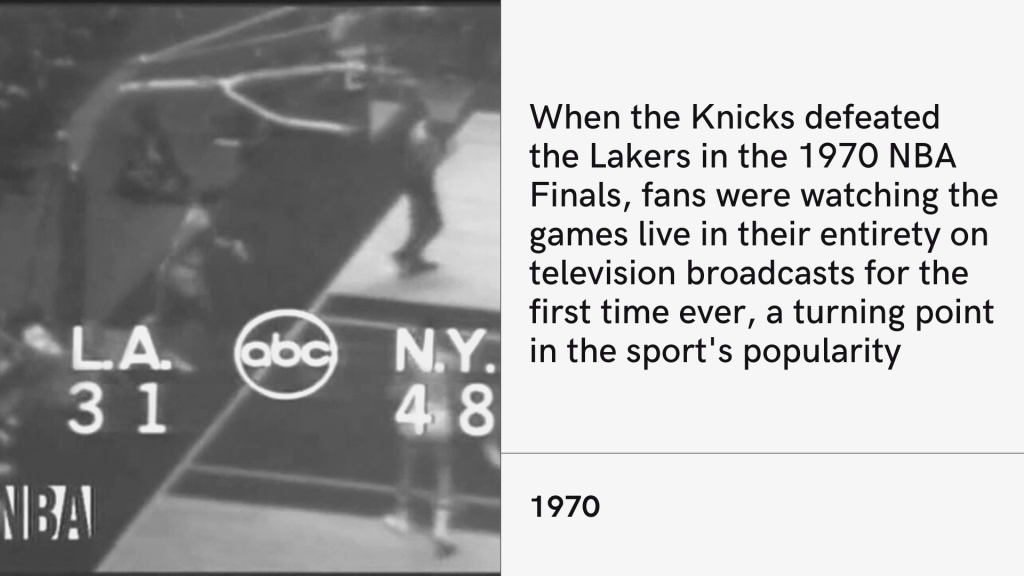
Though NBA games were getting national broadcasts starting in 1952, it took until 1970 for the entire NBA Finals to be broadcast live. ABC gained the rights in 1964 but did not broadcast games that were played on weeknights, including during the postseason and Finals. That changed in 1970, when a vaunted Lakers-Knicks showdown garnered major interest. Chris Schenkel and former Royals star Jack Twyman were on the call for all seven games across the nation but notably not in New York City. Broadcast rules at the time prohibited the New York ABC affiliate from running the national feed for home games, so New Yorkers’ only options were to listen to the local radio call (with a young Marv Albert), pack bars to watch the game on cable television (on the brand new MSG network), or wait for the ABC repeat broadcast later in the evening. Thus, when Twyman made his famed announcement that Willis Reed was coming out of the Madison Square Garden tunnel to start game seven despite a severe thigh injury, millions of fans saw it live on TV but only a small percentage of New Yorkers were amongst them. NBA television coverage would go through fits and starts over the succeeding years, with tape delay playoff broadcasts still a regular occurrence, but the 1970 Finals still marked a turning point in basketball as a powerhouse sport in American media.
24) 1970: Oscar Robertson sues the NBA over the reserve clause
25) 1970: Spencer Haywood sues the NBA over draft eligibility
Two full years before Curt Flood famously took on Major League Baseball in court, Robertson challenged the reserve clause in the NBA. A long-time civil rights activist who had languished for years on the Cincinnati Royals, Robertson was a perfect adjuvant for taking on the unfair labor practices of the NBA. His case hinged on the impending merger of the NBA and ABA, which would have cut off the only free agency avenue for pro basketball years and which this lawsuit managed to delay by several years. One year later, Haywood also took the NBA to court, challenging the league’s draft eligibility rule. An ABA star at age 20 thanks to the league instituting a “hardship rule” to allow entry without four years of college play, Haywood was unhappy with his Denver Rockets contract and signed an illegal deal with Sonics owner Sam Schulman. An unwritten part of the deal was Schulman handled the finances of Haywood being sued by the Rockets for breach of contract, and funding his own anti-trust lawsuit against the NBA. Both players were ultimately granted a Pyrrhic victory. Robertson eventually won his lawsuit in 1976, forcing the NBA to institute restricted free agency, but it came two years after his retirement (he did manage to get traded from Cincinnati to the Bucks and finally win a title late in his career). Haywood was also victorious, after his case made it all the way to the Supreme Court in 1971, and the NBA soon after created its own “hardship” clause for early draft entry. But he spent the rest of his career battling a perception from fans, the media, and opposing players as a malcontent who upset the apple cart.
26) 1971: Lew Alcindor changes his name to Kareem Abdul-Jabbar
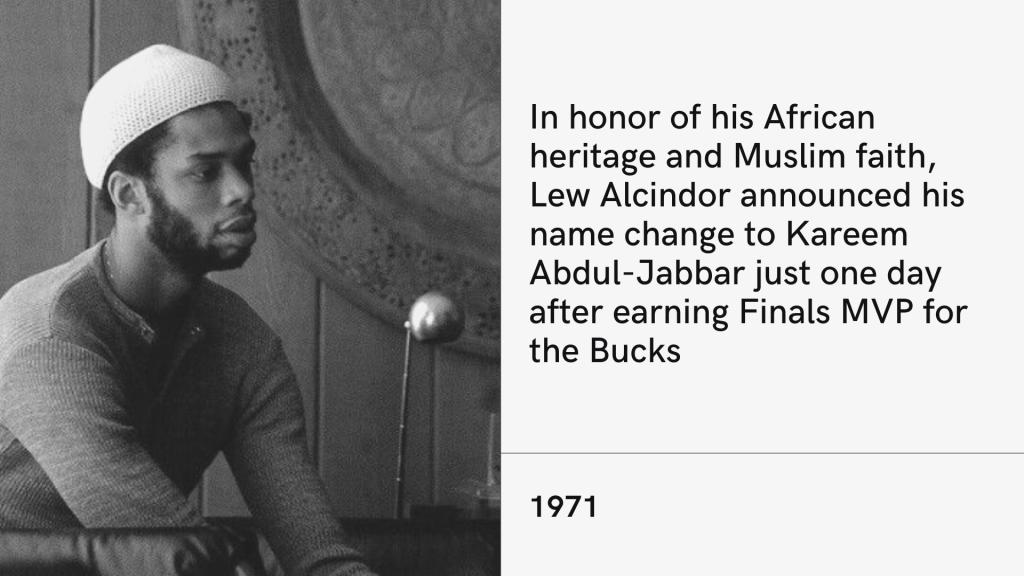
There was no doubt in the spring of 1971 that Lew Alcindor was the biggest star in basketball. The former three-time NCAA Player of the Year at UCLA had similarly taken the NBA by storm in his first two years as a pro. In the ’70-’71 season, he was named league MVP, won the scoring title, and then earned Finals MVP honors while leading the young Bucks franchise to its first title. Just one day after Milwaukee clinched that title, Alcindor called a press conference to announce that he had converted to Islam and changed his name to Kareem Abdul-Jabbar to honor his African heritage. It was a defiant move, one deeply grounded in the athlete activism that had sparked so many NBA stars of the ’60s, like Bill Russell and Oscar Robertson. It was also part of the same moral and ethical spirit that inspired Abdul-Jabbar to boycott the 1968 Olympics over the U.S. involvement in Vietnam. An unapologetic Abdul-Jabbar picked up right where Alcindor had left off, earning league MVP in ’71-’72 and continuing to dominate the NBA for the remainder of the decade.
27) 1975: David Falk is hired as a basketball agent at ProServ
In the early days of the NBA, especially before Oscar Robertson challenged the reserve clause, there was little need for agents as players would negotiate their contracts directly with management. Just about the time that Bob Woolf was building his reputation as the first major NBA agent, representing John Havlicek and Julius Erving, a young Falk took a job at the management firm ProServ. Founded by a former tennis star, ProServ mostly stuck to representing tennis players but Falk had become obsessed with basketball while attending Syracuse and sensed an opportunity there. He was basically put in charge of the firm’s basketball division at age 25 and immediately signed a deal with #1 draft pick John Lucas. After a huge breakthrough later on with James Worthy, negotiating the first million dollar shoe endorsement, Falk used his newfound connections at North Carolina to sign Michael Jordan. From there, he became arguably the most innovative agent in sports history, landing Jordan an incredible array of marketing deals with everything from shoes to cologne to underwear to a Looney Tunes movie. He also became the second most powerful man in the NBA next to David Stern, especially at the center of the 1995 and 1998 lockout negotiations.
28) 1976: The NBA and ABA merge
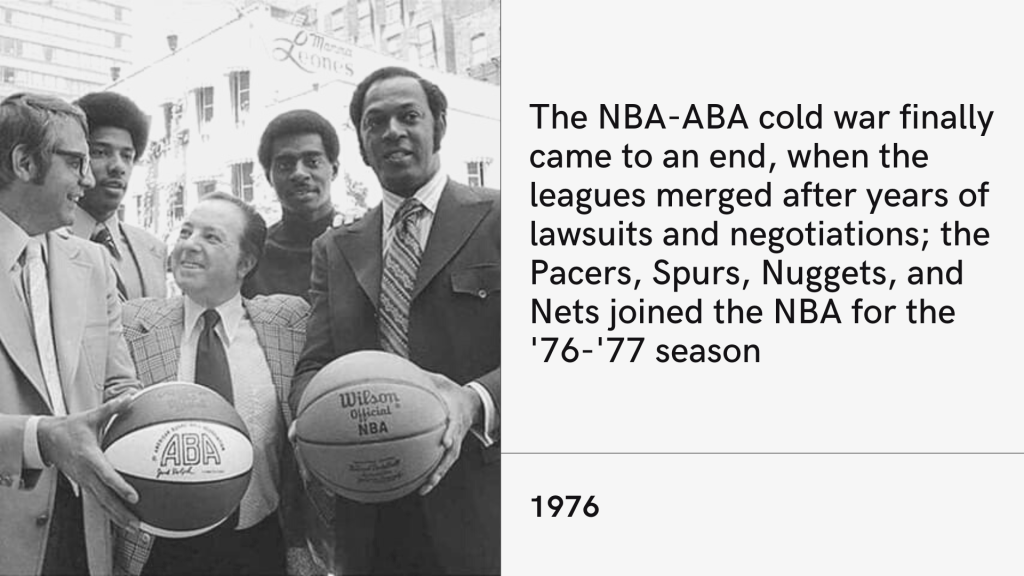
Though many of the owners may have denied it, the ABA was obviously established in 1967 with the express long-term goal of a merger with the NBA. It was a smart investment as ABA franchises were much cheaper and would increase exponentially in value upon a merger, though only four owners would ultimately manage to take advantage. A merger almost happened as early as 1970, but a lawsuit from Oscar Robertson delayed it for several years. When it finally came to pass in 1976, the Nets, Spurs, Pacers, and Nuggets joined the NBA as virtual expansion teams, forced to pay an expansion fee and receiving reduced television and gate revenues. The rosters of the non-merged teams were distributed across the NBA while the owners received solid settlements. Several ABA stars like Julius Erving, George Gervin, and David Thompson immediately took the NBA by storm with their free-wheeling, high-octane offensive styles while others like Louie Dampier struggled to adjust.
29) 1976: The Lakers trade Gail Goodrich to the Jazz for a collection of draft picks
30) 1979: Jerry Buss purchases the Lakers
31) 1979: Jack McKinney crashes his bike, suffers major head injuries, and is forced to quit as Lakers coach
In the first two decades following their 1960 move from Minneapolis to Los Angeles, the Lakers had a penchant for success falling just short of titles. Sporting superstars like Elgin Baylor, Jerry West, Wilt Chamberlain, and Kareem Abdul-Jabbar, they lost in the NBA Finals in 1962, 1963, 1965, 1966, 1968, 1969, 1970, and 1973, and in the Conference Finals in 1960, 1961, 1971, and 1977. There was one title mixed in there, with Chamberlain earning Finals MVP in 1972. Meanwhile, from 1980 to 2020, the Lakers have won 11 titles, by far the most of any franchise over that stretch. The turnaround started in 1976, when the Lakers allowed the then 33-year-old Goodrich to sign as a restricted free agent with the Jazz and received three first round picks in exchange. When Goodrich failed to gel with fellow gunner Pete Maravich, the Jazz fell to the bottom of the standings and the Lakers, despite making the 1979 playoffs, found themselves with the top pick in that year’s draft and used it on Magic Johnson. A few weeks later, owner Jack Kent Cooke sold the team to Buss, who immediately built one of the greatest dynasties of all time around Johnson and Abdul-Jabbar. One of the biggest moves Buss made happened in 1979, when his coach, McKinney, suffered a major head injury by crashing his bike. McKinney was soon after replaced by his assistant, Paul Westhead, but Buss quickly laid plans to give over the team to a young TV broadcaster named Pat Riley, who impressed the owner with his initiative and cool demeanor.
32) 1979: Broadcast deal signed with the USA network
The NBA is now predominantly broadcast on cable television, with marquee games playing throughout the regular season and playoffs on the TNT, ESPN, and NBA TV networks. TNT in particular has become synonymous with the sport, from their signature studio show featuring Charles Barkley to their annual showing of Conference Finals games. This stands in stark contrast to the league’s humble beginnings on cable television. It started with the New York based MSG network in the late ’60s, which broadcast Knicks games but to a limited consumer audience, typically confined to just sports bars. Thanks to a series of FCC regulation changes, their reach grew exponentially in the late ’70s along with the rest of cable TV. The MSG subsequently changed its name to the USA Network and expanded its reach to national broadcasts of the entire NBA. Early highlights included Christmas Day games in 1980, and select games in the 1983 and 1984 Eastern Conference Finals. USA held on to exclusive cable rights to the NBA until 1984, when a new agreement was reached with TNT, which is maintained to this day. While the original USA rights were worth $1.5 million, the most recent negotiations in 2014 cost $24 billion.
33) 1979: Three-point line is approved by owners
We live in a post-analytics revolution world now where the three-pointer is essential to the NBA but when it was first introduced in 1979, many saw it as a cheap gimmick. Even worse, many owners, fans, and media members looked at it as a cheap gimmick that was sure to fail in its attempt to drum up interest that was flagging for a staid league. First tested out by the NCAA in 1945, the three-pointer wasn’t officially adopted anywhere until 1961, when the experimental American Basketball League gave it a try. That organization was short-lived but the three-pointer endured, gaining steam in its popularity when it was sanctioned by the nascent ABA in 1967. In 1979, the NBA Board of Governors voted to sanction the three-point line for a one season trial and a year later, somewhat reluctantly ratified it permanently. Boston’s Chris Ford is credited as the first player to make a three-point field goal (though some argue that Washington’s Kevin Grevey beat him to the punch by a minute or two), doing so on the same night Larry Bird made his pro debut. It was Bird’s embrace of the three-pointer that would help advance its reputation during the ’80s from an artifice to a legitimate strategic maneuver. These days, entire Hall of Fame careers can be crafted on the three-point shot, from Reggie Miller and Ray Allen to Stephen Curry and James Harden.
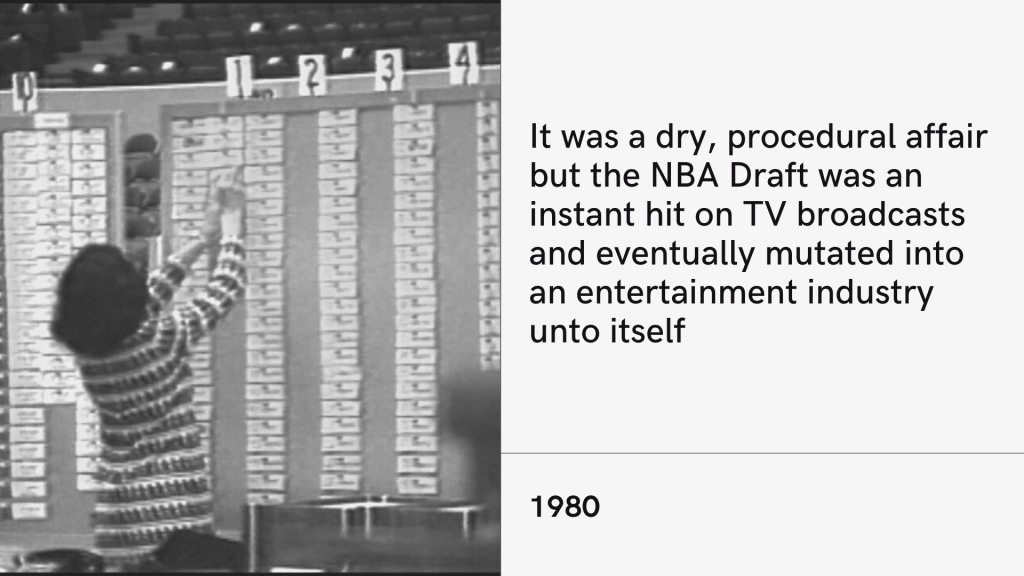
34) 1980: The NBA Draft is televised for the first time
By the end of the ’70s, NBA television ratings had tanked so severely that CBS had reverted to regularly airing games on tape delay. But against that backdrop, the league took a calculated risk in 1980 by televising the draft for the first time. In the same year that the NFL Draft was first shown on TV by ESPN, the NBA Draft went out live to viewers from the Sheraton Centre Hotel in New York on the USA network. Though it lacked the star power of the previous year’s draft, where Magic Johnson was selected first overall, the 1980 edition had no shortage of drama. The Celtics traded the first overall pick to the Warriors, who used it on Purdue’s Joe Barry Carroll. In return, Boston received Robert Parish and the third overall pick, which they used on Minnesota’s Kevin McHale, setting the stage for their ’80s dynasty. USA retained the draft broadcasting rights until the mid ’80s, when TNT/TBS took over right as the lottery system injected a new level of excitement into the proceedings. While the early draft broadcasts were dry, procedural affairs, they’ve developed over the years into entertainment arguably on par with the games themselves,
35) 1981: David Halberstam’s “The Breaks of the Game” is published
Numerous books had been written about the NBA before “The Breaks of the Game” came out in 1981 but none of them captured the racial, class, and structural politics of the league the way it did. Halberstam was embedded with the Trail Blazers for the ’79-’80 season and gave his firsthand account of a league and sport at a crossroads, with a mostly white fanbase being sold a mainly black sport. The “main characters” were Bill Walton, Kermit Washington, and Maurice Lucas, which painted a fascinating exploration of how teams and players generally deal with injuries, suspensions, and contract negotiations, respectively. Four decades later, it’s still the gold standard for non-fiction basketball writing and has now inspired numerous generations of sports journalists to find the humanity in every player and the tensions behind every relationship in the sport.
36) 1983: David Stern introduces his new substance abuse policy
Though Larry O’Brien was the commissioner who signed it and made it official (along with then Players Association president Bob Lanier), Stern, then vice president of business and legal affairs, was the real architect. It was his first significant initiative in that role and it had wide ranging ramifications. Notable players like John Drew, Micheal Ray Richardson, Lewis Lloyd, and Mitchell Wiggins soon had their careers derailed or completely ended by suspensions for substance abuse. It was also a public relations boon for the NBA with media and fans seemingly convinced that the league had “cleaned up its act,” so to speak. It’s arguable what the real impact was of this policy on the rise of popularity of the NBA in the ’80s, compared to the influx of star talent like Larry Bird and Michael Jordan, but there’s no doubt the impact, both positive and negative, was felt for years to come.
37) 1984: Salary cap is instituted for the ’84-’85 season
As opposed to popular belief, ’84-’85 wasn’t the first NBA season played under a salary cap. It actually started in the league’s inaugural season, ’46-’47, when the cap was set at $55,000 but was quickly retired. Almost 40 years later, the league controversially revived the concept. The official stance was that the salary cap would restore competitive balance to the league, allowing then struggling smaller market teams like the Cavaliers, Pacers, and Trail Blazers to keep up with the big spenders like the Celtics, Lakers, and 76ers. But it’s arguable the real reasoning was that owners were concerned about the rising star profiles of the league’s top players and desired a mechanism to keep their individual salaries under control. Along with the drug policy noted above, this was the real groundwork for commissioner David Stern and the owners to command control of the NBA for the next few decades.
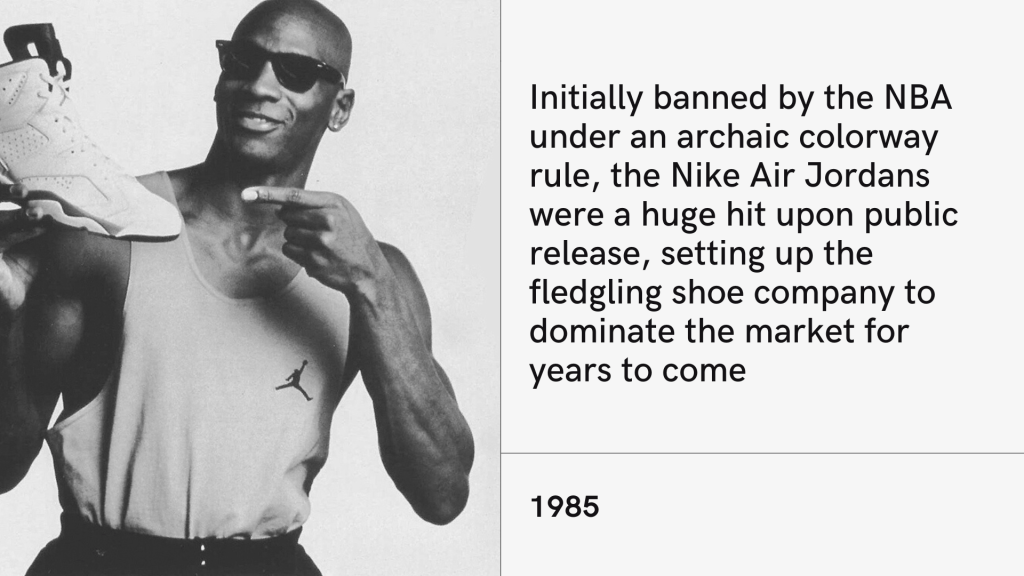
38) 1985: Nike releases the Air Jordan I to the general public
Shoe endorsements were nothing new when Michael Jordan was drafted by the Bulls in 1984 and subsequently inked a deal with Nike. From Walt Frazier and Puma to Dr. J and Converse to Moses Malone’s signature Air Force 1’s, NBA stars were regularly hauling in large sums just for sporting unique kicks. But this was an unparalleled marriage of the greatest star in the sport’s history with a fledgling but keen sportswear company. Jordan took the court in his rookie season wearing the Nike Air Ship and it was immediately banned by the league under an archaic color percentage rule that was eventually repealed. Nike wisely jumped on the marketing opportunity, claiming Jordan’s sneakers were banned for providing him an unfair advantage and covering the Bulls star’s fines as he continued to wear them during games. In the spring of 1985, they released the shoes to the general public as the Air Jordan I (with a new color scheme that fit within the NBA regulation) and shoe culture has never been the same. Even now, almost two decades removed from Jordan’s last NBA appearance, the Air Jordan is still the most popular basketball shoe brand in the world and sneaker sponsorships have since become a rite of passage for any young NBA star. By the way, if you picked up an Air Jordan I in 1985 for its original retail price of $65 and still have them in relatively good condition, they’re going for thousands of dollars now on the re-sale market.
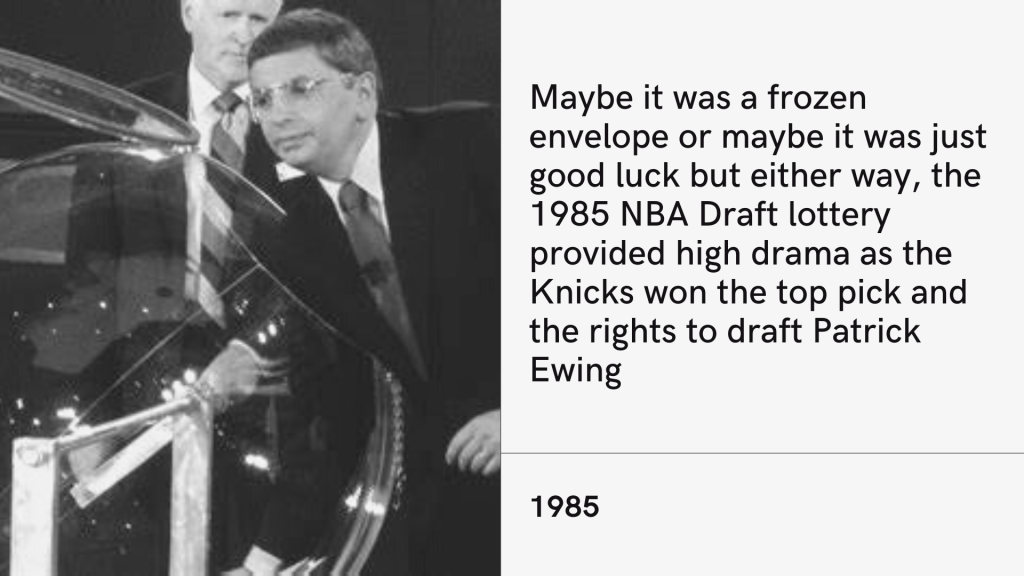
39) 1985: The Knicks win the first draft lottery
1984 should have been a coronation year for David Stern and the NBA, with the Lakers and Celtics matching up in the NBA Finals for the first time in the Magic Johnson-Larry Bird era, the new substance abuse policy helping to win over casual fans, and surefire superstars Hakeem Olajuwon and Michael Jordan headlining a supremely talented draft class. But the home stretch of the ’83-’84 season was still marred by yet another scandal, as the Rockets and Bulls were amongst several teams obviously tanking down the stretch to improve their draft position. Seeking to counteract this practice, the league instituted a lottery system starting in 1985, whereby the non-playoff teams’ draft order would be determined by Stern randomly selecting envelopes out of a hopper. When the Knicks won the first lottery and the rights to draft Patrick Ewing, Stern was immediately accused of chicanery, with many still maintaining that he froze the Knicks’ envelope to ensure he selected it. Though this conspiracy theory seems unfounded, the league still responded by tweaking the system over the years both to safeguard its integrity and respond to teams finding new ways to tank.
40) 1986: Len Bias passes away just two days after being drafted by the Celtics
June of 2021 marked 35 years since Bias’ passing from cardiac arrest. Just two days removed from being drafted #2 overall by the Celtics, the Maryland star’s passing was a snubbing out of what could have been one of the great NBA talents of the ’90s, maybe even one that could match Michael Jordan. Boston was the defending champs when they drafted him and had landed the pick years earlier in a trade with the SuperSonics. Bias was already being billed as the heir apparent to Larry Bird, a young superstar that would smoothly bridge the mighty Celtics into the next decade. Instead he was dead at 22 and soon after became a cautionary tale, not just in the basketball world but across all spectrums of America. When the news broke that Bias had cocaine in his system that led to his death, the media pounced, followed by politicians. Soon enough, President Ronald Reagan was signing into law the Anti-Drug Abuse Act of 1986, a disastrous bill that was one of the key planks of the harmful U.S. “War on Drugs.”





41) 1986: David Stern meets with officials from the China Central Television Network (CCTV)
Though the 1992 Olympics are an obvious flashpoint for the expansion of the NBA in the international market, a more overlooked moment came in 1986. This meeting between commissioner David Stern and CCTV reps was regarding broadcasting NBA games in the most populated nation on Earth. The Chinese television group agreed and broadcasts started in 1986, with a majorly tape delayed showing of the previous years’ NBA Finals games between the Lakers and Celtics. These broadcasts were sent for free by Stern, who understood the potential eventual return on investment of growing the sport’s popularity in China. The NBA eventually opened its first overseas headquarters in Hong Kong in 1992 and in 1994, CCTV broadcasted a live NBA game for the first time, an NBA Finals match-up between the Rockets and Knicks.
42) 1988: Tom Chambers becomes the first unrestricted free agent
Though free agency technically started in the NBA in 1974 as a result of a landmark Oscar Robertson lawsuit, it was in a restricted form for its first 14 years. Things changed in a hurry in 1988, when a collective bargaining agreement between the players and owners produced new regulations on free agency. For the first time, a player with seven or more years of experience entering free agency could sign with another team without compensation for their previous team. This was a sea change in contract negotiations, as the restricted free agency era was essentially just glorified trades where the owners still had the majority of control. The biggest star of the first free agent class of 1988 was Chambers, an All-Star who had led the Sonics to the 1987 Western Conference Finals. He signed with the Suns and peaked over the next few years in Phoenix, getting named to three more All-Star teams and averaging as many as 27.2 points per game. Other notable signings that summer included Moses Malone to the Hawks, Kurt Rambis to the Hornets, and Walter Davis to the Nuggets.
43) 1989: FIBA lifts its Olympics ban on professional players
As opposed to popular belief, NBA players participating in the Olympics was not the dream of then commissioner David Stern or really anyone associated with the NBA in a management capacity. Instead, it was Borislav Stanković, a former Yugoslavian player and coach who became the FIBA Secretary General in the ’70s. He made an official visit to the U.S. in 1975, watched live NBA basketball for the first time, and was immediately enamored. Stanković dedicated the next decade-plus to ensuring that the Olympics and other FIBA competitions could include what was truly the pinnacle of basketball talent. It finally came true in 1989, when the FIBA Congress voted to allow pro players in the 1992 Olympics. The U.S. was amongst a handful of countries that voted no and Stern was initially obstinate in his refusal of officially condoning the idea. Eventually he was forced to relent and in retrospect he happily admitted that the Dream Team was a momentous step in the international growth of basketball and the NBA.
44) 1989: NBC acquires NBA broadcasting rights
45) 1990: John Tesh composes “Roundball Rock”
It’s unknown how much CBS paid for its rights to broadcast the NBA that lasted from 1973 to 1990. NBC would eventually shell out $150 million per year for the rights starting with the ’90-’91, as the league’s popularity and TV ratings were still rising exponentially thanks to an influx of superstars like Magic Johnson, Larry Bird, and Michael Jordan. With a pre-game and halftime show hosted by Bob Costas, play-by-play provided by Marv Albert, and a slick, expertly packaged presentation, NBC revolutionized modern basketball programming. They certainly benefitted from the ’90s being the decade of Jordan and the early ’00s being dominated by Shaquille O’Neal and Kobe Bryant. NBC also had a secret weapon in “Roundball Rock,” an earworm score composed by new age pianist Tesh. It was play approximately 12,000 times during the NBA on NBC run and to this day still elicits a Pavlovian response in any Gen X’er or older Millennial that was weened on ’90s basketball (Conan O’Brian would hilariously lament the song’s demise whenever Tesh appeared on his show). How did the NBC lose the NBA to ABC and ESPN in 2003? Dick Ebersol is mostly to blame, from his stubborn refusal to embrace cable and online partnerships (an area where ABC and ESPN especially excelled) to his overpayment for various football properties like the XFL, Arena League, and Notre Dame.
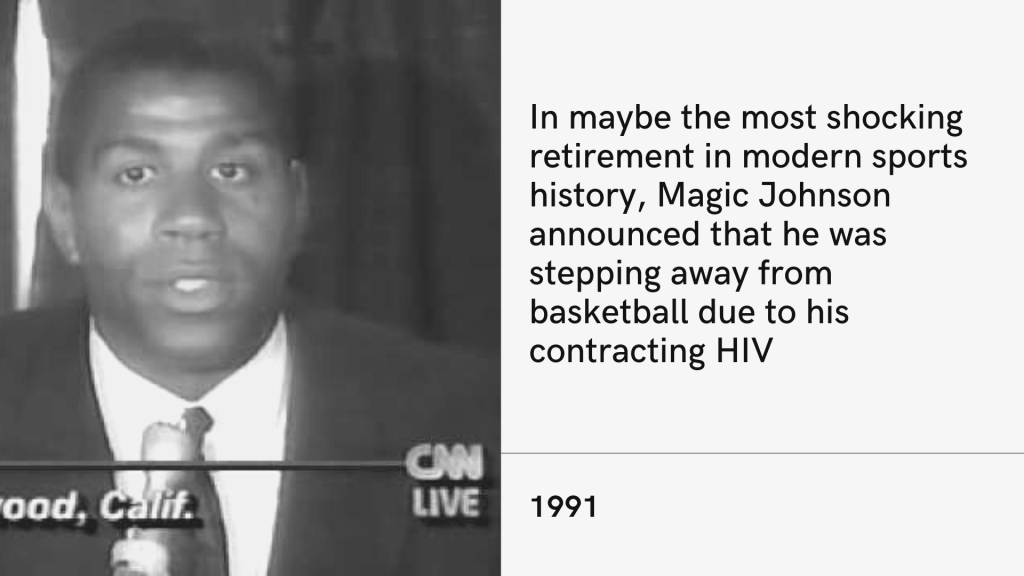
46) 1991: Magic Johnson announces he has contracted HIV and is retiring
On November 7, 1991, Johnson took the podium at the Great Western Forum for a press conference. He had missed the first three games of the ’91-’92 season with “flu-like symptoms” and reporters showed up expecting a straightforward update on his status going forward. They likely realized something bigger was about to be announced when they viewed Johnson standing on the dais flanked by Jerry Buss, David Stern, and former star teammate Kareem Abdul-Jabbar. The Lakers legend got straight to the point, announcing that he had tested positive for HIV (a surprise diagnosis that came from a standard set of tests for a life insurance policy) and was retiring, effective immediately. We often tend to overrate the effect of sports on the greater culture and politics of America but there’s no denying the impact of Johnson being the first star athlete to contract HIV. Similar to how the delay of the ’19-’20 NBA season finally snapped most of us into reality about COVID-19, Johnson’s announcement, followed by his continued advocacy, were a turning point in Americans’ awareness of HIV and AIDS.
47) 1993: “NBA Jam” is released in arcades
It was far from the first basketball video game and certainly not the most realistic, but even as it approaches its 30th anniversary, “NBA Jam” is still the pinnacle of pixelated basketball. Released in arcades in April of 1993, just as Michael Jordan and the Bulls were embarking on their third straight postseason title run, “NBA Jam” eschewed the verisimilitude of cohorts like “Tecmo NBA Basketball” to instead concentrate on NBA basketball as a bombastic, bigger-than-life joy. It was an instant hit, one of the biggest in arcade history, eventually spawning 12 sequels or spin-off editions and getting ported to virtually every home console imaginable (including a recently released home arcade cabinet). It’s conceivable that large swaths of NBA fans can trace their origins to stumbling across “NBA Jam” in arcade form at their local Pizza Hut or on Super Nintendo or Genesis at their local Blockbuster.
48) 1993: Michael Jordan retires to play baseball
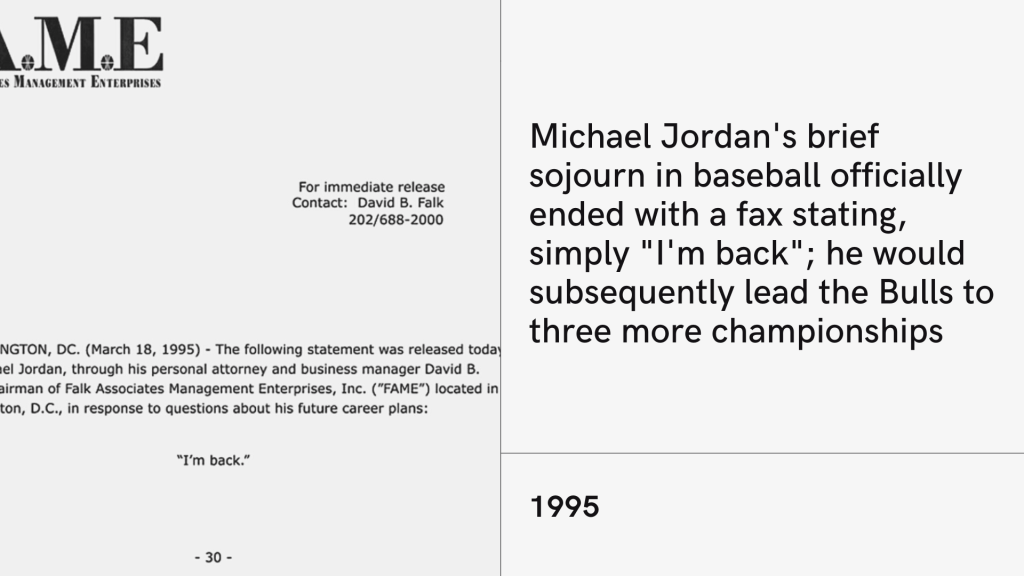
49) 1995: Michael Jordan faxes in his comeback statement
Whether it was burnout, wanderlust, or a clandestine request from the league office, Jordan’s 1993 retirement announcement was maybe the most notable in sports history (give or take a Lou Gehrig). The then three-time league MVP and three-time Finals MVP was already in the discussion of greatest player of all time and had become a cottage industry unto himself, with specialty licensed shoes, video games, sports drinks, and even a cologne. But he was also exhausted from years of top-level pressure, the recent murder of his father, and the media firestorm around his supposed gambling addiction. Like many a grieving child has done, he opted to go through with his late father’s wishes, making an attempt at a pro baseball career. The league certainly suffered in terms of interest and television ratings but the talent level was still incredible, with stars like Scottie Pippen and Hakeem Olajuwon filling the attention void with career peaks. After Jordan’s time with the White Sox ran its course with minimal success, he announced his return to the NBA in March of 1995 with an infamously terse fax that read, simply, “I’m back.” Because his #23 jersey had been retired by the team, Jordan wore #45 on March 18, 1995, when he scored 18 points in a loss to the Pacers. A rusty Jordan and the Bulls were knocked out of the playoffs in the Conference Finals that spring by Orlando but a year later they broke the record for wins in a season with 72 and embarked on a championship three-peat.
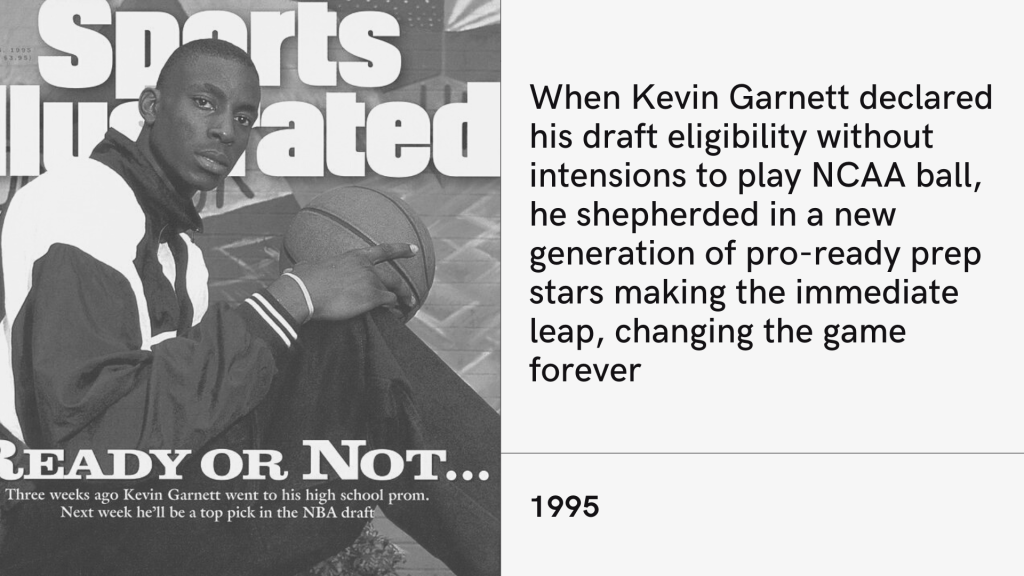
50) 1995: Kevin Garnett declares his eligibility for the NBA Draft
51) 1996: Kobe Bryant signs with Arn Tellem as an agent
It’s often assumed that the influx of prep players eschewing the NCAA and jumping straight into NBA Draft eligibility in the mid ’90s was the result of some regulation change. But that wasn’t the case, as the league actually lifted its age eligibility rule in the early ’70s, following a lawsuit from Spencer Haywood and the ABA merger. A few high school players did test the waters early on, most notably Darryl Dawkins, but the sentiment through the ’80s and early ’90s remained that players needed at least a couple years at the NCAA level before they were NBA ready. This preconception was smashed in 1995 by Garnett, who had an undeniably qualified mixture of pure athletic talent and maturity (he also was likely ineligible for the NCAA due to poor test scores). He was drafted #5 overall by the Timberwolves in 1995 and eventually became the first prep-to-pro player to be named an All-Star (in 1997) and the first to be named MVP (in 2004). Meanwhile, Bryant had a strong pro basketball pedigree as his father, Joe, had spent several years in the NBA and then in European leagues. He signed a contract at age 17 with the high powered agent Tellem, who maneuvered him onto the Lakers (controversially refusing private workouts for other teams). Over the next several years, dozens of high school players would declare themselves eligible without NCAA experience, some successful (e.g., Tracy McGrady, Jermaine O’Neal), others much less so (e.g., Kwame Brown, Korleone Young).
52) 1996: John Hollinger launches the “Alleyoop” website for advanced statistics
We’re currently in a full blown analytics era in the NBA, with teams running their offense and defense to maximum efficiency thanks to video tracking technology, full play-by-play, and synergy data. It obviously wasn’t always that way. In fact, for the first three decades, the NBA basically just tracked and posted lineups and basic box scores. Things expanded in the ’70s and ’80s, with blocks and steals added as base statistics, plus full game logs allowing for most robust analysis. This set the stage for Hollinger, a young basketball journalist from Portland, to revolutionize how players, coaches, front offices, the media, and fans can use statistics to interact with the game. In 1996, he started a website called “Alleyoop” which quickly became a haven as the “thinking man’s” basketball corner of the internet. Positioned perfectly at the nexus of the rise of internet media and fantasy sports obsession, Hollinger’s pet project was a new statistic he called Player Efficiency Rating, or PER. Meant to quantify everything a player does on the court in one handy statistic, PER and “Alleyoop” were the genesis of the current NBA analytics obsession. Hollinger eventually moved on to bigger and better things, including stints with Sports Illustrated and ESPN, and eventually a front office job with the Grizzlies.
53) 1996: Juwan Howard signs the first $100 million contract
54) 1996: Shaquille O’Neal signs a $120 million contract with the Lakers
Thanks in large part to the proliferation of internet commentary, even casual NBA fans can now immerse themselves in the complex regulations of the salary cap. Things were a little less clear back in the ’90s, as franchises were adjusting to the still novel concept and its seemingly constantly changing regulations. Thus, the first $100 million contract in NBA history, signed by Howard to join the Heat, was voided by the league office. Turns out the Heat had miscalculated their available salary due to performance bonuses due to several players. Howard then re-signed with the Bullets for seven years and $105 million, making it the actual first $100 million-plus NBA contract ever signed. This placed the Bullets over the cap as well but rules were (and still are) in place allowing them to exceed that amount to re-sign their own player. He ended up lasting just a few more disappointing seasons in Washington, never reaching an All-Star Game and reaching the postseason just once. Contrast that with O’Neal, who just a few days after Howard agreed to the second contract in NBA history worth over $100 million. By the time his era in Los Angeles was over in 2004, O’Neal had earned league MVP, played in four NBA Finals, and won three titles, earning Finals MVP in each of them. It was a major power shift in the NBA as the Magic struggled for years to rebuild without their franchise center, while the Lakers dominated the ’00s.
55) 1996: “Space Jam” is released in theaters
There was actually a long history of NBA stars being featured in major films before “Space Jam” hit theaters in November of 1996. The first notable example was Jamaal Wilkes in “Cornbread, Earl and Me” in 1975, while Julius Erving, Kareem Abdul-Jabbar, and Wilt Chamberlain took their turns in the Hollywood spotlight in the ’80s. “Space Jam” was, for better or worse, the apotheosis of the NBA star/film industry nexus. Based on a popular Nike commercial, it featured Michael Jordan acting alongside Bugs Bunny, Daffy Duck, and the rest of the Looney Tunes gang. Jordan’s longtime friends Larry Bird and Charles Barkley made cameo appearances, as did Patrick Ewing, Muggsy Bogues, Larry Johnson, and numerous others. Though it was panned by critics, “Space Jam” was a box office hit and still has legions of adoring fans that grew up watching repeated viewings. The inevitable sequel starring LeBron James has the inexorable addition of further “Warner Brothers Extended Universe” characters, such as Harry Potter and King Kong. Just a few months before “Space Jam,” Shaquille O’Neal’s genie film “Kazaam” was a box office disaster, showing the true yin and yang of athlete forays into Hollywood.
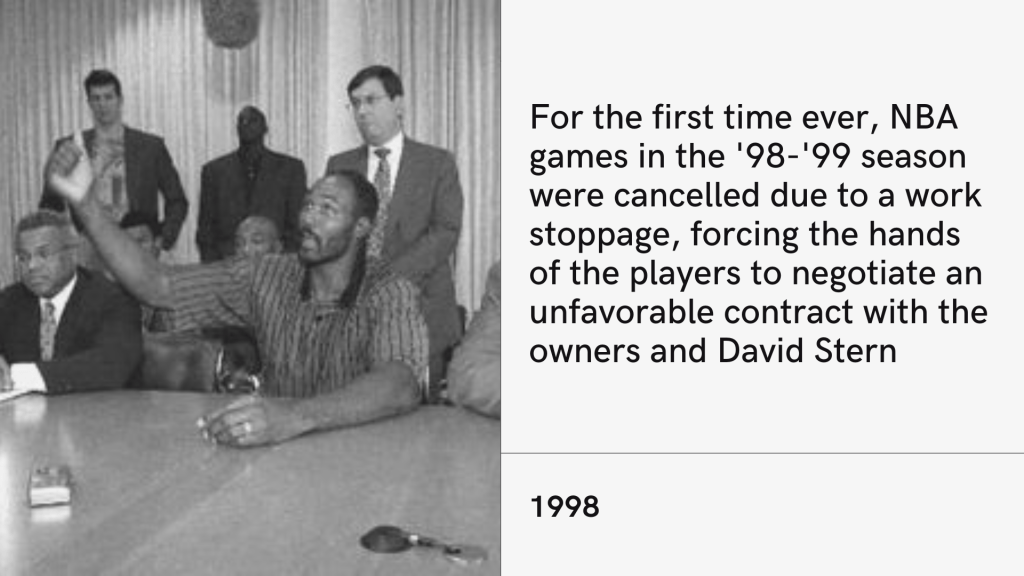
56) 1998: The owners institute a lockout
Labor disputes in U.S. pro sports was nothing new by the late ’90s but this was a significant event in two ways. First, almost all major previous shutdowns had been a player strike but this was the first significant owner lockout of a U.S. sport. That signified a considerable shift in American attitudes towards labor relations that had been building since the ’70s. This was also the first time the NBA had to actually cancel games due to a labor disagreement, something the MLB, NFL, and NHL had all dealt with previously. There had never been a player strike in NBA history but there was actually brief, un-obstructive lockouts in 1995 and 1996. With both franchise revenue and franchise expenses rising exponentially through the ’90s, it was seemingly inevitable that a work stoppage would eventually disrupt the regular season. That finally did happen in 1998, when the owners ceased operations in June of 1998 and didn’t resume until a negotiation was settled in January of 1999. That final settlement was an unquestionable victory for the owners and commissioner David Stern, as the NBA became the first pro league to cap individual player salaries, a rookie pay scale was introduced, and mandatory drug testing was expanded. The ’98-’99 season was shortened from 82 games to 50 and is widely considered one of the worst in NBA history, as rusty and out-of-shape players meandered through an arguably lost year.
57) 2000: Mark Cuban purchases the Mavericks
Just a few years after he had purchased the team himself, former presidential candidate Ross Perot sold the Mavericks to Cuban in January of 2000. Just 41 years old at the time, Cuban was a new breed of NBA owner. He had made his money on the internet, selling his company, broadcast.com, to Yahoo for $5.7 billion in 1999 (right before the dot com crash). Rather than a quiet presence observing games from his luxury box, he was boisterous and discernible, sitting court side to cheer on the Mavericks and giving quotes regularly to the media. Cuban was also a successful owner, throwing money at a moribund franchise and using modern business management techniques to build a winning culture that culminated in a 2011 championship.
58) 2001: Illegal defense is retired and replaced by the defensive three seconds rule
1998 was a rough year for the NBA, with Michael Jordan retiring, seemingly for good this time, and an owner lockout lasting over six months and reducing the ’98-’99 season. When play finally resumed in 1999, the game was not an aesthetically pleasing one. The ensuing era was best signified by the knock-down, drag-out Heat-Knicks rivalry, which culminated in a 2000 playoff game in which the teams combined for just 153 points despite going to overtime. The NBA went to the rulebook for the solution, eliminating what had previously been known as illegal defense and replacing it with a new three seconds rule. The three seconds rule technically made zone defense legal but also made camping out in the paint defensively impossible. This forced offenses to move away from the stagnant, isolation schemes that had dominated the late ’90s and early ’00s and into more motion-heavy offenses. It took a few years and some refinements but this did eventually lead to an offensive revival that helped the NBA reach new heights of popularity.
59) 2001: NBA Development League is founded
When the Greenville Groove and North Charleston Lowgators tipped off in November of 2001, the National Basketball Development League (NBDL) became the first pro basketball minor league in America. Chris “Birdman” Andersen soon after became the first “call up” to the majors, signing with the Nuggets after a brief stint with the NBDL’s Fayetteville Patriots. The league became more codified in 2005, when it changed its name to the D-League and teams started official affiliations with NBA squads. Now expanded to 30 teams from the original eight, and rebranded as G-League as part of a sponsorship with Gatorade, it’s became an institution and developmental pipeline. Players like Hassan Whiteside, Jeremy Lin, and C.J. McCollum have worked their way up through the G-League ranks, as have coaches like Quin Snyder and Nick Nurse.
60) 2001: Kwame Brown is drafted #1 overall by the Wizards
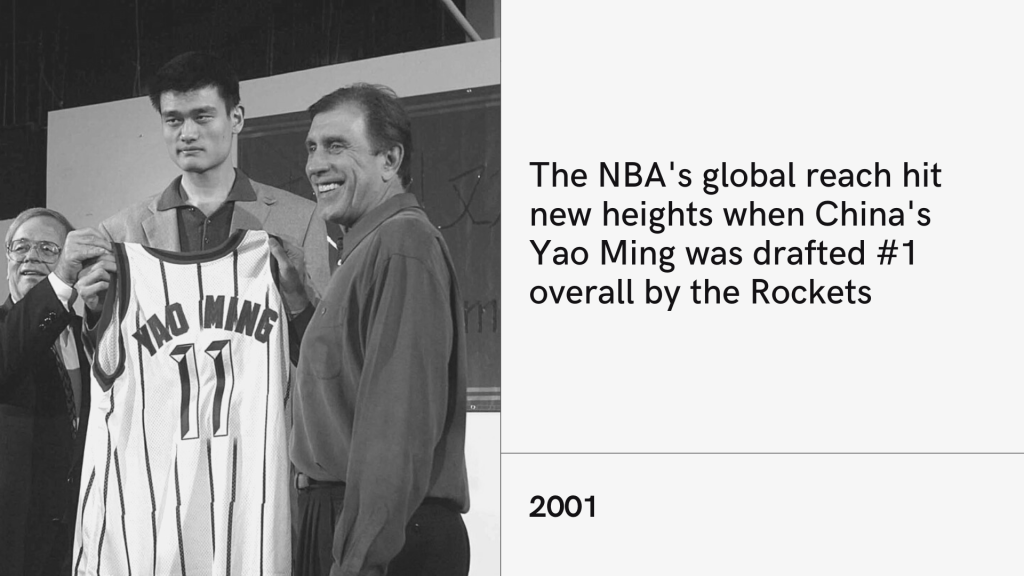
61) 2002: Yao Ming is drafted #1 overall by the Rockets
Back-to-back #1 overall picks in 2001 and 2002 made inextricable marks on the NBA for vastly different reasons. Brown was the first player to be drafted #1 overall straight out of high school and had the added pressure of Michael Jordan being the Wizards team president who opted to pick him. Jordan soon after became his teammate as well and reportedly his tormentor, verbally abusing the young center in an attempt to motivate him. Brown never rounded out to anything better than a decent role player, peaking with career high averages of 10.9 points and 7.4 rebounds per game in ’03-’04. He was traded to the Lakers at age 23 and out of the league by age 30. His legend is more secure off the court, where he’s consistently cited as one of the motivating factors in the NBA instituting an age restriction on draft eligibility in 2006. Conversely, Yao came to the NBA fully formed at age 22, getting named 1st-Team All-Rookie for the Rockets in ’02-’03 after nearly averaging a double-double in his rookie season. Though his career was ultimately marked by injuries and postseason disappointments, it was also a watershed moment in the NBA international reach. Ming’s popularity in his native nation of China fostered an explosion of the sport back home, which had already been growing since the late ’80s. This was especially on display at the 2008 Olympics in Beijing, when not just Yao but also American superstars like Kobe Bryant and LeBron James were mobbed by adoring Chinese fans wherever they went.
62) 2002: Luxury tax is instituted for teams going over the salary cap
As a fallout from the 1998 collective bargaining agreement, the NBA owners agreed to a luxury tax to improve revenue sharing with smaller market teams and to more effectively cap individual salaries. In other words, it was yet another tool to save the owners from themselves, in terms of overspending. This seemed to work for a while, for the owners at least, as they curbed spending on salaries to navigate the tax while big market teams willing to exceed the tax, like the Mavericks, were placing extra cash in the hands of frugal, smaller market franchises, like the Jazz. As is the case with any capitalist market, inefficiencies were eventually exposed by both the owners and the players, who learned to time and tailor their contract demands with expected collective bargaining agreements and salary cap/tax fluctuations. It was also left to the whim of outside market forces, like the 2008 economic collapse that reportedly caused over two-thirds of NBA franchises to lose money for multiple seasons. The recent COVID-19 pandemic has caused another major shift in the tax, rendering it nearly fruitless to stop current big spenders like the Warriors, Nets, and Lakers.
63) 2002: Rich Paul and LeBron James meet outside the Akron-Canton Airport
The most powerful player and subsequent agent of the 21st century teamed up thanks to the throwback jersey craze of the early ’00s. Born and raised in Cleveland, Paul was fresh out of high school when he started a throwback jersey business, purchasing the vintage clothing from Atlanta and then re-selling it across his hometown. In 2002, he was selling jerseys out of his trunk at the Akron-Canton Airport when the Warren Moon Oilers jersey he was sporting caught the eye of James, who was then a high school senior. James purchased a couple jerseys from Paul and thus began a beneficial relationship for both men. Paul quickly joined James’ inner circle of friends and then became his agent, first under Leon Rose at CAA and later under his own agency, Klutch. Under Paul’s counsel, James changed the rules of star athlete contract negotiation, first with his signing with the Heat in 2010, then with his return to Cleveland in 2014 and his move to Los Angeles in 2018. From selling jerseys out of his trunk at the airport to now arguably the most powerful agent in sports, Paul was the central force who moved Anthony Davis from New Orleans to Los Angeles via trade, displaying the capacity that star players and agents now have in compelling ownership decisions.
64) 2004: Crackdown on defensive hand-checking
Whether you’re an old school type who laments the decline of the NBA paint enforcers or you’re a modern fan thrilled with high scoring shootouts, the likely dividing line for you is 2004, when the emphasis was increased on referees calling hand checking fouls. Defined, broadly, as a defender placing their hands on an offensive player in a manner that impedes their movement, hand-checking tended to slow down the game and grant outsized advantages to power forwards and centers. The tactic had been previously curbed with new regulations in 1994 but was essentially eliminated completely for the ’04-’05 season. Probably the most immediate beneficiary was Suns point guard Steve Nash, whose breakneck style thrived under the new rules and he earned back-to-back MVP awards in ’04-’05 and ’05-’06. In fact, since hand-checking was eliminated, the only traditional big man to win MVP was Dirk Nowitzki in ’06-’07. Combined with the rise of analytics and the expulsion of the illegal defense penalty, the removal of hand-checking has led to an unprecedented rise in offensive efficiency over the last decade-and-a-half, with guards like Stephen Curry, Russell Westbrook, and James Harden setting previously unheard of statistical milestones and records.
65) 2005: Hurricane Katrina causes extensive damage to the New Orleans Arena
When Hurricane Katrina hit New Orleans in August of 2005, the damage and destruction to the city was extensive and naturally included its sports teams. The Hornets were then in town and playing in the newly opened (in 2002) New Orleans Arena (now called the Smoothie King Center). While the venue itself wasn’t heavily affected by the hurricane, the area surrounding it was ravaged by floods, rendering the arena unusable. The Hornets moved their training camp to Colorado and searched for a temporary home for the regular season, initially expecting to be back in New Orleans around the All-Star break. Instead, they wound up playing the majority of their home games for the next two seasons in Oklahoma City, which beat out hosting bids from San Diego, Louisville, Nashville, and Kansas City. Temporarily renamed the New Orleans/Oklahoma City Hornets for the ’05-’06 and ’06-’07 seasons, the team was a huge hit in their new home, drawing massive crowds despite missing the postseason each year. New Orleans were rightfully concerned that their NBA franchise would never return permanently but sure enough they did in ’07-’08 and had a terrific season, with Chris Paul guiding them to the Conference Semifinals. Oklahoma City had meanwhile proven its worth as an NBA host site, something that was obviously not lost on the NBA.
66) 2006: Draft age eligibility raised to one year removed from high school
Four decades after merging with the ABA and dropping its original draft age eligibility rule, the NBA decided that enough was enough. More and more star prep players were skipping the NCAA ranks entirely and though there were certainly some successes along the way (i.e., Kobe Bryant, Kevin Garnett, LeBron James) there were also some high profile failures like Korleone Young, Kwame Brown, and Darius Miles that were drawing negative attention to the league policies. As part of the 2004 collective bargaining agreement between the owners and the players’ association, David Stern attempted to re-instate a minimum age of 20 but was negotiated down to one year removed from high school. It was controversial at the time and it remains controversial now, as players are increasingly skipping a year in the NCAA to instead get paid overseas or in the G-League while awaiting their eligibility. Current commissioner Adam Silver originally floated the idea of raising the eligibility age even further but has since flipped on that position and now seems open to lowering it again the next time the CBA is negotiated.
67) 2007: Tim Donaghy admits to point shaving
There always has been, and always will be, fans who consider the NBA to be just as rigged as professional wrestling. This is especially true in the gambling community, but even though several major point shaving scandals had popped up over the years in college basketball, there was scant evidence that NBA games had been compromised in any fashion. Then along came a federal indictment against Tim Donaghy. The referee was accused of filtering inside information to bettors, and using his on-court status to tilt final scores in the favored direction of a point spread. The information and story that slowly unfolded was like a treasure trove of every previously unfounded cliche people repeatedly tossed at the NBA: refs being paid off by shady mob-connected gamblers, games being fixed by the league office to better serve bigger market teams, and, of course, star players receiving reverential treatment in foul calls. David Stern responded by painting Donaghy as a rogue scumbag looking to damage the sport to preserve his own reputation. The truth is likely somewhere in between, but either way Donaghy’s name has become synonymous with the lingering ugly underbelly of the modern NBA.
68) 2008: Sonics relocate to Oklahoma City and become the Thunder
NBA franchises relocating was certainly nothing new by the time the SuperSonics became the Thunder in 2008, but never one as storied in its previous home as this one. Right as the Sonics were celebrating their 40th anniversary in the Emerald City, with a history that included a 1979 championship, as well as NBA Finals appearances in 1978 and 1996, new owner Clay Bennett announced he was relocating the team to Oklahoma City. This came after demands for public funding to replace the aging KeyArena were denied by the city of Seattle but Bennett seemed hellbent on the move from the beginning, especially after Oklahoma City had so ably hosted the wayward Hornets in the ’05-’06 and ’06-’07 seasons. Seattle has since fully renovated KeyArena, rebranding it as Climate Pledge Arena (as sponsored by Amazon). It will host the NHL’s Kraken starting in 2021 but thus far no movement has been made on restoring the NBA to the city, either through relocation or expansion. In fact, Seattle seems to have possibly fallen in line behind Mexico City, Las Vegas, and Tampa in the NBA franchise expansion/relocation list.
69) 2008: Shaquille O’Neal (@the_real_shaq) joins Twitter
Originally conceived as a narrow online messaging service, Twitter launched in 2006 to limited fanfare. A major tipping point for the platform came in 2008, when O’Neal was one of the first major celebrities to join and begin spouting his thoughts, jokes, and opinions, 140 characters at a time. Reportedly motivated to join by the legion of Shaq impersonators already on the app, his first tweet (appropriately: “this is the real SHAQUILLE O’NEAL”) came in November of 2008, in the early stages of his final All-Star season with the Suns. His earliest posts were typically jokes at his own expense or playful jabs at other tweeting celebrities like Kevin Hart but O’Neal broke new ground in 2011, when he arguably became the first superstar athlete to announce his retirement on Twitter. Since the Diesel’s joining, Twitter has become a home base over the years for almost every NBA player to interact with fans, trash talk, push sponsorships, make announcements, and, occasionally, get themselves into trouble.
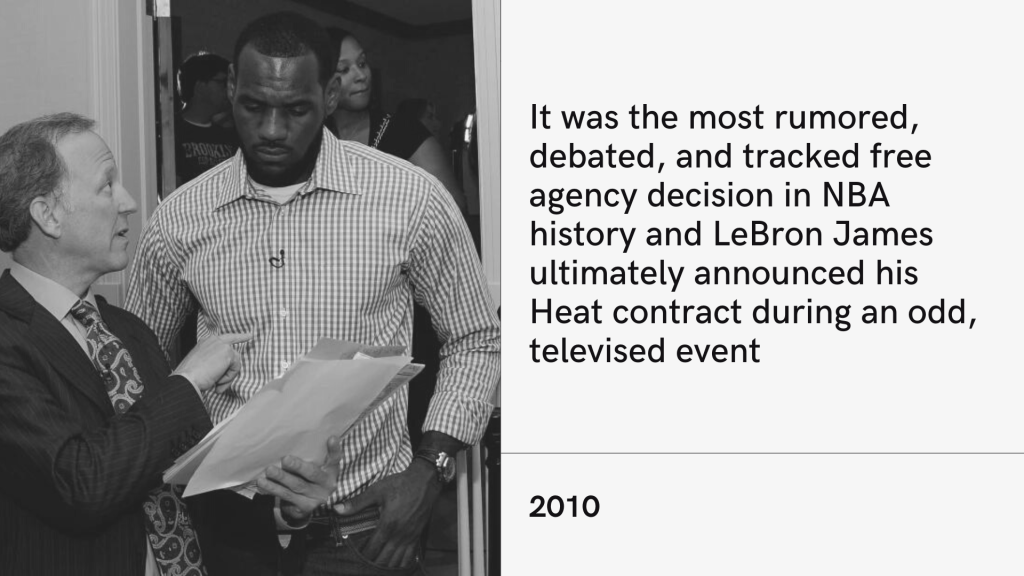
70) 2010: LeBron James makes “The Decision” on live television
Players greater than James may eventually come and go in the NBA, but it’s hard to imagine anyone will ever change the league with a free agency decision the way he did in 2010. In a one hour-plus special on ESPN, James raised over $2 million for the Boys and Girls Club while announcing that he would be “taking his talents to South Beach,” joining fellow All-Stars Dwyane Wade and Chris Bosh on the Heat. It completely altered the way fans, players, owners, and the media perceived free agency, player-owner power balances, and the marketing of the sport’s top talent. It proved that players finally had bargaining power on their side in a way that early pioneers like Oscar Robertson could only dream of, and kicked off the era of the NBA “super team.” It also turned James into a pariah in certain circles, especially in his hometown of Cleveland, where fans burned his jersey in effigy and turned his name into epithets like “LeFraud.” All was forgiven four years later, when James returned to the Cavaliers as a free agent and then carried them to the 2016 championship.
71) 2010: SportVU video data tracking debuts in NBA arenas
Analytics and advanced statistics were already ingrained philosophies in every NBA front office by 2010, but the advent of the SportVU data tracking system was still evolutionary. Using a patented camera system that can capture data 25 times per second and track every person on the court, the SportVU system (which is owned by the analytics company STATS) was first installed at the Amway Center in Orlando during the 2009 NBA Finals. The results of this installation were demoed to NBA owners and by the start of the ’10-’11 season, the Mavericks, Rockets, Thunder, and Spurs were all fully contracted to use SportVU. The technology was so robust and useful that within three years, every NBA team was not only using SportVU but incorporating the data into their roster and coaching decisions. While reading statistics and watching game tape can tell most of the story, video data tracking has allowed every movement of every player throughout a game to be analyzed and used. It is no doubt the present and future of analytic analysis of basketball.
72) 2014: Adam Silver replaces David Stern as commissioner
It’s pretty incredible in retrospect that when Silver took over from Stern in February of 2014, he was becoming just the fifth commissioner in nearly 70 years of NBA history. While the first three commissioners, Maurice Podoloff, J. Walter Kennedy, and Larry O’Brien had been in charge for about 38 years combined, Stern himself had been at the helm for exactly three decades, having taken over on February 1, 1984. While Stern’s tenure is seen in retrospect as an overall success, it was also an exceedingly rocky one, with numerous controversies that had to be navigated as the NBA transitioned into its current status as a pro sports powerhouse. Silver’s job has been more of a hands-off steward, at least thus far, though the financial issues stemming from the COVID-19 shutdowns may have ramifications for years that could greatly affect the player-owner relationship dynamic. Regardless of how you feel about him, Stern was undoubtedly a legend of the NBA, a man whose imprint on the league is arguably just as large as Michael Jordan’s or Bill Russell’s.
73) 2014: Donald Sterling’s racist tirade is leaked to the media
Just a few months after taking over the commissionership from David Stern, Adam Silver had to deal with one of the weirdest sagas in NBA history, which that ended with the largest lawsuit ever levied against the league. Sterling spent much of his adulthood doing despicable and arguably racist things and in April of 2014 some direct evidence was finally caught on tape and released to the public. The immediate disgust regarding Sterling’s racist tirade was swift and palpable thanks to the newly minted social media age, and happened just as his Clippers were embroiled in a first round playoff series with the Warriors. Players from both teams threatened to boycott games if the NBA didn’t act, so Silver stepped in swiftly, fining Sterling $2.5 million and banning him from the league for life. Sterling seemed contrite and cooperative about the arrangement at first but just as his co-owner (and wife) Shelly Sterling was about to finalize a sale to Steve Ballmar, Donald stepped in and sued the NBA for $1 billion. A nasty public triangular dispute ensued between the Sterlings and the NBA that lasted for almost two years until the lawsuit was quietly settled in 2016 on undisclosed terms. The event really set the stage for the new player dynamic with the league office in the Silver era, one that was leveraged again in 2020 in line with civil unrest amidst police brutality in the U.S.
74) 2020: Kobe Bryant passes away in a helicopter crash
While we’ve seen the loss of an arguably bigger legend previously in Wilt Chamberlain’s 1999 passing, there was something uniquely devastating about the loss of Bryant. It was so sudden, with the 41-year-old Bryant and his daughter Gianni ending up victims of a helicopter crash. Though he had retired three-and-a-half years prior, Bryant was still heavily involved in basketball at the time of his death, most notably running his Mamba Sports Academy. It’s no surprise that his passing was related to that basketball obsession, as he was taking a helicopter to catch a basketball tournament at the academy. The rest of the ’19-’20 season became a de facto tribute to Bryant’s legacy, most notably at the All-Star Game, where the MVP trophy was named after him. While the death of Len Bias obviously had the bigger societal reach and the more tragic loss of potential, the death of Bryant was still arguably the most tragic in NBA family history.
75) 2020: Rudy Gobert tests positive for COVID-19
COVID-19 seemed like a distant reality to most Americans on the morning of March 11, 2020. Cases were rare in the U.S. at that point and all political capital was being expended on essentially ignoring the pandemic and hoping it would stay contained to other continents. That veil of reality was pierced by the NBA that evening, when the Jazz-Thunder game was indefinitely postponed after Jazz center Gobert tested positive for Coronavirus. The French All-Star was a fitting Patient X, as he had been previously joking about contraction days earlier, rubbing microphones during a press conference to prove his indifference. One more NBA game that evening between the Mavericks and Nuggets was allowed to finish before the NBA shut down operations completely. Games would not resume for 141 days, in a sequestered “bubble” on the Disney World campus in Florida. In addition to the labor and general ethical concerns all of this has raised, there have also been numerous tactical impacts on the NBA, from the additional delay of the ’20-’21 schedule to escalating financial woes due to loss of ticket/concession income and cratering television ratings. It will likely be years before we understand the full impact COVID-19 had on the future of the league and basketball itself.
Next up in 75th Anniversary
- The ultimate standings: Power ranking the 45 NBA franchises by their all-time results
- Extracurricular activities: 75 off-court moments that shaped the NBA
- Squad goals: 75 greatest NBA teams
- Noms de plume: 75 greatest NBA and ABA player nicknames
- Instant classics: 75 greatest games in NBA history
- Founding ballers: 75 greatest players who participated in the inaugural NBA season (’46-’47)
- Listed legends: 75 players to track for the NBA 75th anniversary team
 Basketball, Listed