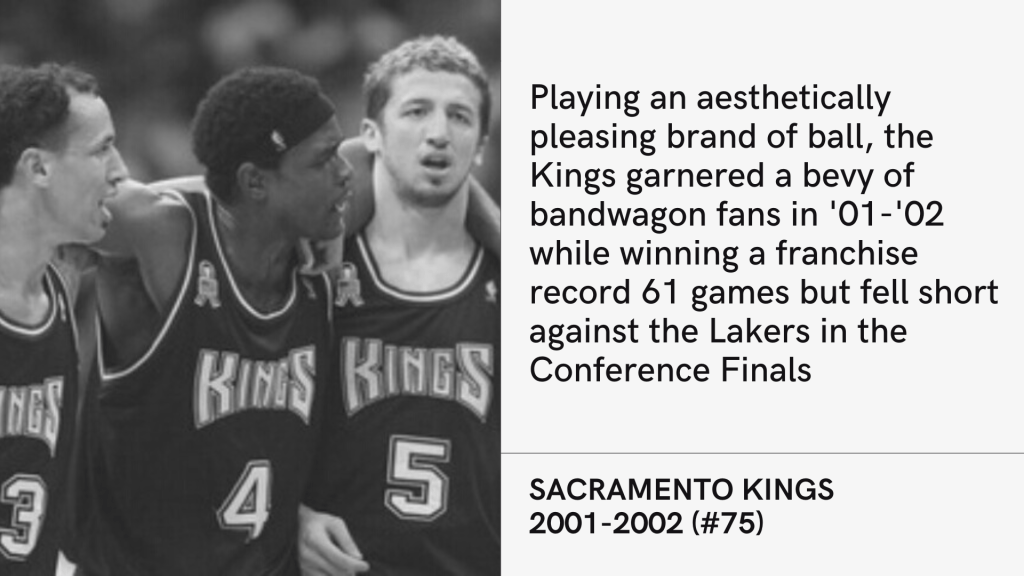
75) ’01-’02 Sacramento Kings
Result: Lost Conference Finals
Key players: Chris Webber, Mike Bibby, Vlade Divac, Peja Stojakovic
This was the culmination of years of careful planning from team president Geoff Petrie, completely rebuilding from scratch a franchise that didn’t win a playoff series in its first 13 years in Sacramento. With smooth passing big men Webber and Divac and play maker Bibby collectively running Rick Adelman’s offensive schemes to perfection, the Kings won a franchise record 61 games in ’01-’02 and entered a competitive postseason as the overall top seed. Their cross-state rivals the Lakers awaited in the Conference Finals and vexed the Kings once again. Sacramento had a 2-1 series lead but dropped game four on a miraculous Robert Horry buzzer beater, then games six and seven on questionable officiating and even more questionable shot selection and turnovers.
74) ’05-’06 Dallas Mavericks
Result: Lost NBA Finals
Key players: Dirk Nowitzki, Josh Howard, Jason Terry, Jerry Stackhouse
Following five straight years of disappointing playoff losses, most notably in the Conference Finals in 2003, the Mavericks seemed to exorcising all their demons in 2006 under new coach Avery Johnson. They survived a thrilling Conference Semifinals series against the rival Spurs, then dispatched the Suns in the Conference Finals to reach the NBA Finals for the first time in franchise history. Prior to that, they had won 60 games with the best offensive rating in the league and, most notably, a top level defense, anchored by Howard and center Erick Dampier. Dallas won the first two games of the Finals easily and held a 12-point lead late in game three when things turned completely at the hands of Dwyane Wade and the officials, and they eventually lost the series in six.
73) ’93-’94 New York Knicks
Result: Lost NBA Finals
Key players: Patrick Ewing, Charles Oakley, John Starks, Derek Harper
In the two-year window of Michael Jordan’s first retirement, perhaps the most tragic near miss of a title was Ewing and the Knicks. This squad as constituted arguably peaked in ’92-’93, when they won 60 games and blew a 2-0 Conference Finals lead to the Bulls and they brought back essentially the same roster for the 1994 playoffs, just swapping out an injured Doc Rivers for Harper. Behind an incredible defense, anchored by Ewing and Oakley and patterned by coach Pat Riley, the Knicks survived seven-game grinds against the Jordan-less Bulls in the Conference Semifinals and the Pacers in the Conference Finals. Perhaps owing to fatigue, they couldn’t overcome the Rockets in the NBA Finals, losing in another seven-game marathon. They trail only the ’03-’04 Pistons and ’98-’99 Spurs as the best defensive rating for a post-merger Finals team.
72) ’04-’05 Phoenix Suns
Result: Lost Conference Finals
Key players: Steve Nash, Amar’e Stoudemire, Shawn Marion, Joe Johnson
After years of fair but middling results, this Suns came seemingly out of nowhere after hiring Mike D’Antoni and signing Nash. Their new point guard was the perfect avatar for their newly adopted high-octane offensive system, and with Stoudemire also emerging as a star in his third season, Phoenix tied the franchise record with 62 wins and secured the top seed in the West. They lost in the Conference Finals to the Spurs in five games and that would end up as their peak, as the next few seasons were marked by injuries, ill-timed suspensions, and questionable roster moves (most notably Johnson getting traded to the Hawks in the 2005 offseason). But this was the roster that set the template for the 21st century run-and-gun, three-point shooting (Quentin Richardson led the league in three-point field goals) offensive philosophy.
71) ’09-’10 Los Angeles Lakers
Result: NBA champions
Key players: Kobe Bryant, Pau Gasol, Lamar Odom, Metta World Peace
After winning the ’08-’09 title, the Lakers attempted to repeat in ’09-’10 by basically running it back. One notable change was swapping out Trevor Ariza, who signed with the Rockets, with World Peace, who was still going by Ron Artest at the time. Bryant supposedly pushed for the World Peace signing after facing off against him in the 2009 Conference Semifinals, and though it wasn’t always perfect it did pay off in the postseason, when the embattled forward made a difference with his defensive intensity and some clutch shots (most notably a buzzer beating put-back that swung the Conference Finals series against Phoenix). For the second straight year an expected coronation series against LeBron James and the Cavaliers was upended by a surprise Finals replacement. This time it was a familiar foe in the aging Celtics, who used their knock-down-drag-out style to push the NBA Finals to seven games, where a career-making performance from Gasol helped the Lakers hang on for back-to-back titles.
70) ’97-’98 Utah Jazz
Result: Lost NBA Finals
Key players: Karl Malone, John Stockton, Jeff Hornacek, Bryon Russell
Similar to the ’09-’10 Celtics, this Jazz team played waning but crafty spoiler in the Conference Finals, sweeping the upstart Lakers to prevent a Michael Jordan-Shaquille O’Neal Finals showdown. Though their three best players, Malone, Stockton, and Hornacek, were all north of 34 years old, this was one of the best teams in Jazz history, winning 62 games with an offensive rating of 112.7. It was also essentially their last stand of the Stockton/Malone era, as they would lose in the second round or earlier in the next five seasons. Save for an embarrassing 96-54 loss in game three, the Jazz kept every Finals game close against Chicago, ultimately dropping in six games when Jordan hit “The Final Shot.” Malone finished second in MVP voting behind Jordan but this was the only ’90s season in which Stockton didn’t get named to the All-NBA team.
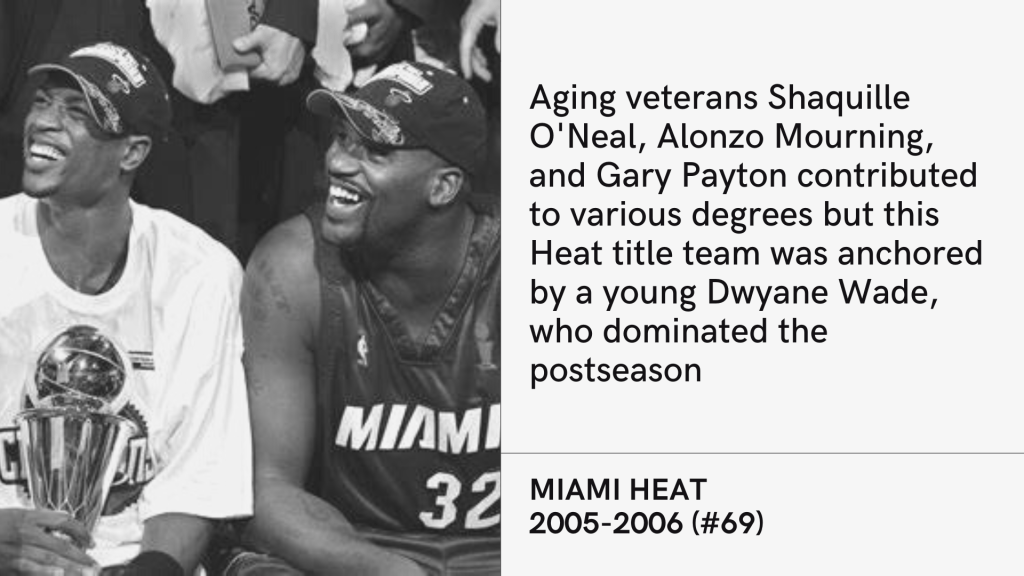
69) ’05-’06 Miami Heat
Result: NBA champions
Key players: Dwyane Wade, Shaquille O’Neal, Antoine Walker, Jason Williams
Just based on perusing the roster of this team and factoring in their championship in a competitive NBA, you’d think they’d rank higher on this list. But O’Neal was at the beginning of the end of his career, averaging career lows in points and rebounds, while Alonzo Mourning and Gary Payton were basically non-entities off the bench. In fact, the ’04-’05 Heat that reached the Conference Finals had a better offensive rating, defensive rating, and simple rating score than this squad. Insinuations about the referees aside, they won the championship thanks to an incredible postseason run from Wade, especially when he averaged 34.7 points per game during the Finals against Dallas and earned MVP honors. There was also some crafty coaching from Pat Riley, who took over midseason from Stan van Gundy.
Our fourth volume will be published throughout the ’21-’22 NBA season
68) ’15-’16 Oklahoma City Thunder
Result: Lost Conference Finals
Key players: Kevin Durant, Russell Westbrook, Serge Ibaka, Steven Adams
Few teams, if any, in NBA history have come as close to reaching the NBA Finals without actually doing so as the ’15-’16 Thunder. Their shortcoming is even more tragic when taking into account that they almost upended the 73-win Warriors in the Conference Finals, and that this was the final appearance ever for Durant before fleeing as a free agent for those same Warriors. The Spurs team they defeated in the Conference Semifinals was one of the last cuts for this list, and those Warriors are in the top 10 despite losing in the NBA Finals. Durant and Westbrook were both at their offensive efficiency peaks this season, while role players Ibaka, Adams, Enes Kanter, and Andres Roberson all played their parts perfectly. If it wasn’t for one stretch of one game where Klay Thompson put on maybe the greatest shooting performance in league history, we may be celebrating this as one of the all-time great champions.
67) ’86-’87 Boston Celtics
Result: Lost NBA Finals
Key players: Larry Bird, Kevin McHale, Robert Parish, Dennis Johnson
This was essentially the last hurrah for the ’80s Celtics and they came up just short of winning a third title in four seasons. Johnson, McHale, and Parish took statistical tumbles after this season, while Bird struggled with injuries for the remainder of his career. Offense was certainly not a problem for this team; in fact, they set the franchise record for offensive rating in ’86-’87. Defense was more of a concern and it came back to bite them in the NBA Finals, when they gave up 100+ points to the Lakers in all six games, including a 141-122 blowout loss in game two. It was a similar story in the Conference Finals against Detroit but the crafty Celtics held off the “Bad Boys” one last time in a brutal seven-game affair.
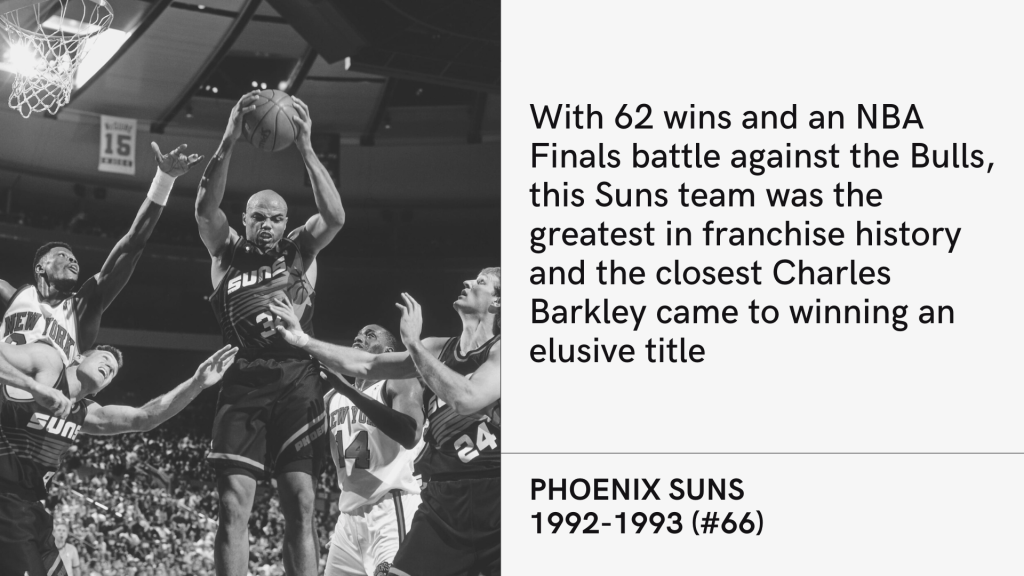
66) ’92-’93 Phoenix Suns
Result: Lost NBA Finals
Key players: Charles Barkley, Kevin Johnson, Dan Majerle, Danny Ainge
This is easily the greatest team in Suns history and non-coincidentally also the most tragic. After adding Barkley via trade, they won a franchise record 62 games to secure the best record in the NBA and their offensive rating of 113.3 was one of the highest in history up to that point. Barkley became the first Suns player to be named MVP while Majerle became the first to lead the NBA in three-point field goals. The postseason turned out to be a slog, starting with surviving a scare from the #8 seed Lakers in the Conference Quarterfinals, followed by tough series wins over the Spurs and Sonics. They put up a strong fight against the Bulls in the NBA Finals, where Barkley arguably outplayed Michael Jordan, but Johnson struggled to overcome injuries and the Suns fell in six games.
65) ’17-’18 Houston Rockets
Result: Lost Conference Finals
Key players: James Harden, Chris Paul, Eric Gordon, Clint Capela
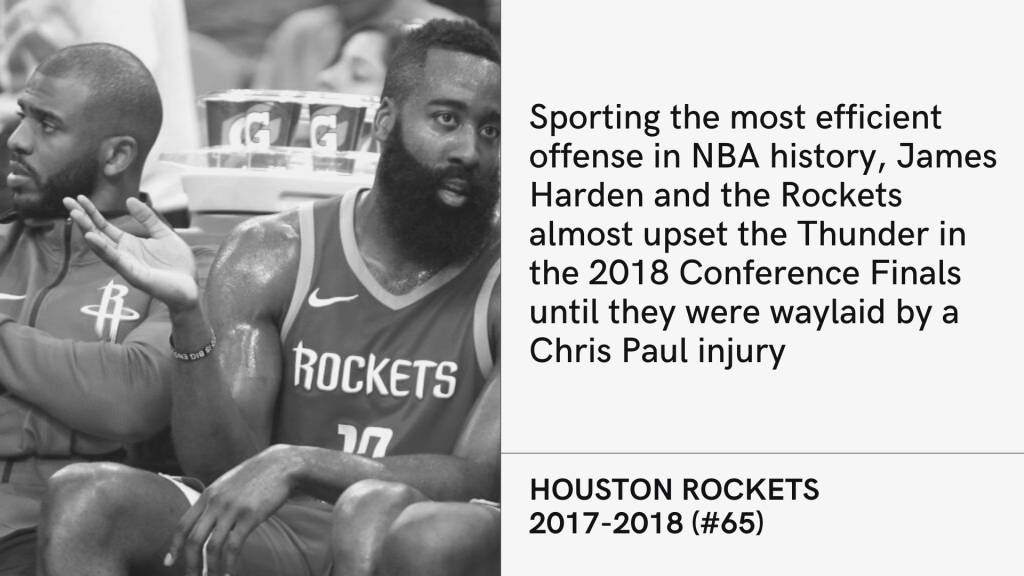
This was the full apotheosis of the modern NBA analytics revolution, a team built entirely around offensive efficiency. The ’17-’18 Rockets absolutely smashed the record for most three-point field goals in a season (a record they had set the year before) and finished with an offensive rating of 114.7, which is the 13th highest all time. The three-guard rotation of Paul, Harden, and Gordon shot the lights out as the Rockets won a franchise record 65 games. In fact, it was the first time in Rockets history that they cracked 60 wins, a feat that even the Hakeem Olajuwon title teams couldn’t pull off. It’s arguable that this would have been your ’17-’18 NBA champions, if not for an ill-timed Paul injury during the Conference Finals that swung the series towards the Warriors.
64) ’07-’08 Los Angeles Lakers
Result: Lost NBA Finals
Key players: Kobe Bryant, Pau Gasol, Lamar Odom, Derek Fisher
Though they didn’t win the championship, losing to the Celtics in six games in the NBA Finals, this was the best Lakers offensive team of the ’00s, with 113.0 offensive rating, plus a post-merger franchise record 7.34 SRS. After two consecutive first round playoff exits, the Lakers were transformed at the deadline in 2008 by trading for Gasol from the Grizzlies. Bryant won his sole MVP award in this season and while Gasol’s stats took a hit in his new role, he was still at his peak best helping the Lakers return to the NBA Finals. Things arguably may have gone differently in the postseason if center Andrew Bynum remained healthy, but the oft-injured youngster missed the entire playoffs with a dislocated kneecap.
63) ’93-’94 Houston Rockets
Result: NBA champions
Key players: Hakeem Olajuwon, Otis Thorpe, Vernon Maxwell, Robert Horry
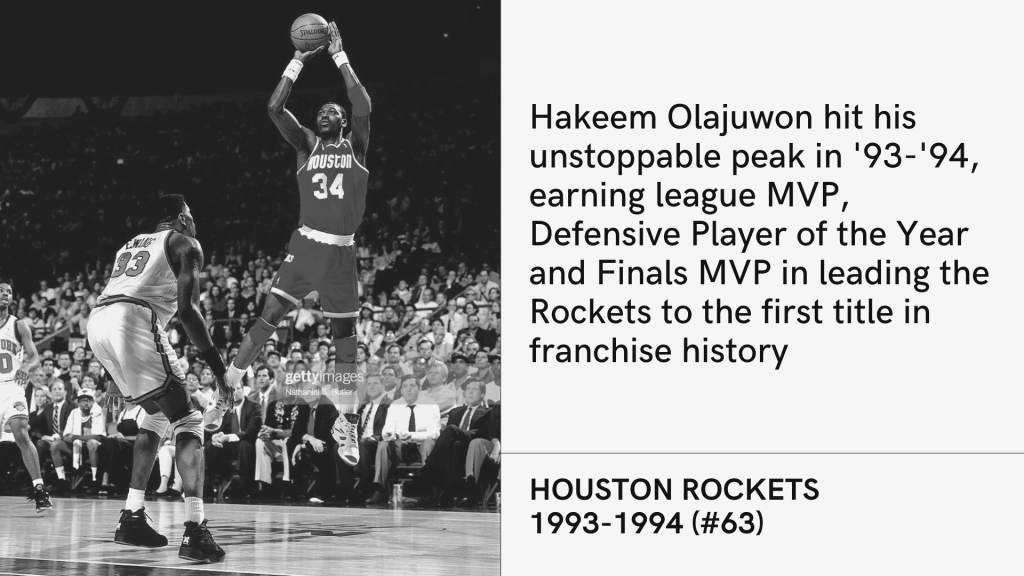
The first championship team in Rockets history was a bit of a one-man show, as Olajuwon put together an impressive season that culminated in winning both league MVP and Finals MVP. There wasn’t too much impressive statistically about this team aside from Olajuwon individually, but they were built perfectly around their star center and just plain winners. The five starters all averaged double-digit scoring in the postseason, while the bench, led by rookie Sam Cassell usually outpaced opponents. The Rockets won a second consecutive championship in ’94-’95 but that roster didn’t make this list as they struggled in the regular season before turning it on in the playoffs.
62) ’11-’12 Oklahoma City Thunder
Result: Lost NBA Finals
Key players: Kevin Durant, Russell Westbrook, James Harden, Serge Ibaka
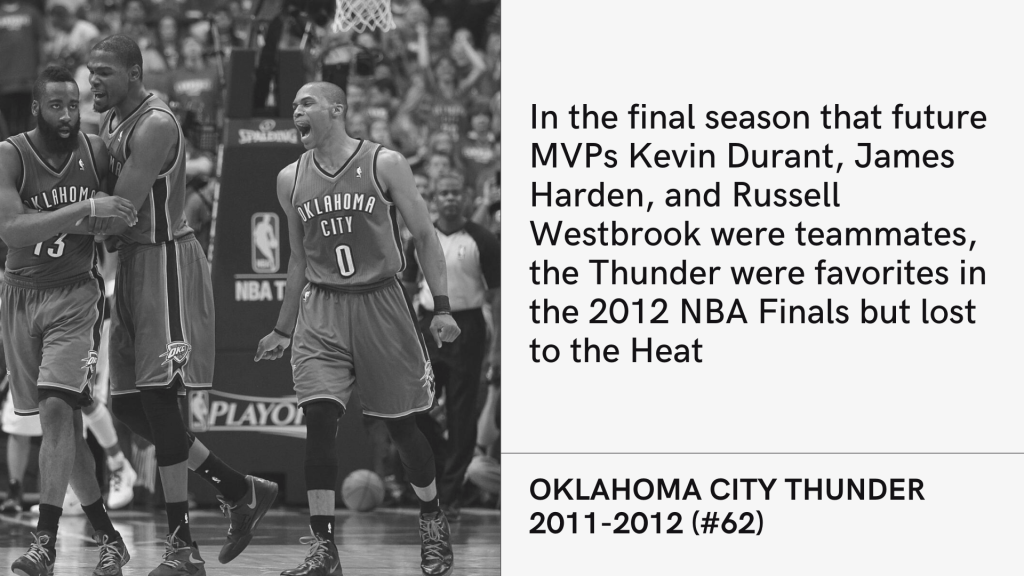
The final Sonics team in ’07-’08 lost 62 games, while the first Thunder team in ’08-’09, featuring rookies Westbrook and Ibaka and a second-year Durant, had a 3-29 record circa New Year’s Eve. Things turned around quickly from there, as they added Harden in the 2009 Draft, won 50 games and reached the playoffs in ’09-’10, then the Conference Finals in 2011. ’11-’12 was the first Thunder season with legitimate expectations and they didn’t disappoint, sporting the second best offense in the league in terms of offensive rating, with Durant winning the scoring title, and Ibaka leading the league in blocks. They dispatched the last good Kobe Bryant Lakers team in the Conference Semifinals, then overcame an incredible Spurs team in the Conference Finals before running into a buzzsaw in the Heat in the NBA Finals. This would ultimately be the peak for this group as Harden was traded in the summer of 2012 to the Rockets.
61) ’81-’82 Los Angeles Lakers
Result: NBA champions
Key players: Magic Johnson, Kareem Abdul-Jabbar, Jamaal Wilkes, Norm Nixon
Coming off a championship in ’79-’80, the Lakers struggled to defend their title in ’80-’81, as Johnson suffered a major knee injury and they were upset by the Rockets in the Conference Semifinals. Coach Paul Westhead attempted to shake up and slow down the offense in ’81-’82 which rankled his young point guard and caused tension amongst all the team’s stars. He was summarily fired by Dr. Jerry Buss and replaced with assistant Pat Riley. Seven months later they were winning the second title of Johnson’s career and the first of four under Riley. The offense was free-flowing again, finishing only behind the run-and-gun Nuggets in most statistical categories, while the defense was still solid with Michael Cooper emerging as an elite perimeter shutdown guy. They easily swept the Suns and Spurs in consecutive playoff series, then cruised over the Sixers in the NBA Finals in six.
60) ’12-’13 San Antonio Spurs
Result: Lost NBA Finals
Key players: Kawhi Leonard, Tony Parker, Tim Duncan, Manu Ginobili
Waiting for the Spurs’ championship window to close shut was a yearly tradition starting shortly after their 2007 title. Then, they not only extended the window but revamped it with the drafting of Leonard in 2011. Built expertly as usual by general manager R.C. Buford, the ’12-’13 Spurs flanked the aging but still effective Duncan with the dynamo Leonard, the now elite Parker, the herky-jerky Ginobili, plus ace role players like Danny Green, Boris Diaw, and Tiago Splitter. This squad was actually a step down statistically from the ’11-’12 team that lost in the Conference Finals in all categories except defense, where Leonard solidified them. Their NBA Finals loss to the Heat was arguably the most razor-thin in league history, with Ray Allen’s miracle three-pointer being the only difference.
59) ’08-’09 Cleveland Cavaliers
Result: Lost Conference Finals
Key players: LeBron James, Mo Williams, Zydrunas Ilgauskas, Delonte West
As good as things got in James’ second era in Cleveland, this was actually the Cavaliers team with the most regular season wins, finishing with a 66-16 record. They cruised to the top seed in the East as James was named league MVP for the first time, then decimated the Pistons and Hawks in playoff sweeps to reach the Conference Finals. Waiting there was a match-up nightmare, as the Magic’s versatile forward duo of Hedo Turkoglu and Rashard Lewis were able to stretch the Cavs thin, while Dwight Howard dominated the middle. Not only is this the best Cavs team in terms of wins, they also set the franchise record for Simple Rating System with an 8.68 score, which is the fifth highest in NBA history for a team that didn’t reach the NBA Finals. Cleveland’s upset loss in the 2010 Conference Semifinals is what ultimately spurred James to Miami but this season was arguably the biggest disappointment of either of his stints there.
58) ’76-’77 Portland Trail Blazers
Result: NBA champions
Key players: Bill Walton, Maurice Lucas, Lionel Hollins, Bob Gross
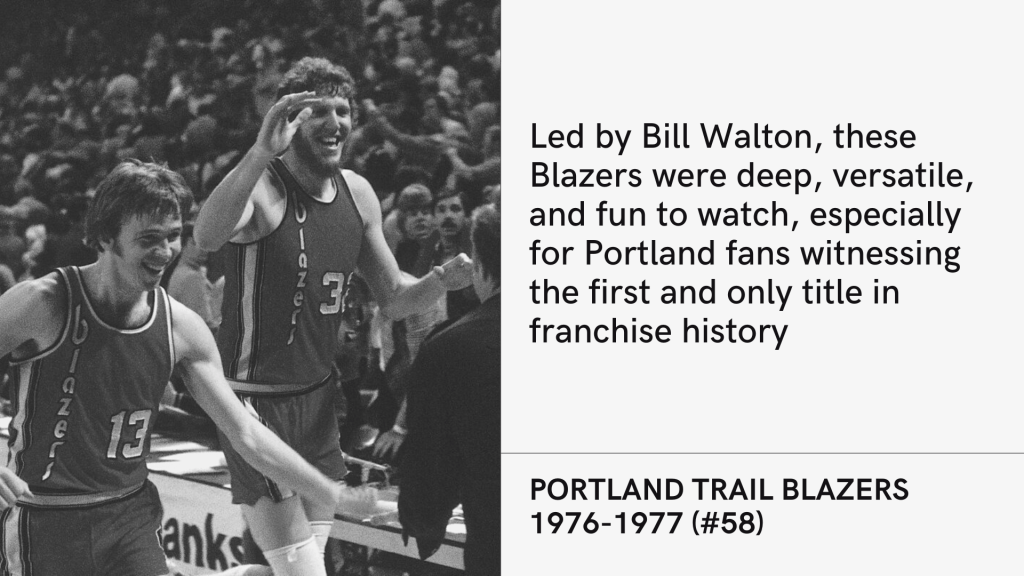
They won just 49 games, captured their championship in arguably the weakest era of NBA history, and featured only two All-Star players, but this Blazers team is as beloved as maybe any title team. A large part of that is in being the only title team in Blazers history and the other factor is that this would constitute most of Walton’s short prime, as injuries derailed the remainder of his Hall of Fame career. Though their free-flowing, heavy-passing offense is often the focal point, it was defense that carried these Blazers to glory. They were hardly world-beaters in the regular season, finishing with the #3 seed in the West, but dominated in the playoffs, taking down the Nuggets and Lakers, the latter in a sweep, before upsetting the 76ers in the NBA Finals.
57) ’10-’11 Miami Heat
Result: Lost NBA Finals
Key players: LeBron James, Dwyane Wade, Chris Bosh, Mario Chalmers
The much-ballyhooed combination of James, Wade, and Bosh brought with it an infamous pep rally where the trio promised multiple titles to the city of Miami. Things got off to a rocky start in ’10-’11 as the supporting cast was lacking, but this was still undoubtedly an all-timer team. James took a bit of a step back adjusting to life as not the sole offensive threat, but his stats were still incredible and he sorted things out with Wade and Bosh as the season wore on. Prior to the NBA Finals they had little issue in the playoffs, including a five-game series victory over the top-seeded Bulls in the Conference Finals. Even though they weren’t at 100% yet, it would take a perfect effort from an opponent to topple this team and it happened in the Finals, when Dirk Nowitzki and the Mavericks pulled off the unlikely.
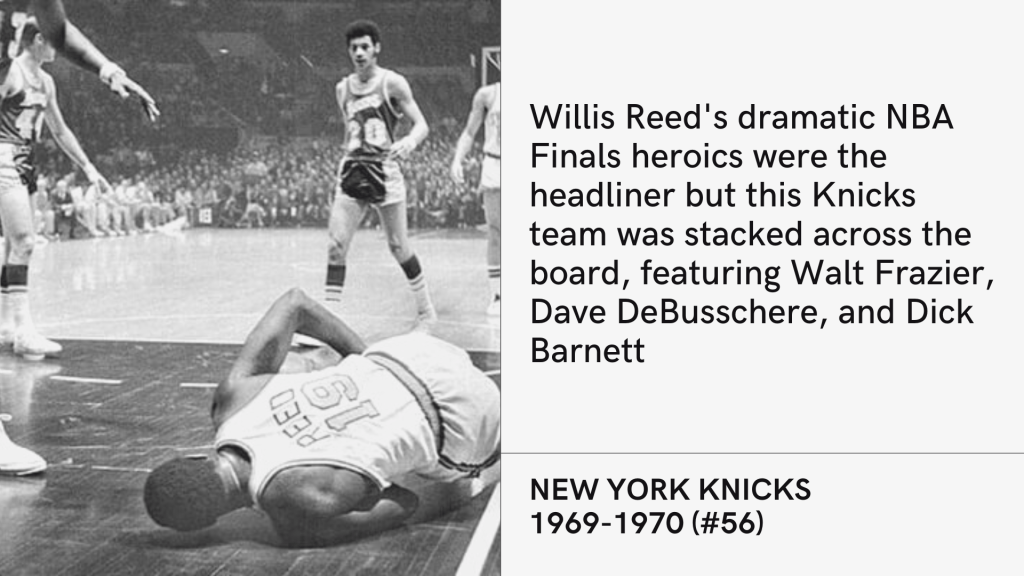
56) ’69-’70 New York Knicks
Result: NBA champions
Key players: Willis Reed, Walt Frazier, Dave DeBusschere, Dick Barnett
Owing largely to their being the first title team from New York, these Knicks are one of the most overrated teams in NBA history, but certainly still deserve inclusion here. Spurred by the dynamic duo of smooth point guard Frazier and bruising center Reed, plus an expertly built veteran supporting cast of DeBusschere, Barnett, Bill Bradley, and Cazzie Russell, the ’69-’70 Knicks cemented themselves in New York sports history with a memorable playoffs run. That included surprisingly difficult series wins against the Bullets and Bucks, and was capped by Reed’s dramatic return from injury in game seven of the NBA Finals, as the Knicks felled the Lakers.
55) ’60-’61 Boston Celtics
Result: NBA champions
Key players: Bill Russell, Tom Heinsohn, Bob Cousy, Bill Sharman
The lowest-ranked of seven Russell-led Celtics teams on this list, the ’60-’61 squad were notably the weakest offensively of the era. Not that it mattered in the standings, as they easily led the NBA with 57 wins, then destroyed the Syracuse Nationals in the Conference Finals and St. Louis Hawks in the NBA Finals. Russell earned his second of five MVP awards and Sam Jones started to step up his offense. This was also notable as Sharman’s final season, ending it with his fourth title, and the year Cousy started to lose a step at age 32, as he didn’t lead the league in assists for the first time in eight years.
54) ’84-’85 Boston Celtics
Result: Lost NBA Finals
Key players: Larry Bird, Kevin McHale, Robert Parish, Dennis Johnson
This squad was slightly better than the ’83-’84 title team offensively, but slightly worse defensively to even it out. There was some strife right before the season started as longtime backup point guard Gerald Henderson was traded to the Sonics, while first round pick Michael Young was waived. They actually improved on wins from the year before, from 62 to 63, and signing veteran guard Ray Williams was key down the stretch, but they ran into a determined Lakers team in the NBA Finals. The series started with the Memorial Day Massacre win for Boston, but the Lakers took four of the next five games, including two in the Boston Garden. Bird won his second of three consecutive MVP trophies in ’84-’85, while leading the NBA in PER and win shares.
53) ’03-’04 Detroit Pistons
Result: NBA champions
Key players: Chauncey Billups, Ben Wallace, Richard Hamilton, Rasheed Wallace
Already title contenders in ’02-’03, the Pistons took it to the next level in ’03-’04 with their trade deadline deal for Wallace. He was languishing on the Hawks at the time and was just the offensive injection needed in the Pistons lineup that featured guards Billups and Hamilton, stout center Wallace, and small forward Tayshaun Prince. It’s notable that this was the lowest rated post-merger team on this list in terms of offensive rating but the highest in defensive ranking. They absolutely handcuffed opponents, centered literally and figuratively around Wallace, a four-time Defensive Player of the Year winner. Hamilton was the hero in the Conference Finals, consistently knocking down huge jumpers while hampering Reggie Miller in a six game victory over the Pacers, while Billups came up huge in the NBA Finals upset of the Lakers, earning Finals MVP honors. Though they wouldn’t win another title, this core squad eventually reached at least the Conference Finals in six straight seasons.
52) ’91-’92 Portland Trail Blazers
Result: Lost NBA Finals
Key players: Clyde Drexler, Terry Porter, Jerome Kersey, Buck Williams
Though the ’89-’90 Blazers team that also reached the NBA Finals won more games, as did the ’90-’91 edition with essentially the same roster, this was the best of the ’90s Portland teams. Drexler peaked in ’91-’92, finishing second in MVP voting behind Michael Jordan, while the supporting cast of Porter, Kersey, Williams, Kevin Duckworth, Cliff Robinson, and Danny Ainge was never better. On paper, they matched up well against the Bulls in the NBA Finals but in practice, of course, a motivated Jordan was nearly impossible to overcome. This core group would not win another playoff series together again and Drexler was eventually traded to Houston. 1992 was also Portland’s last NBA Finals appearance, as of this writing, despite Conference Finals appearances in 1999, 2000, and 2019.
51) ’87-’88 Los Angeles Lakers
Result: NBA champions
Key players: Magic Johnson, James Worthy, Byron Scott, Kareem Abdul-Jabbar
It took a couple lucky breaks for these Lakers to be fifth and final title team of the Showtime era. Most notable was an injury to Isiah Thomas in the NBA Finals, which limited the star point guard late in the series and allowed the Lakers to escape in seven games. Before they even got to that point, Los Angeles had to battle through seven-game series against the Jazz in the Conference Semifinals and Mavericks in the Conference Finals. This was especially redeeming to coach Pat Riley, who had guaranteed these Lakers would become the first team since the ’68-’69 Celtics to repeat as champs. Also notable is that this was the season in which Abdul-Jabbar turned 40 years old though he’d stick one around for one more year, retiring after the Lakers lost in the 1989 Finals rematch against Detroit.
50) ’52-’53 Minneapolis Lakers
Result: NBA champions
Key players: George Mikan, Slater Martin, Jim Pollard, Vern Mikkelsen
This was not the best of the five Mikan-era Lakers championship teams but they finish a close second. Mikan himself was actually starting to slip at this point as the NBA had widened the lane one season earlier in response to his dominance. He averaged a then career low 20.6 points per game but did lead the league in rebounding at 14.4 per game. Thanks to a balanced scoring attack, the Lakers were still effective offensively while dominating on the defensive end, as Mikan was able to take full advantage of the new rule to even further annihilate opponents in the paint with his size and length. They got a tough fight from the Pistons in the Conference Finals but advanced by holding them to 58 points in the winner-take-all game five, then eased past the Knicks in the NBA Finals for a fourth title in five years.
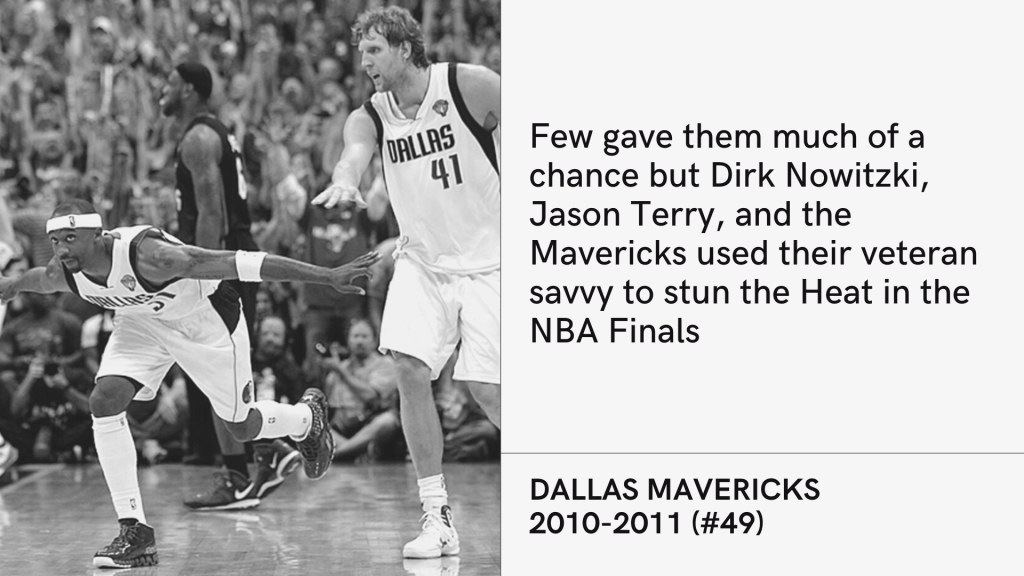
49) ’10-’11 Dallas Mavericks
Result: NBA champions
Key players: Dirk Nowitzki, Jason Terry, Tyson Chandler, Shawn Marion
On paper heading into the season, this team was quite a long-shot to make this list. Most pundits had written off Nowitzki and the Mavericks as no longer a title contender but they stunned the world, especially in the NBA Finals against LeBron James and the Heat. The key difference between this team and past Mavs squads was Chandler, still in his dominant defensive prime, who was acquired via trade from the Bobcats in July of 2010. With Chandler and Marion providing stout defense, while the veteran Kidd was a steady hand at point guard, it came down to Nowitzki and Terry shooting lights out against Miami, while role players like J.J. Barea and DeShawn Stevenson also provided unlikely heroics.
48) ’73-’74 Milwaukee Bucks
Result: Lost NBA Finals
Key players: Kareem Abdul-Jabbar, Bob Dandridge, Lucius Allen, Oscar Robertson
Advanced metrics love the early ’70s Bucks. Even though this team won just 59 games and were (slightly) upset by the Celtics in the NBA Finals, they still secured a place in top 50 thanks to their SRS and defensive rating. Abdul-Jabbar won his third MVP award in ’73-’74 and joined Bill Russell as the second player to earn MVP and then lose in the subsequent NBA Finals. This was the final season of the aging Robertson’s career but Dandridge and Allen were in their absolute prime. In fact, a late season knee injury to Allen was likely the difference in the NBA Finals against Boston as his replacement, Mickey Davis, struggled to contribute.
47) ’98-’99 San Antonio Spurs
Result: NBA champions
Key players: Tim Duncan, David Robinson, Sean Elliott, Avery Johnson
Many would prefer to always add an asterisk next to this Spurs team, but it’s even more impressive that they were this good in a lockout-shortened season. The “Twin Towers” of Duncan and Robinson were never better as a duo, even as Duncan was playing in just his second season. Oft overlooked veterans Elliott (who hit the “Memorial Day Miracle” game winner in the Conference Finals) and Johnson (who clinched the NBA Finals with a last second three-pointer in game five) were also crucial to this team’s success, as were similarly cast off role players like Mario Elie, Steve Kerr, and Jaren Jackson. You can quibble over just how stout the competition was for San Antonio in the postseason but there’s no doubt they stomped it, losing just two playoff games total en route to the title. Though this is, in many ways, the most beloved of the Spurs’ five title teams, it is also the weakest.
46) ’58-’59 Boston Celtics
Result: NBA champions
Key players: Bill Russell, Bob Cousy, Frank Ramsey, Bill Sharman
After losing the 1958 NBA Finals to the Hawks, Russell and the Celtics were out to prove that their 1957 title wasn’t a one-time fluke. They did so convincingly, becoming the second team ever to win 50 regular season games (in just a 72-game schedule back then), with Russell, Cousy, and Sharman all earning 1st-Team All-NBA honors. As a team, Boston led the NBA in scoring, rebounding, and assists, and were dominant in defensive rating. The Conference Finals were surprisingly tough, with Dolph Schayes and the Nationals forcing a full seven games, but the NBA Finals were an easy sweep over a rookie Elgin Baylor and the Lakers. It was the first of seven occasions in the Russell era that the Celtics knocked out the Lakers in the Finals.
45) ’95-’96 Seattle SuperSonics
Result: Lost NBA Finals
Key players: Gary Payton, Shawn Kemp, Detlef Schrempf, Hersey Hawkins
Michael Jordan notably laughed them off as a non-threat in the documentary “The Last Dance,” but this Sonics team was incredible and just had the misfortune of peaking the same year the Bulls were unstoppable 72-game winners. They set a still-standing franchise record with 64 wins, swept the defending champion Rockets in the Conference Semifinals and then held off the Jazz in seven games in the Conference Finals. It was a sweet redemption for the same core roster that had been stunned as a #1 seed in the first round by the Nuggets two years prior. Payton was named Defensive Player of the Year while Kemp joined him on the 2nd-Team All-NBA list. A trade of Kendall Gill for Hawkins had also really solidified the rotation, which also included the wily Schrempf, veteran postman Sam Perkins, and franchise legend Nate McMillan. They fell behind 3-0 to the Bulls before getting their footing and turning the series into a fight, ultimately losing in six games.
44) ’18-’19 Toronto Raptors
Result: NBA champions
Key players: Kawhi Leonard, Kyle Lowry, Pascal Siakam, Marc Gasol
There was little to cheer for in the first 20 years of Raptors history and in the mid ’10s that transitioned into perennial postseason disappointments against superior, LeBron James-led teams. That all changed in ’18-’19, thanks to the greatest one-year rental in NBA history with Leonard, some other shrewd roster moves, James’ departure for the Lakers, and some timely injuries to multiple Warriors stars. Credit also here to Nick Nurse, who established himself as one of the premier coaches in the NBA by guiding essentially a completely remade roster to 58 wins and a title. This team didn’t do any one thing particularly great but did everything well and ran an impressive eight deep in the playoff rotation. Leonard, after a disastrous ’17-’18 with the Spurs, re-established himself as one of the league’s biggest stars, nailing an improbable buzzer beater against the 76ers in the Conference Semifinals, then outplaying Giannis Antetokounpmo and Stephen Curry in subsequent series and earning Finals MVP for a second time. Would they have won the title if Kevin Durant and Klay Thompson had stayed healthy? It’s unlikely but that’s the breaks of the game and still jubilant Raptors fans pay it no mind.
43) ’79-’80 Los Angeles Lakers
Result: NBA champions
Key players: Kareem Abdul-Jabbar, Magic Johnson, Jamaal Wilkes, Norm Nixon
What do you get when you pair a once-in-a-generation rookie talent with a six-time MVP on a roster that also featured two other All-Stars? You get not only the first of five Lakers championships in the Showtime era, but one of the 50 greatest teams in NBA history. In probably the greatest post-merger performance by a rookie, Johnson instantly remade this Lakers team, which had been floundering in early playoff exits in previous years despite the considerable talent already there. Most notably, he stepped in at center for an injured Abdul-Jabbar in the NBA Finals, clinching the series in game six with a magnificent performance that earned Finals MVP honors. There were some growing pains here for Johnson and Nixon as dual play makers and this was statistically the worst of the ’80s Lakers title teams, but their dominant postseason is undeniable.
42) ’89-’90 Detroit Pistons
Result: NBA champions
Key players: Isiah Thomas, Joe Dumars, Bill Laimbeer, Dennis Rodman
The second of the “Bad Boys” title teams lacked the dominance of the original, perhaps owing to Pat Riley’s infamous “disease of more” but they pushed through and won the title all the same. This was thanks to veteran leadership and continuity, as essentially the same roster returned from the year before with one notable exception of Rick Mahorn, who was stolen away by the Timberwolves in the expansion draft. Though vets like Laimbeer, Vinnie Johnson, Mark Aguirre, and James Edwards were noticeably on the tail end of their career, youngsters like Dumars and Rodman were still coming into their own at this point and helped drive the defensive intensity (Rodman won Defensive Player of the Year while Dumars was 1st-Team All-Defensive). They deployed the “Jordan Rules” to hold off the Bulls one last time in the Conference Finals, then dispatched the Blazers in five games that were all relatively close affairs.
41) ’62-’63 Boston Celtics
Result: NBA champions
Key players: Bill Russell, Sam Jones, Tom Heinsohn, Bob Cousy
This Celtics season was notable amongst the Russell era years for two reasons. One, it was Cousy’s final season, which he announced before it started, and the rookie year for John Havlicek, in a passing of the play making torch. Second, it was the year they scarcely survived a Conference Finals scare from Oscar Robertson and the Royals, pulling away late to win the decisive game seven thanks to 47 points from Jones. For the second straight year the Lakers were waiting in the NBA Finals and gave Boston a fight before ultimately succumbing in six games. Though this team had the best offensive rating of any ’50s or ’60s Celtics squad, it was still a transitional year overall, as Cousy was obviously laboring while Havlicek was getting his feet wet. This would seem to be their ultimate battle station overlap roster but higher levels of dominance were actually behind them and soon lay ahead.
40) ’00-’01 Los Angeles Lakers
Result: NBA champions
Key players: Shaquille O’Neal, Kobe Bryant, Derek Fisher, Rick Fox
Anyone who closely followed the 2001 postseason likely sees this ranking as too low. The Lakers decimated their playoff opponents this season, losing just one game across four series, sweeping tough teams in Portland, Sacramento, and San Antonio. But this was an especially weak regular season to balance it out, with Bryant missing 14 games due to injuries and a viral infection, and O’Neal going full-on coasting mode, showing up to training camp out of shape and building up towards the playoffs. This was also the year of the failed Isaiah Rider experiment, which ended with the guard suspended for drug use and left off the postseason roster. None of this mattered come spring however, with the Lakers crushing the opposition en route to their second straight championship.
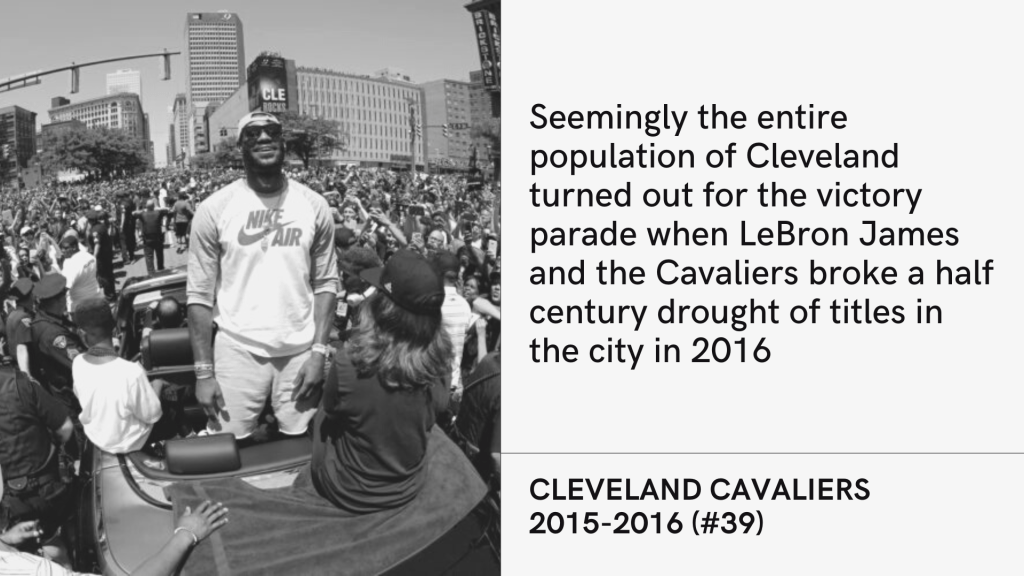
39) ’15-’16 Cleveland Cavaliers
Result: NBA champions
Key players: LeBron James, Kyrie Irving, Kevin Love, Tristan Thompson
One thing about the two James eras in Cleveland, is that the teams in his younger days had much better regular seasons but the teams in his later days turned it on come playoffs time. Obviously, Cavs fans will take the latter and it paid off in the ultimate way with a championship in 2016. This was the second of four consecutive Finals match-ups between the Cavaliers and Warriors and the only one where they had a chance, as the 2015 Finals were marred by injuries to Irving and Love and the 2017 and 2018 editions of Golden State were just plain unstoppable. As good as this team was on paper and as much as they dominated the East in the playoffs, the Cavs were heavy underdogs against the 73-win Warriors in the Finals. They pulled off the near impossible in the span of a few days, overcoming a 3-1 series deficit, shocking the Warriors, and bringing an improbable championship to the city of Cleveland. A well-timed suspension to Draymond Green certainly helped, but all credit is due to the big three stars of this time coming up huge in the clutch, especially in game seven, plus stellar performances from role players Thompson, J.R. Smith, Richard Jefferson, and Channing Frye. The ’08-’09 Cavs were better in every way statistically, but this is the team that lives on forever as the first Cleveland basketball champs.
38) ’80-’81 Boston Celtics
Result: NBA champions
Key players: Larry Bird, Kevin McHale, Robert Parish, Cedric Maxwell
In the latest of a string of infamous coups, Red Auerbach stacked his roster for the decade in June of 1980, when he traded two first round picks to the Warriors in exchange for Parish and the #3 pick, which he used on McHale. It paid immediate dividends, as the two acquisitions teamed up with second-year star Bird in the front court to lead the Celtics to 62 wins and the ’80-’81 championship. The back court featured Maxwell, who was named Finals MVP, plus Tiny Archibald and Gerald Henderson. After an incredible Conference Finals against the Sixers, where the Celtics improbably erased a 3-1 series deficit, they got lucky in the NBA Finals in that the Western bracket had been completely upended and their opponent was a Rockets team that had finished below .500 in the regular season. Though this team falls amongst the all-time greats, it’s also far below the other two Celtics title squads of the ’80s.
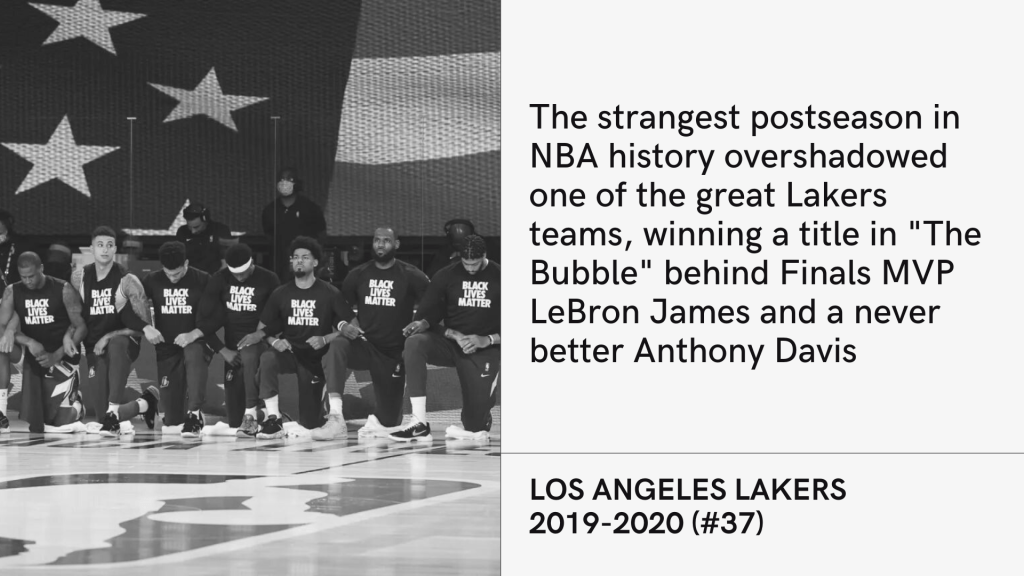
37) ’19-’20 Los Angeles Lakers
Result: NBA champions
Key players: LeBron James, Anthony Davis, Rajon Rondo, Kyle Kuzma
’19-’20 was arguably the weirdest season in NBA history, bifurcated by a deadly virus and closed out in a “bubble” on the campus of Walt Disney World. But it ended in two familiar ways: with the Lakers as champions for a record tying 17th time, and LeBron James earning his fourth Finals MVP. It wasn’t the most talented on paper supporting cast James ever had but it was arguably the most compatible. He was surrounded by shooting specialists like Kuzma and Kentavious Caldwell-Pope, defensive specialists like Rondo and Dwight Howard, and some who split the difference, like Danny Green. There was also the secondary scorer and defensive anchor Davis, whose inside game was a perfect complement to James’ play making (for the first time in his career, he averaged 10+ assists per game, leading the league).
36) ’71-’72 Milwaukee Bucks
Result: Lost Conference Finals
Key players: Kareem Abdul-Jabbar, Bob Dandridge, Lucius Allen, Oscar Robertson
The greatest team of all-time that didn’t reach the NBA Finals, the ’71-’72 Bucks were just unfortunate that they ran into one of the five overall greatest teams in history in the Conference Finals. That opponent was the Lakers, whose record 33-game regular season winning streak was actually snapped by the Bucks in January of 1972. But Los Angeles won the other four regular seasons matchups against Milwaukee, beat them out by six games for the top seed in the West, and then eliminated them in the Conference Finals in six games, with two of those Lakers wins coming down to the final possession. Still in just his third NBA season, Abdul-Jabbar won his second consecutive scoring title (with a career high 34.8 points per game) and MVP, while Dandridge and Allen had breakout seasons. Robertson was still effective in the regular season, but the 33-year-old did struggle some in the playoffs, especially against Jerry West. Their simple rating system of 10.70 is the sixth highest for any team in NBA history.
35) ’02-’03 San Antonio Spurs
Result: NBA champions
Key players: Tim Duncan, Tony Parker, Manu Ginobili, David Robinson
The season started with franchise legend Robinson announcing he would retire at the end, and the subsequently inspired Spurs sent him off as a two-time champion. This was arguably Duncan’s individual peak, averaging 23.3 points and a career-high 12.9 rebounds per game while earning MVP and Finals MVP. It was also the (relatively quiet) rookie season for Ginobili, and the breakout season for Parker, who had to deal with rumors that the Spurs were going to sign Jason Kidd in the offseason to replace him. Thus, we transitioned from the “Twin Towers” to the “Big Three,” and this was also the first season the Spurs moved from the cavernous Alamodome to the AT&T Center. While the NBA Finals opponent, the Nets, were relatively weak, the Western Conference opposition was as tough as ever, with the Spurs eliminating solid Lakers and Mavericks teams in succession.
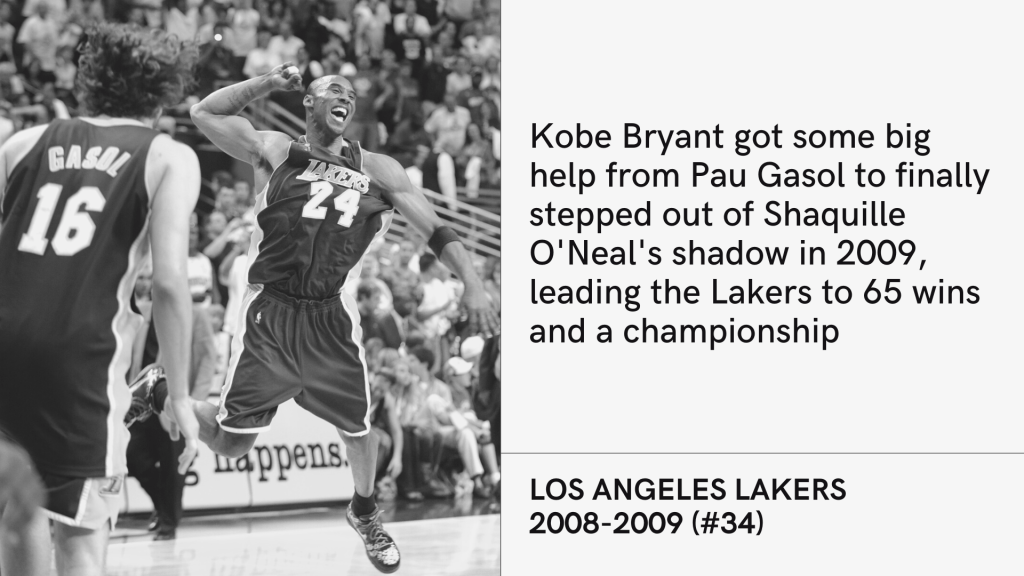
34) ’08-’09 Los Angeles Lakers
Result: NBA champions
Key players: Kobe Bryant, Pau Gasol, Lamar Odom, Trevor Ariza
Following a disappointing loss to the Celtics in the 2008 NBA Finals, Bryant and the Lakers left little to chance in ’08-’09. They started the season with wins in 14 of their first 15 games, eventually finishing with a 65-17 record while ranking near the top of the leaderboard in both offensive rating and defensive rating. The West playoffs weren’t easy, with the Rockets and Nuggets providing surprisingly stout challenges, but the NBA Finals opponent was a surprising and overwhelmed Magic team that couldn’t contain Bryant and Gasol. Though this team lacked the down-the-roster star power of the ’80s or early ’00s Lakers, they were comparable statistically in almost every way, especially in terms of efficiency.
33) ’63-’64 Boston Celtics
Result: NBA champions
Key players: Bill Russell, Sam Jones, John Havlicek, Tom Heinsohn
In their first season without legendary point guard Bob Cousy, the Celtics established their dominance even further by spreading out the scoring (eight players averaged eight-plus points per game) and cranking up the defensive pressure. New point guard K.C. Jones had a breakout season as a defensive specialist, as did combo forward Satch Sanders, while Havlicek and Sam Jones took the reins as the top scorers. This was the first season that Russell faced off with Wilt Chamberlain in the NBA Finals, as the Celtics dispatched the Warriors in five games.
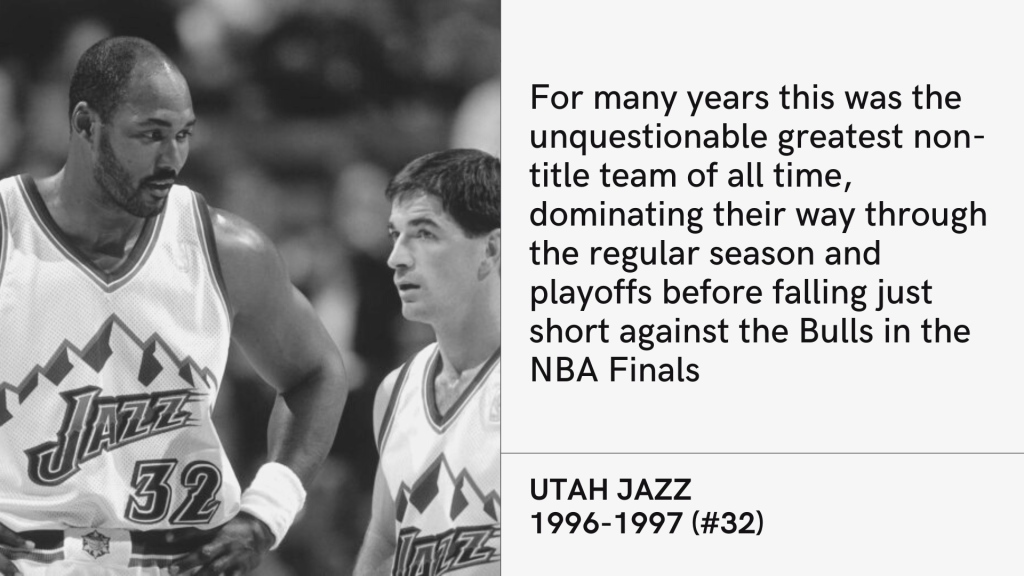
32) ’96-’97 Utah Jazz
Result: Lost NBA Finals
Key players: Karl Malone, John Stockton, Jeff Hornacek, Bryon Russell
It was a bit cruel that Stockton and Malone were already in the late stages of their career when the Jazz supporting cast was finally perfectly built around them. Even more barbarous is that this peak came just as Michael Jordan had returned and the Bulls were virtually unstoppable. This Jazz team came as close as anyone to dethroning Chicago, tying the series at 2-2 before losing the last two games by a combined six points. Prior to that, Utah’s 64 wins was a franchise record and they looked dominant against strong Western Conference opponents in the postseason, including knocking out the Rockets in six games in the Conference Finals, ending it with a Stockton buzzer beater. They are the second greatest non-champions on our list, trailing only the legendary ’15-’16 Warriors.
31) ’92-’93 Chicago Bulls
Result: NBA champions
Key players: Michael Jordan, Scottie Pippen, Horace Grant, B.J. Armstrong
The third and final installment of the original Bulls trilogy of titles was the weakest of their six championship teams. Though Jordan, Pippen, and Grant were in their absolute primes, they struggled in the regular season, winning just 57 games, which landed them at the #2 seed in the East. They then rallied in the postseason, winning two of the toughest playoff series of the Jordan era, a Conference Finals brawl against the Knicks, followed by an NBA Finals tilt with Charles Barkley and the Suns. An exhausted Jordan retired after the season to play baseball, leaving Pippen to carry the torch for the better part of two years.
30) ’11-’12 Miami Heat
Result: NBA champions
Key players: LeBron James, Dwyane Wade, Chris Bosh, Shane Battier
With the supporting cast still struggling to coalesce, the James-Wade duo still not at full capacity, and the disappointment of the 2011 NBA Finals still hanging over their heads, the Heat were in trouble in the 2012 postseason. But James and crew kept finding a second gear, first holding off a young, upstart Pacers team in the Conference Semifinals, before rallying from a 3-2 series deficit to overcome the Celtics in the Conference Finals. The Thunder and their own “big three” awaited in the NBA Finals but after a game one loss the Heat poured it on, winning four straight thanks to James’ dominating performance coupled with surprising clutch input from Battier, Mario Chalmers, and Mike Miller. This Heat team had the lowest offensive rating of any champion of the ’10s, but also the best defensive rating.
29) ’83-’84 Boston Celtics
Result: NBA champions
Key players: Larry Bird, Kevin McHale, Robert Parish, Cedric Maxwell
They had won a title previously in ’80-’81 but this is the season that the ’80s Celtics dynasty really took flight. Bird won his first of three consecutive MVP awards, while McHale was named Sixth Man of the Year. Two bold moves in June of 1983 really spurred this team to greatness: firing Bill Fitch as head coach and replacing him with K.C. Jones, and trading for Dennis Johnson from the Suns. Their 1984 NBA Finals victory over the Lakers featured many of the rivalry’s most memorable moments, from a Gerald Henderson steal from James Worthy that swung game two, to McHale’s clothesline takedown of Kurt Rambis, to the infamous 97 degree conditions in the Boston Garden for game five.
28) ’17-’18 Golden State Warriors
Result: NBA champions
Key players: Kevin Durant, Stephen Curry, Draymond Green, Klay Thompson
With MVPs Durant and Curry perfectly mingling on the court, alongside All-Stars Thompson and Green, a championship in ’17-’18 seemed like a formality for the Warriors, barring a major injury. All four stars struggled to stay on the court during the regular season as the team won just 57 games, but they managed to not only stay healthy for the duration of the postseason, they were actually assisted along the way by an ill-timed injury to Chris Paul, just as the Rockets seemed primed to stun them in the Conference Finals. Watching the fully operational Warriors sweep LeBron James and the Cavaliers in the 2018 NBA Finals was akin to witnessing John Henry not only get defeated by the steam engine drill, but run over by it for good measure.
27) ’01-’02 Los Angeles Lakers
Result: NBA champions
Key players: Shaquille O’Neal, Kobe Bryant, Derek Fisher, Robert Horry
Though the Bryant-O’Neal relationship was starting to fissure at this point, due in large part to Shaq showing up to camp out of shape and not taking the regular season seriously at all, this was still the best of the three consecutive Lakers title teams statistically. There were other issues here too, like free agent signee Mitch Richmond being completely washed up, but the Lakers won 16 of their first 17 games before effectively hitting cruise control and finishing with the #2 seed in the West. They crushed the Trail Blazers in the Conference Quarterfinals and then the Spurs in the Conference Semifinals, taking down an at-his-peak Tim Duncan, before barely surviving the Kings in the Conference Finals, thanks in some measure to the refs. O’Neal put on as dominant a performance as ever in the NBA Finals sweep of the Nets to earn his third consecutive Finals MVP trophy.
26) ’64-’65 Boston Celtics
Result: NBA champions
Key players: Bill Russell, Sam Jones, John Havlicek, Satch Sanders
Though this was the Russell Celtics team selected for inclusion in the NBA’s 1997 list of the 10 greatest teams of all time, they come in only third in the dynasty history by our metrics. This is the season that Jones, despite already being 31 years old, took over as an offensive force, leading the Celtics in regular season scoring and in the postseason at 28.6 points per game. Their 62 regular season wins set the franchise record (it was broken eight years later) and was 13 games ahead of the next closest team in the NBA, but they got an unexpected battle from Wilt Chamberlain and the 76ers in the Conference Finals, just squeaking out of trouble in seven games thanks to Havlicek’s legendary late steal.






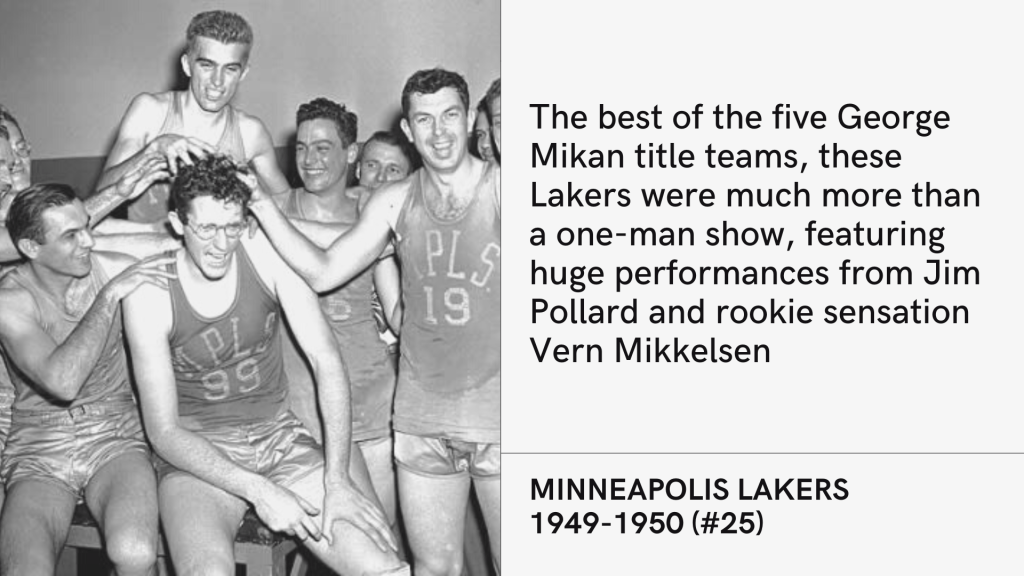



25) ’49-’50 Minneapolis Lakers
Result: NBA champions
Key players: George Mikan, Vern Mikkelsen, Jim Pollard, Arnie Ferrin
In the first season of the newly minted NBA, formed by a merger of the BAA and NBL, the Lakers asserted themselves as the dominant force and a dynasty to be reckoned with. At the center of it was Mikan, who won his second consecutive scoring title with 27.4 points per game (only one other player in the entire league even scored 20+ per game that season). He had even more help in the front court in ’49-’50 thanks to the presence of rookie power forward Mikkelsen, in addition to the always reliable Pollard, who was named 1st-Team All-NBA alongside Mikan. The Lakers got a break in the playoffs when their biggest rival, the Rochester Royals, were upset early, allowing them to skate through to the NBA Finals, where they defeated a tough Syracuse Nationals team in six games.
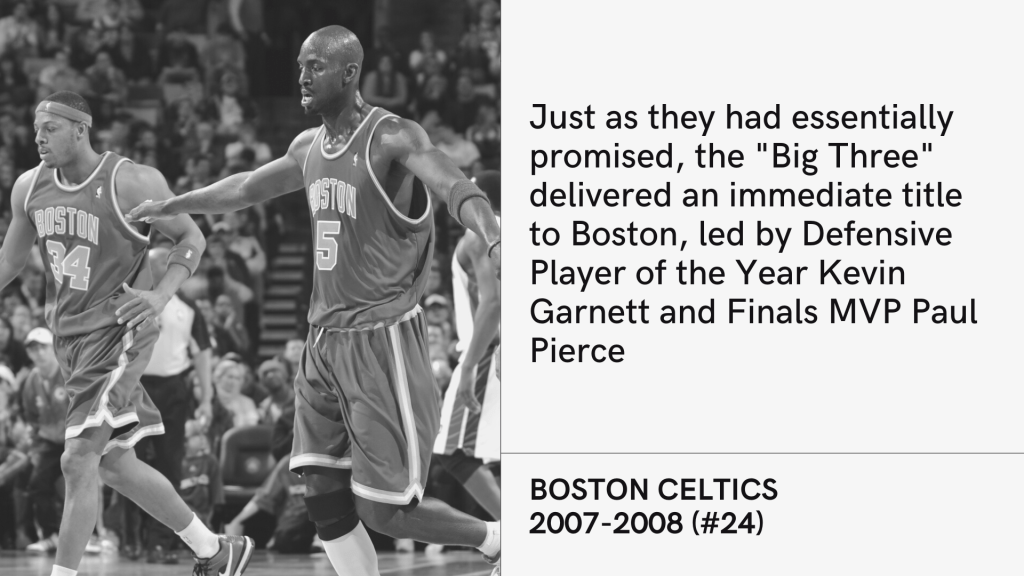
24) ’07-’08 Boston Celtics
Result: NBA champions
Key players: Paul Pierce, Kevin Garnett, Ray Allen, Rajon Rondo
Kicking off an era of unprecedented superstar teammate combos, Garnett and Allen joined Pierce in Boston in the 2007 offseason and the Celtics immediately became the best team in the NBA. They finished with one of the best defensive ratings of the post-merger era, thanks to Garnett aggressively manning the middle, while Rondo emerged as a perimeter pest and role players like Kendrick Perkins and James Posey harassed opposing scorers. Boston finished with the league’s best record with 66 wins, the third highest total in franchise history, but did struggle in the playoffs, needing seven games to dispatch the #8 seed Hawks and going the distance again in the second round against LeBron James and the Cavs. They rallied from there, taking down the Pistons in six games in the Conference Finals then memorably defeating their old rival, the Lakers, in the NBA Finals.
23) ’84-’85 Los Angeles Lakers
Result: NBA champions
Key players: Magic Johnson, Kareem Abdul-Jabbar, James Worthy, Byron Scott
With Worthy coming into his own as an All-Star level player and Abdul-Jabbar having his final great season at age 37, the ’84-’85 Lakers definitively avenged back-to-back Finals losses in 1983 and 1984. They improved massively on the offensive end, truly taking the breakneck Showtime style into overdrive thanks to both Worthy and Scott’s emergence as offensive threats, while still remaining stout defensively, led by perimeter stopper Michael Cooper, who was named 1st-Team All-Defensive. After easily defeating the Suns, Blazers, and Nuggets in the Western Conference playoffs, they handled their business against the rival Celtics in the NBA Finals, winning two games in the Boston Garden, including the clinching game six.
22) ’04-’05 San Antonio Spurs
Result: NBA champions
Key players: Tim Duncan, Manu Ginobili, Tony Parker, Robert Horry
This was the first Spurs dynasty team to lead with offensive efficiency, thanks to Parker making the leap in his third season and Ginobili peaking at an All-Star level. They dominated the first two-thirds of the regular season before a Duncan ankle injury caused them to struggle down the stretch, settling for the #2 seed in the West. But the postseason, as usual, was San Antonio’s true time to shine, especially in the Conference Finals when they put down the upstart, top-seeded Suns in five games. Though their NBA Finals against the Pistons went the full seven games, there was little doubt at any time during the series that the Spurs were the superior team.
21) ’59-’60 Boston Celtics
Result: NBA champions
Key players: Bill Russell, Tom Heinsohn, Bob Cousy, Bill Sharman
Of all the Russell-era Celtics teams, this one had the highest simple rating score and the highest offensive rating while still maintaining an elite defensive rating. It was arguably the final season of the primes of Cousy, who led the league in assists for the eighth straight year, and Sharman, who averaged 19.3 points per game at age 33. They won 17 straight games at one point, not losing in the entire month of December, and finished the season at 59-16, 10 games ahead of anyone else in the standings. The Warriors, led by rookie Wilt Chamberlain, gave the Celtics a fight in the Conference Finals, as did their old rivals the Hawks, who forced seven games in the NBA Finals.
20) ’88-’89 Detroit Pistons
Result: NBA champions
Key players: Isiah Thomas, Joe Dumars, Mark Aguirre, Bill Laimbeer
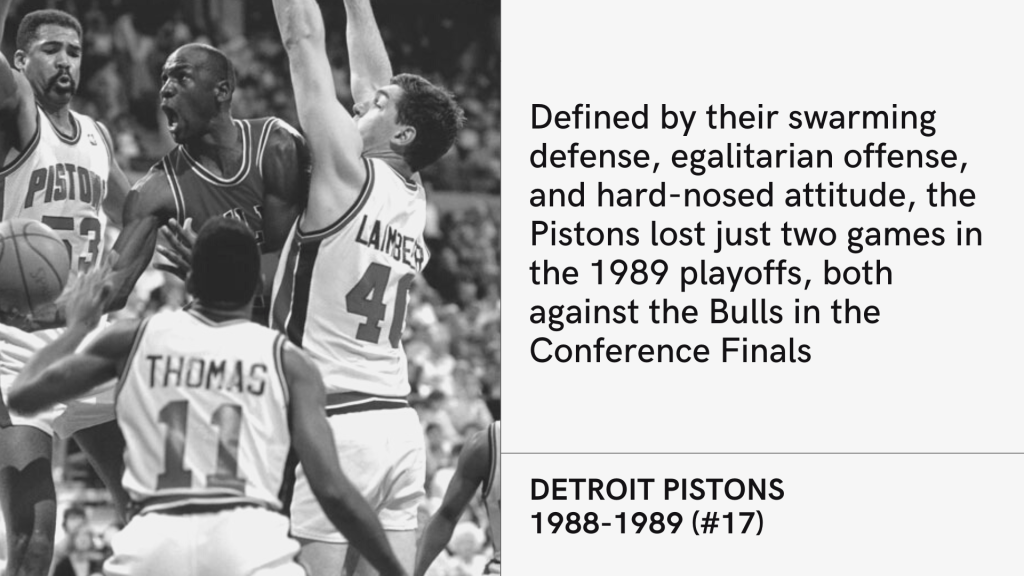
Thanks to a crucial mid-season swap of Adrian Dantley for Aguirre, the “Bad Boys” Pistons finally reached the mountaintop in ’88-’89, sweeping the Lakers in the NBA Finals. In fact, they lost just two games in the entire 1989 postseason, both in the Conference Finals against the Bulls. This was the ultimate team effort, with five different players averaging double-digit scoring in the playoffs, while front court enforcers Dennis Rodman and Rick Mahorn combined for over 15 rebounds per game. While Thomas was still the unquestioned leader and best player on the court, he sacrificed his own stats for the good of this squad, and his back court-mate Dumars was named Finals MVP for averaging 27.3 points per game in the series.
19) ’13-’14 San Antonio Spurs
Result: NBA champions
Key players: Kawhi Leonard, Tony Parker, Tim Duncan, Manu Ginobili
Revenge was served more lukewarm than cold for this Spurs team, who avenged their devastating 2013 Finals loss in dominating fashion. They outscored the Heat by 14.0 points per game in the NBA Finals, setting the all-time record and leaving no doubt in a five game series win. Contributions came from all over the place, from aging veterans Duncan and Ginobili to prime Parker to rising defensive superstar (and Finals MVP) Leonard to clutch role players like Boris Diaw, Patty Mills, and Danny Green. They had the best offensive rating of the five Spurs title teams and finished third in the NBA in defensive rating while winning a league high 62 games.
18) ’97-’98 Chicago Bulls
Result: NBA champions
Key players: Michael Jordan, Scottie Pippen, Toni Kukoc, Dennis Rodman
The “Last Dance” Bulls were weary and fractured but still dominated when it mattered. They had the worst offensive rating of the Jordan title era but also the best defensive rating, owing in large part to the slowed-down pace of the late ’90s NBA. A Pippen preseason surgery caused a slow start but the Bulls recovered to still win 62 games and clinch the top seed in the East, while Jordan was named MVP for the fifth time in his career. They faced two of the toughest postseason challenges of their six title runs in the 1998 playoffs, just escaping the Pacers in seven games in the Conference Finals, and then finishing off the Jazz in six in the NBA Finals thanks to “The Final Shot.”
17) ’12-’13 Miami Heat
Result: NBA champions
Key players: LeBron James, Dwyane Wade, Chris Bosh, Ray Allen
Though the season ended with two knock-down, drag-out battles against the Pacers and Spurs, this was otherwise the absolute zenith of the James Heat era. The Heat were a well-oiled machine in the third season of James, Wade, and Bosh teaming up. James was especially at the height of his powers and almost unanimously won his fourth MVP honor (he fell one vote short). The supporting cast was also at its peak, with strong performances from Shane Battier, Mario Chalmers, and Rashard Lewis, amongst others. It was Allen who took center stage amongst them in the NBA Finals, hitting arguably the most clutch shot in NBA history to tie game six down the stretch and completely swing the series. Long before that the Heat had an incredible regular season as well, at one point winning 27 consecutive games, the second-highest total in NBA history, and finishing with a 66-16 record.
16) ’90-’91 Chicago Bulls
Result: NBA champions
Key players: Michael Jordan, Scottie Pippen, Horace Grant, Bill Cartwright
One of the great dynasties in NBA history started here, with a Bulls team that annihilated their postseason opponents, losing just two games in the entire playoffs en route to their first of six titles over eight years. Though it wasn’t his peak as a scorer, Jordan was arguably never better as an overall player than he was in ’90-’91, controlling the game at both ends of the floor. Youngsters Pippen and Grant were still coming into their own at this point but both contributed immensely, especially in the playoffs, as did veteran role players Cartwright and John Paxson. This was the first Bulls team to crack 60 wins, breaking the previous franchise record of 57 set by the ’71-’72 team.
15) ’99-’00 Los Angeles Lakers
Result: NBA champions
Key players: Shaquille O’Neal, Kobe Bryant, Glen Rice, Robert Horry
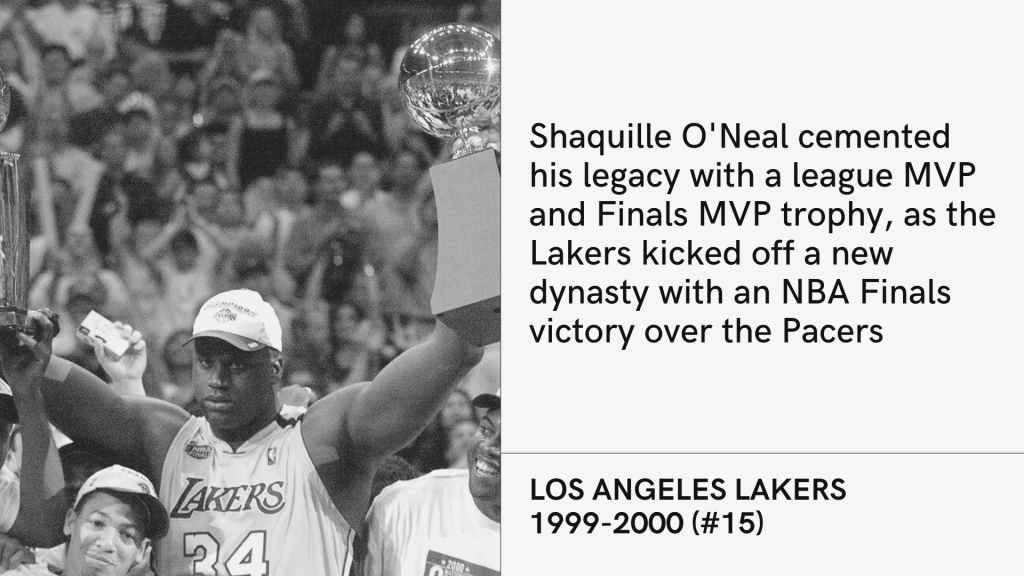
After some fits and starts in the late ’90s, things finally gelled for the O’Neal/Bryant Lakers in ’99-’00, thanks in no small part to Phil Jackson taking over as head coach. The Zen master led them to a franchise record 67 wins, a total even the legendary ’86-’87 team couldn’t muster, as O’Neal earned MVP and Finals MVP honors at the absolute peak of his career. Bryant was only 21-years-old for this team but skilled beyond his years, averaging 21.1 points per game in the postseason. The supporting cast was completely remade in the 1999 offseason, with veterans Rice, A.C. Green, Brian Shaw, and Ron Harper all acquired via trade or free agency. In addition to their wins mark, the ’99-’00 Lakers also set the post-merger franchise records for simple rating system (thanks to an exceedingly difficult schedule against a stacked Western Conference) and defensive rating.
14) ’14-’15 Golden State Warriors
Result: NBA champions
Key players: Stephen Curry, Draymond Green, Klay Thompson, Andre Iguodala
A longtime NBA laughingstock just a few years prior, things came together quickly for the Warriors, culminating in this ’14-’15 team winning the franchise’s first title in 40 years. Like the ’99-’00 Lakers, a lot can be attributed to the new head coach, in this case Steve Kerr, who got the most out of his budding superstars. Curry won his first of two consecutive MVP trophies, taking the NBA by storm with his trick dribbling and unlimited shooting range. Meanwhile, the Warriors also had arguably the league’s second best pure shooter in Thompson, plus a 1st-Team All-Defensive anchor in Green. Iguodala wound up as the surprise Finals MVP, thanks to his harassment of LeBron James as the Warriors upended the short-handed Cavaliers in their first of four consecutive Finals battles. This team set the franchise records for wins (67), simple rating system, and offensive rating, only to annihilate all of them the next season.
13) ’61-’62 Boston Celtics
Result: NBA champions
Key players: Bill Russell, Sam Jones, Bob Cousy, Tom Heinsohn
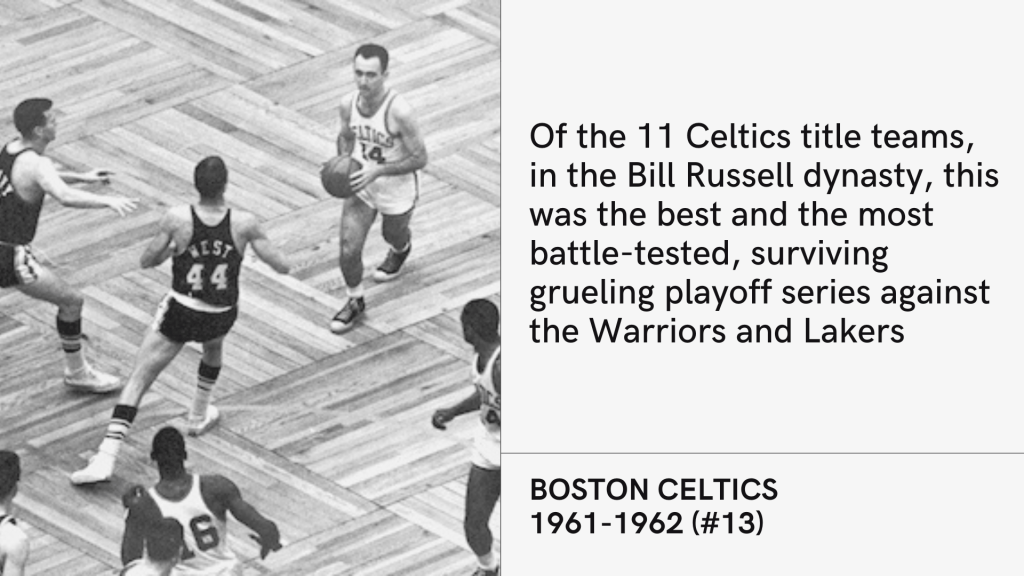
The highest-rated of seven Russell-era Celtics teams on this list, the ’61-’62 edition takes the cake thanks to their incredible advanced metrics (only the ’85-’86 team has a higher simple rating system in franchise history) and their arduous but convincing defeats of the Warriors and Lakers in the postseason, two opponents at their absolute heights. Russell won his third MVP trophy while averaging a career high 18.9 points per game, while Jones had his breakout season, getting named an All-Star for the first time at age 28 (Cousy and Heinsohn were also All-Stars). They were the first NBA team to ever win 60 games (the league had expanded the year before from 75 games to 80) and dominated the regular season before going to war with Wilt Chamberlain’s Warriors and Elgin Baylor’s Lakers in consecutive playoff series to win the title.
12) ’06-’07 San Antonio Spurs
Result: NBA champions
Key players: Tim Duncan, Tony Parker, Manu Ginobili, Michael Finley
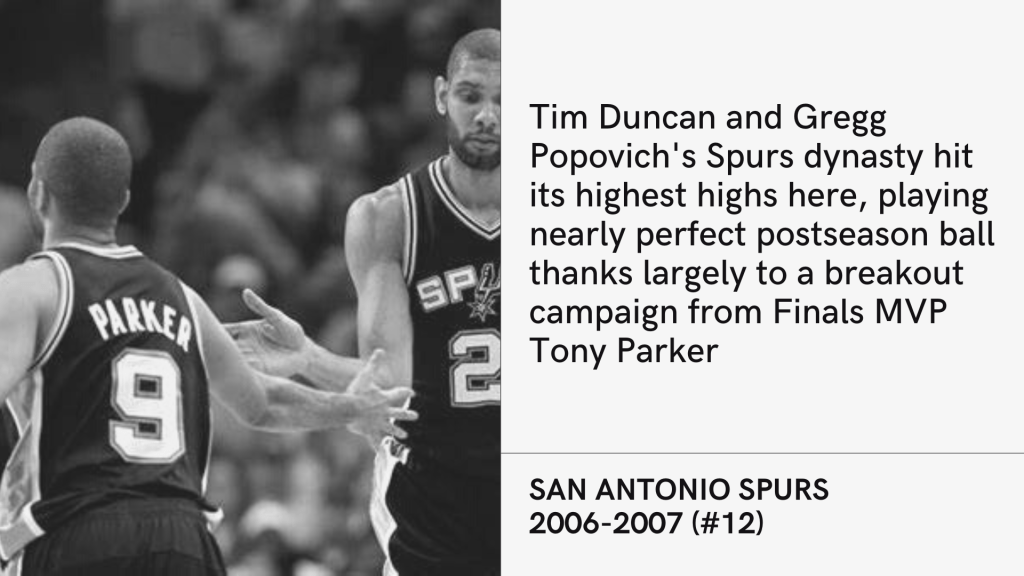
In many ways, this was the perfect distillation of the Duncan/Gregg Popovich era Spurs. They were efficient without being boring, dominant without being flashy, and a pure team effort on both sides of the ball. Though their regular season was somewhat unassuming (they won just 57 games and entered the playoffs as a #3 seed), the Spurs poured it on in the postseason, seemingly adapting to their opponents at will, running the seven-seconds-or-less Suns off the floor in a second round series before locking down defensively in the Conference Finals against the Jazz. The NBA Finals was then essentially a runaway, as they bulldozed LeBron James and the youthful Cavaliers in a sweep, with Parker earning Finals MVP honors. Though their win total wasn’t particularly impressive, this was the most efficient Spurs team of the first 12 years of the Duncan dynasty, based on advanced metrics like offensive rating.
11) ’82-’83 Philadelphia 76ers
Result: NBA champions
Key players: Moses Malone, Julius Erving, Maurice Cheeks, Bobby Jones
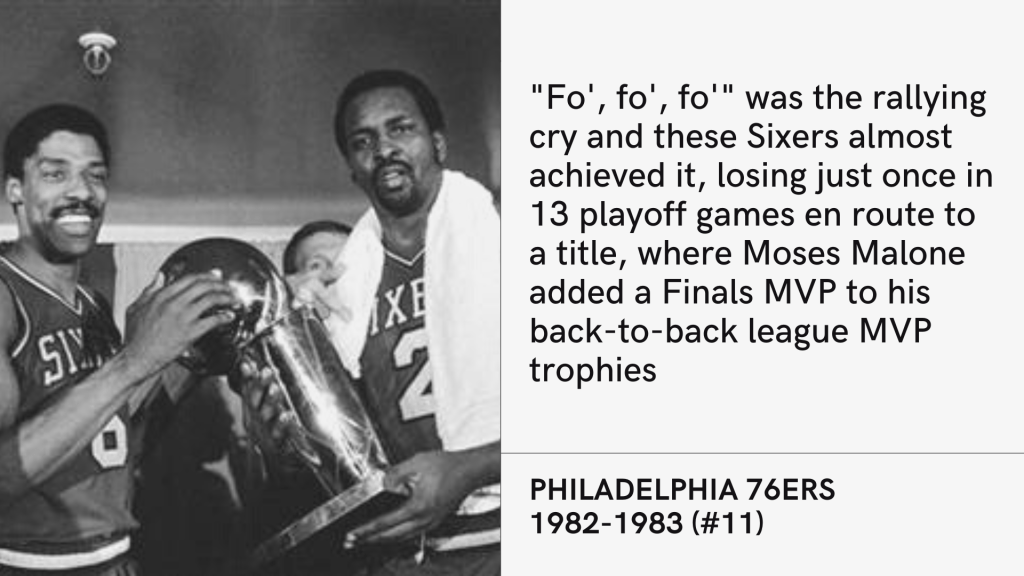
Following disappointing NBA Finals losses in 1977, 1980, and 1982, the Sixers went with the nuclear option for ’82-’83, trading for reigning MVP Malone to add to their own MVP winner Erving. This was a perfectly crafted roster beyond their two superstars, from floor general Cheeks to the efficient scorer Andrew Toney to glue guy and defensive stalwart Jones to the versatile Clint Richardson. When the team compiled a franchise-record 65 wins, by far the most in the NBA that season, and Malone was named MVP for a second straight year, the brash center predicted a “fo’, fo’, fo’” sweep of the postseason. Philly almost made good on that promise, sweeping the rival Celtics in the Conference Semifinals and the hated Lakers in the NBA Finals, with just one loss in between to the Bucks in the Conference Finals (a six point defeat in Milwaukee when they already held a 3-0 series lead). It was the greatest postseason performance in NBA history at the time, and has only ever been topped by the ’00-’01 Lakers and the ’16-’17 Warriors. This team held a special place in Philadelphia’s heart, especially as the city had to wait 25 years for any other pro team to win a title.
10) ’96-’97 Chicago Bulls
Result: NBA champions
Key players: Michael Jordan, Scottie Pippen, Dennis Rodman, Toni Kukoc
There was no way the Bulls were going to match the dominance of their ’95-’96 season but they returned essentially the exact same roster and came about as close as could be reasonably expected. One year after setting the NBA record with 72 wins, they could have crossed the 70-win barrier again in ’96-’97, but settled for 69 after losing three of their final four games with Rodman sitting with a knee injury. The playoffs were the usual Bulls dominance, sweeping the Bullets in the first round, easily setting the aside the Hawks in five games in the second round, then holding off the upstart Heat in five in the Conference Finals. Their NBA Finals match-up against the Jazz was one of the toughest series of Jordan’s career, including the “flu game” in game five, and the Steve Kerr series clinching three-pointer in game six. Jordan was a shocking runner-up in MVP voting to Karl Malone but did secure his fifth Finals MVP trophy. Of the six Bulls title teams, this edition was second only to the ’95-’96 squad in wins, simple rating system, and offensive rating.
9) ’70-’71 Milwaukee Bucks
Result: NBA champions
Key players: Kareem Abdul-Jabbar, Bob Dandridge, Oscar Robertson, Jon McGlocklin
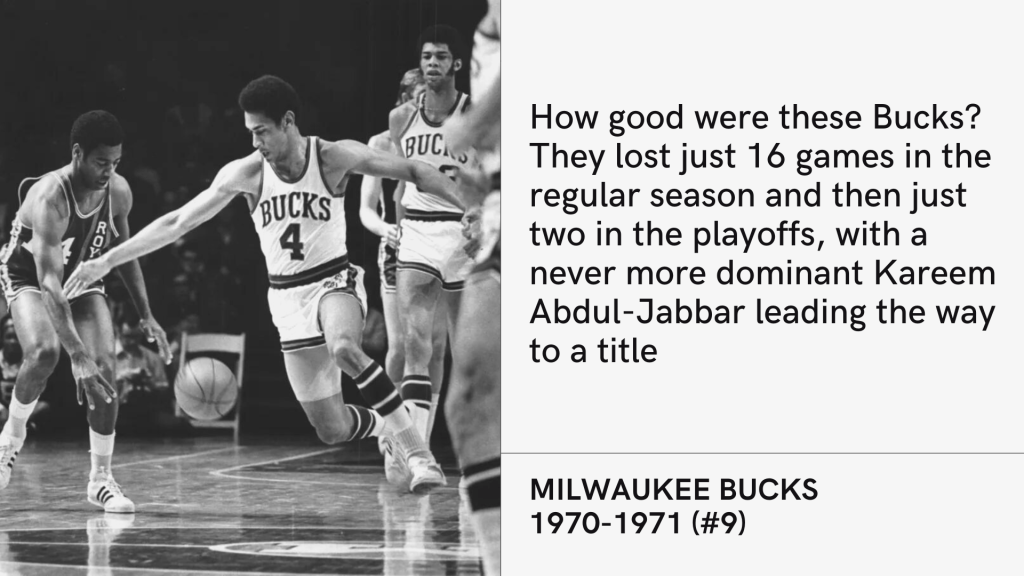
Long suffering on Royals teams that were middling at best, Robertson suddenly found himself traded in 1970 to one of the greatest rosters ever assembled. Anchored by Abdul-Jabbar (then still going by Lew Alcindor), who won MVP and the scoring title in just his second season, the ’70-’71 Bucks were absolutely stacked at the top of the rotation, with Dandridge, McGlocklin, Greg Smith, Bob Boozer, and Lucius Allen all making major contributions. They started off the season with wins in 17 of their first 18 games, then won 20 straight in the home stretch, setting the NBA record (the Lakers would break it a year later). Their 66 wins separated them by a full 14 games from the next best team in the league (the Knicks, with a 52-30 record) and that dominance extended to the postseason, where the Bucks lost just two games total across three series en route to the title. Abdul-Jabbar, Robertson, and Dandridge all averaged 20+ in the Finals as the Bucks dismantled the Bullets in a four game sweep. They still hold the simple rating score all-time record in NBA history, with a mark of 11.92.
8) ’86-’87 Los Angeles Lakers
Result: NBA champions
Key players: Magic Johnson, James Worthy, Kareem Abdul-Jabbar, Byron Scott
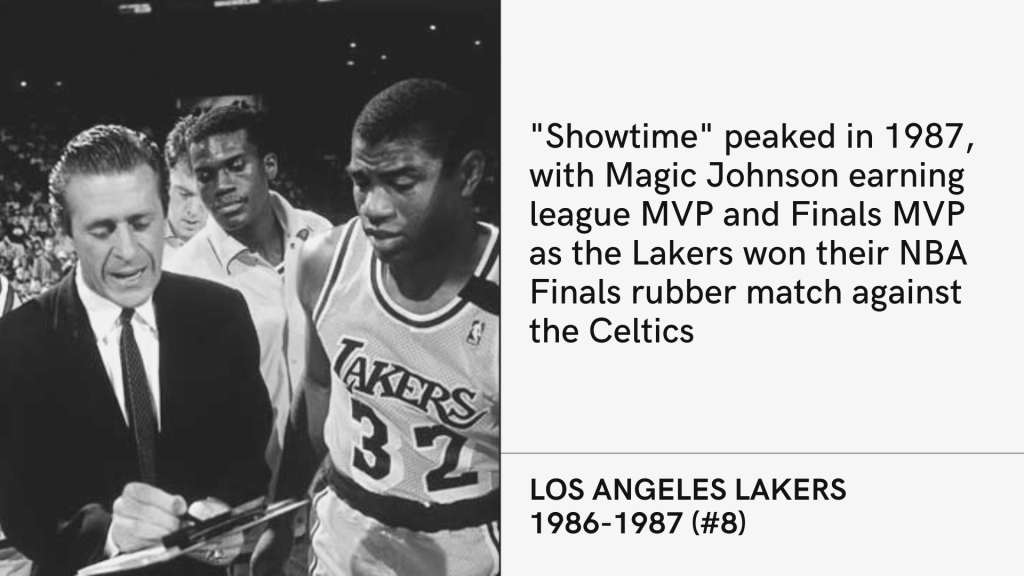
Shocked by a Conference Finals upset loss to the Rockets in 1986, the “Showtime” Lakers peaked in ’86-’87 to reclaim their status as champions. It’s no coincidence that this was arguably the absolute zenith of Johnson’s individual career, as the star point guard earned his first MVP trophy for averaging a career high 23.9 points per game, plus a league-leading 12.2 assists per game. Shifting the offensive focus to Johnson was a strategic move by coach Pat Riley, allowing the aging Abdul-Jabbar to better pick his spots (he also got more rest thanks to the arrival of overqualified backup Mychal Thompson). Worthy, Scott, and Michael Cooper were all also key pieces for this team, as was the young A.C. Green, who took over as the starting power forward. After cruising through the regular season with 65 wins, then easily dispatching the Nuggets, Warriors, and Sonics in the West playoffs, losing just one game across the three series, the Lakers faced their old rivals the Celtics in the NBA Finals. Led by a near triple-double for the series from Johnson and a turn-back-the-clock performance from Kareem, the Lakers prevailed in six games, including two surprising wins in the Boston Garden (one of which was punctuated by Magic’s famed “baby hook” game winner). Johnson accomplished what his longtime rival Larry Bird had the year before, adding a Finals MVP trophy to his league MVP award in the same season, and leading a team to glory that would stand amongst the all-time greats.
7) ’15-’16 Golden State Warriors
Result: Lost NBA Finals
Key players: Stephen Curry, Draymond Green, Klay Thompson, Andre Iguodala
25 spots separate this team from the next-closest non-champions on our list, and for good reason. Standing alongside maybe only the 18-1 Patriots, these Warriors will always be synonymous with achieving unprecedented regular season success but choking when it really counted. We’ll concentrate here on the good, which was their NBA record 73 wins, achieved by finishing out the season with a four game winning streak. They also have the second highest simple rating system score of all-time for a non-champion, and the second highest offensive rating. Curry was named MVP for the second consecutive season, won the scoring title with a career high 30.1 points per game, and became the seventh member of the 50-40-90 club. The Warriors won their first 24 games, setting not just the NBA record but the record for best start for any team in a major U.S. pro sports league. They also set the record for most consecutive home wins during this season, with 54. After facing down an incredibly tough challenge from the Thunder in the Conference Finals, the Warriors seemed in control of the NBA Finals against Cleveland, holding a 3-1 lead. But an untimely Green suspension likely cost them game five, while otherworldly performances from LeBron James and Kyrie Irving were too much to overcome in games six and seven. The ’15-’16 Warriors thus found themselves saddled with the ultimate consolation superlative: greatest team of all-time that didn’t win the title.
6) ’66-’67 Philadelphia 76ers
Result: NBA champions
Key players: Wilt Chamberlain, Hal Greer, Chet Walker, Billy Cunningham
This was the first “great team” in NBA history, honored as such by the NBA in 1980 for its 35th anniversary. After a blistering 46-4 start, which still stands as the greatest in league history, the 76ers eventually also set the record with 68 wins, which only four teams have surpassed since. They then crushed the opposition in the playoffs and became the only team of the ’50s or ’60s to defeat the Celtics in a series in which Bill Russell played every game (out of 28 series played). How did the Sixers, who had just 55 wins in the prior season and were easily defeated by the Celtics in the Conference Finals, turn things around so fully with essentially the same roster? New coach Alex Hannum seemed to be the key element, with his equitable approach and background with Chamberlain from their time together on the Warriors. Chamberlain was unlocked by Hannum’s offensive and defensive philosophy and was never better than in ’66-’67, easily earning MVP. The supporting cast was equally up to the task, with Greer, Walker, and Cunningham all averaging 19+ points per game.
5) ’91-’92 Chicago Bulls
Result: NBA champions
Key players: Michael Jordan, Scottie Pippen, Horace Grant, John Paxson
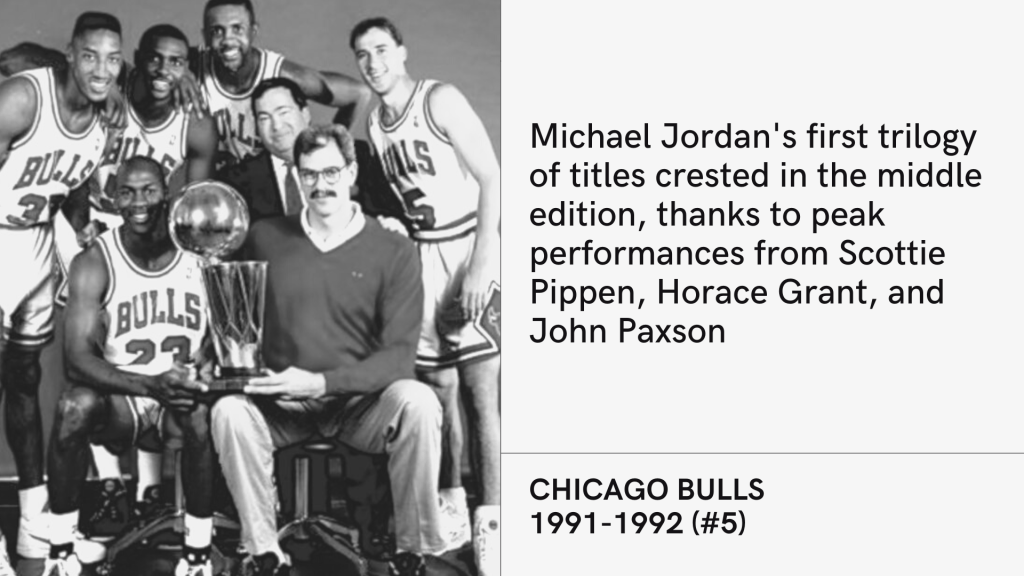
Nestled in between the still green ’90-’91 Bulls title team and the weary ’92-’93 version, the ’91-’92 Bulls were the Goldilocks edition of the first championship trilogy run. They won 67 games, breaking the franchise record that had been set just one year prior. Jordan captured his second consecutive MVP trophy and Finals MVP trophy, and his sixth consecutive scoring title, at 30.1 points per game. Grant and Pippen also made mini-leaps in their play, with Pippen getting named 1st-Team All-Defensive for the first time and finishing in the top 10 in MVP voting. Their offensive rating of 115.5 was the second highest all-time at the time, and has been passed since by only two other teams. In the postseason, the Bulls overcame a Knicks challenge in the Conference Semifinals, knocked out the Cavaliers, as usual, in the Conference Finals, and then slipped past a solid Portland team in the NBA Finals in six games.
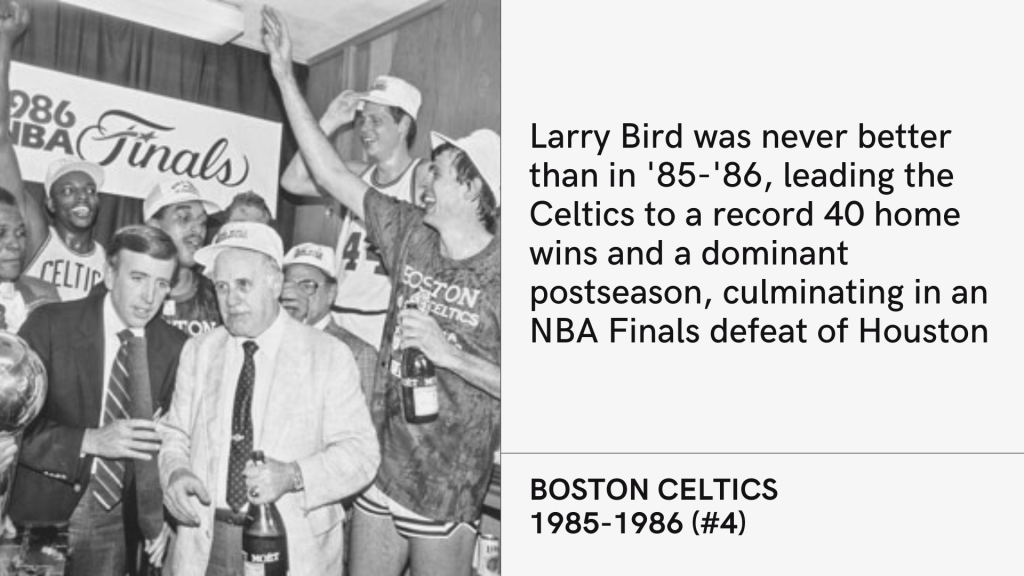
4) ’85-’86 Boston Celtics
Result: NBA champions
Key players: Larry Bird, Kevin McHale, Robert Parish, Dennis Johnson
Boston fans would likely label this placement as blasphemy but fourth is where we have the ’85-’86 Celtics. Their 40 home wins is still the NBA record and is a total so iconic that the one home loss is a thing of lore (a December defeat to Portland) and their 82 combined regular season and playoff wins also set the all-time mark (only two teams, the ’95-’96 Bulls and ’15-’16 Warriors, have topped it). Though his statistics didn’t necessarily reflect it, Bird was at his absolute peak in ’85-’86, earning his third consecutive MVP trophy and his second Finals MVP honor. His front court mates McHale and Parish were also never better, while Johnson and Danny Ainge had rounded into a deadly back court duo. But the real emotional core of this team was Bill Walton, who, at age 33, played 80+ games for the first and only time in his career, and was a shocking winner of the Sixth Man of the Year award. A Finals victory over the Rockets as opposed to the rival Lakers may have taken a little shine off this Celtics season, but they’re legendary in every other sense possible.
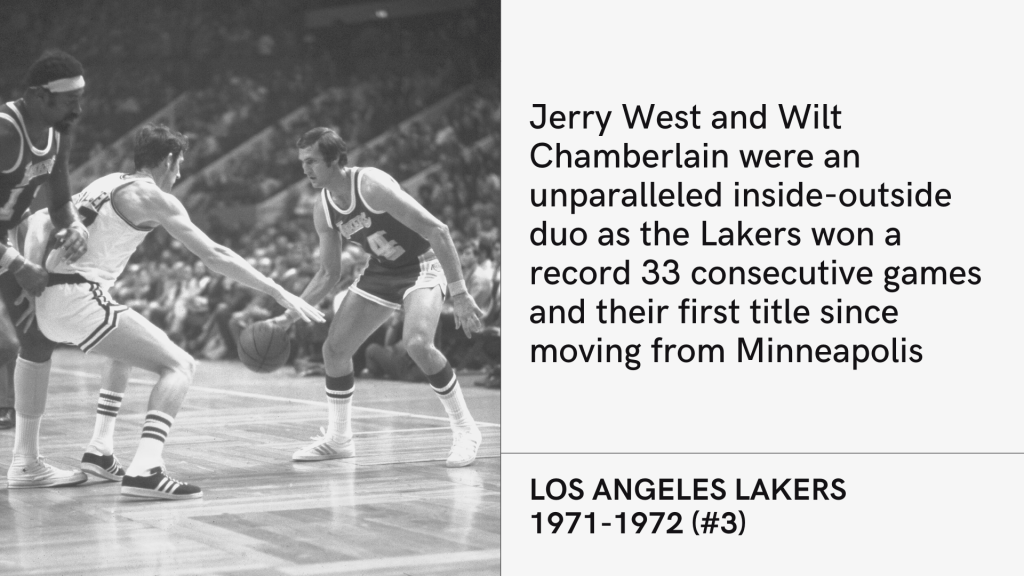
3) ’71-’72 Los Angeles Lakers
Result: NBA champions
Key players: Wilt Chamberlain, Jerry West, Gail Goodrich, Happy Hairston
Imagine if Elgin Baylor had retired before the season rather than during? The Lakers started off 6-3 when Baylor, frustrated by his lingering knee injuries and inability to keep pace in the new up-tempo offense installed by coach Bill Sharman, was replaced in the lineup by Jim McMillian. The Lakers immediately ratted off 33 consecutive wins, still the all-time record, and eventually finished with 69 victories. Though their top two stars, Chamberlain and West, were both north of 30 and near the end of their careers, Sharman was able to reinvigorate the offense, moving away from an inside-outside half court game into a breakneck, transition approach. It was fueled by the young stars Goodrich and Hairston, who both averaged 19+ points per game in the playoffs, while West focused more on his play making and Chamberlain on rebounding, defense, and outlet passing (Happy Hairston was also an unsung hero off the bench). Chamberlain was still capable enough to earn Finals MVP, as the Lakers avenged a loss to the Knicks from two years prior, and captured the first championship since moving to Los Angeles, after seven previous losses.
2) ’16-’17 Golden State Warriors
Result: NBA champions
Key players: Kevin Durant, Stephen Curry, Draymond Green, Klay Thompson
How do you follow up compiling the greatest regular season in NBA history and the greatest collapse in NBA Finals history? Why not go out and sign the greatest offensive threat of his generation, Durant, to fuel the most unstoppable offense ever compiled. It was obvious heading into the ’16-’17 season that the only team that could stop the Warriors was the Warriors themselves, but thanks to the steady hand of Steve Kerr at coach, that never even came close to happening. They started the season with wins in 16 of their first 18 games and never looked back, eventually winning 67 for the season and then plowing through the playoffs. In fact, their 16-1 postseason record is the greatest of all time and started with a record 15 consecutive wins before the Cavaliers managed to steal game four of the NBA Finals. Durant, Curry, Thompson, and Green were all named to the All-Star team, while Green earned Defensive Player of the Year and Durant took home Finals MVP. Their offensive rating of 115.6 tied the ’86-’87 Lakers as the all-time greatest (the ’18-’19 edition of the Warriors later broke the record) and their simple rating system score of 11.3 trails only the team ahead of them on this list, the ’95-’96 Bulls.
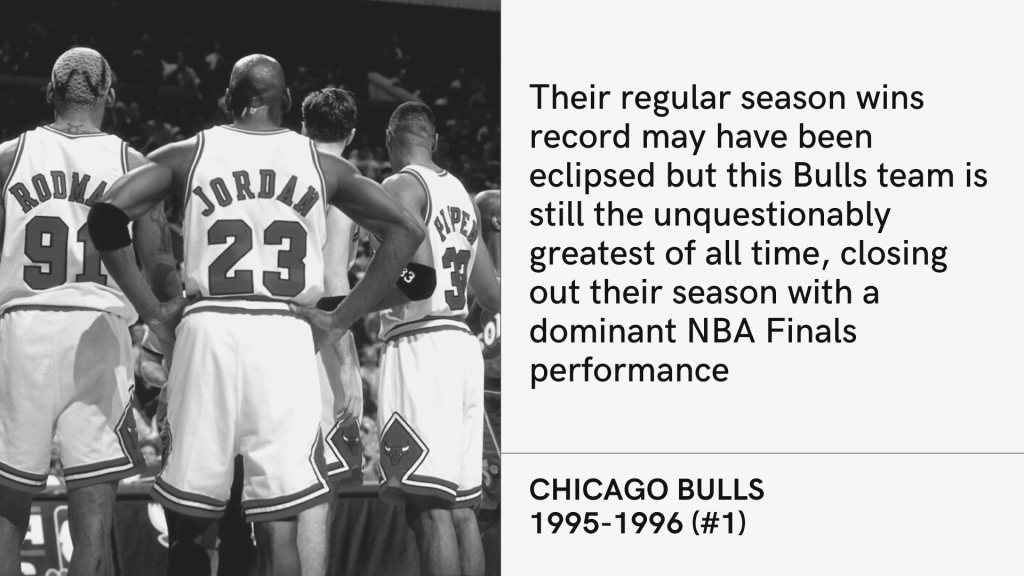
1) ’95-’96 Chicago Bulls
Result: NBA champions
Key players: Michael Jordan, Scottie Pippen, Dennis Rodman, Toni Kukoc
Cue “Sirius,” pop the champagne, and light a cigar because the ’95-’96 Bulls are the greatest team in NBA history. That designation is nothing new for them. In fact, it was already being bandied about as soon as they added the greatest rebounder of all time, Rodman, to a lineup already featuring an intensely motivated Jordan (even by his standards), a never better Pippen, and a rising star in Kukoc. They became just the fourth team in NBA history with an offensive rating over 115, while maintaining an incredible defensive rating of 101.8 (easily the lowest ever for a team with a concurrent offensive rating above 112). Chicago won 41 of its first 44 games, which put them on pace for 76 wins at that point, before suffering a surprise two game losing streak in early February (it was on the back end of a long West Coast road trip). They still ended up with a record 72 wins then blitzed their postseason opponents, winning in 14 of their first 15 playoff games (with the one loss coming in overtime against the Knicks) by an average margin of 14.5 points. Jordan was named MVP for the fourth time while Pippen finished fifth in voting, plus second in Defensive Player of the Year voting, and was named 1st-Team All-NBA and 1st-Team All-Defensive. The Swiss Army Knife Kukoc was named Sixth Man of the Year while Rodman won his fifth consecutive rebounding title and mostly stayed out of the tabloids.
Next up in 75th Anniversary
- The ultimate standings: Power ranking the 45 NBA franchises by their all-time results
- Extracurricular activities: 75 off-court moments that shaped the NBA
- Squad goals: 75 greatest NBA teams
- Noms de plume: 75 greatest NBA and ABA player nicknames
- Instant classics: 75 greatest games in NBA history
- Founding ballers: 75 greatest players who participated in the inaugural NBA season (’46-’47)
- Listed legends: 75 players to track for the NBA 75th anniversary team
Next up in Team Rankings
- Boomshakalaka!: Ranking the 27 rosters from the original NBA Jam (1993 arcade edition)
- Us against the world: Ranking the 18 U.S. FIBA World Cup teams
- Uncut nets: 25 greatest NCAA programs without a Final Four appearance (since 1985)
- The ultimate standings: Power ranking the 45 NBA franchises by their all-time results
- Squad goals: 75 greatest NBA teams
- Gold standards: Ranking the 18 U.S. men’s Olympic basketball teams
- March sadness: 28 greatest NCAA teams that fell short of reaching the Final Four
- Bone dry: 15 all-time longest NBA franchise playoff droughts
- Oh, the humanity!: Ranking the 30 NBA franchises by torture level of their fans
 Basketball, Listed