Editor’s note: this list takes into account only a player’s time on the Suns, not the rest of their career with other franchises.
23) Paul Silas, 1969-1972
Buried on the depth chart at power forward early in his career with the Hawks, Silas was just starting to break out when he was traded to the Suns in 1969. Joining a young roster on a young franchise just getting its footing, Silas was given some room to breath in Phoenix and developed into one of the league’s premier rebounding and defending forwards, a status he would hold for the entire ’70s. He averaged a double-double in each of his three seasons with the Suns, including a career high 17.5 points per game in ’71-’72, was named to his first All-Star Game in 1972, and became the first Phoenix player to be named All-Defensive in ’70-’71. As the starting power forward, Silas was also part of the first Suns playoffs team, the ’69-’70 squad that almost stunned the Lakers in a Conference Semifinals series. Traded to the Celtics for Charlie Scott in 1972, Silas eventually won three championships, two with Boston and one with Seattle. Though he was with the franchise for just three seasons, he’s still in the top 10 in total rebounds, and holds the franchise records for rebounds and rebounds per game in a single season.
22) Truck Robinson, 1979-1982
One of the best power forwards of the late ’70s and early ’80s, Robinson came to the Suns via trade during the ’78-’79 season for pennies on the dollar., thanks to his situation with his prior team, the Jazz, becoming untenable due to conflicts with coach Elgin Baylor and fellow All-Star teammate Pete Maravich. Though his stats fell some from his peak with the Jazz, Robinson was still a monster at power forward in his four-plus seasons in Phoenix, averaging 18.1 points and 9.5 rebounds per game. He was one of three Suns on the 1981 All-Star team (the first time in franchise history that that happened) and was the leading rebounder and fourth leading postseason scorer on the ’78-’79 team that reached game seven of the Conference Finals before losing to the Sonics.
21) Dennis Johnson, 1980-1983
A Finals MVP for the Sonics early in his career, and a key member of two Celtics championship teams in the back half, in between Johnson had his best statistical output with the Suns. In ’80-’81, his first season with Phoenix, he was 1st-Team All-NBA for the first and only time in his career, then averaged a career high 19.5 points per game in ’81-’82. Johnson was also an All-Star and 1st-Team All-Defensive in all three years with the Suns but just like his previous stop in Seattle, he butted heads with his coach and eventually forced a trade. And just like the Sonics before him, the Suns regretted dealing Johnson away as the replacement (Rick Robey) failed to live up to him offensively or defensively and the team immediately regressed.
20) Clifford Robinson, 1997-2001
Yes, it’s going to be a theme on this list of players coming to the Suns just past their prime, putting up big numbers, then moving on with their career. Robinson is certainly one of the prime examples, as he was already 30 years old when the Suns signed him as a free agent in 1997, and had peaked a couple years earlier as an All-Star and 20+ point scorer for Portland. Joining a team in the midst of its transition from the Kevin Johnson era to the Jason Kidd one, Robinson continued his career long role a reliable outside shooter and versatile paint defender (he was 2nd-Team All-Defensive in ’99-’00). Though his stats overall with the Suns weren’t as impressive as they had been with the Blazers, Robinson did log the best game of his career in January of 2000, becoming the oldest player at the time to ever score 50 points in a game (at age 33).

Our third volume will be published throughout the ’20-’21 NBA season
19) Kyle Macy, 1980-1985
All-Star level expectations never panned out for Macy, an All-American at Kentucky, after the Suns drafted him in the first round in 1979 (he joined the team one year later after finishing college). But he did go down as one of the franchise’s all-time greatest free throw shooters. In fact, Macy’s 88.4% free throw shooting in his five seasons in Phoenix was the franchise record for over two decades before Steve Nash eventually overtook it. He led the NBA in the category twice while playing for the Suns (the first player in team history to do so), including a career high 90.7% in ’84-’85. Starting at point guard, Macy was a key part of the ’83-’84 team that reached the Conference Finals but by ’84-’85 was starting to struggle with injuries. When the Suns let him walk as a free agent in 1985, Macy played out one season with the Bulls (starting in the back court with Michael Jordan) and one with the Pacers before quietly retiring.
18) Leandro Barbosa, 2003-2010, 2013-2014, and 2016-2017
A bit of an enigma when the Suns traded for him on draft day in 2003, Barbosa soon after developed into one of the key members of the “Seven Seconds or Less” era and was beloved by fans for his pure speed, unique shot mechanics, and general fearless style. His pro career started in his native Brazil at age 17, four full years before reaching the NBA. Nicknamed “Brazilian Blur” for obvious reasons, Barbosa struggled at first to match his style with a bench specialist position but eventually settled in so successfully that he was named Sixth Man of the Year in ’06-’07. His 18.1 points and 4.0 assists per game that season were both career highs and both third on a Suns team that won 61 games and were arguably robbed of a title due to player suspensions in the Conference Semifinals against San Antonio. After seven seasons and three Conference finals appearances, Barbosa was traded to the Raptors in 2010 but made his way back to Phoenix twice, eventually retiring with the team in 2017. He is third in franchise history in three-point field goals and one of just 11 players to log 500+ games with the team.
17) Neal Walk, 1969-1974
One of the most infamous consolation prizes in NBA history, Walk was the second overall pick of the Suns in the 1969 Draft after they lost the coin toss to the Bucks for the top pick. That #1 selection was Kareem Abdul-Jabbar, who likely would have completely changed the course of the Suns franchise. Instead, they got Walk, who had just broken the NCAA record for rebounds per game in a season. He took over as the starting center in ’70-’71 and progressed nicely, peaking at 20.2 points and 12.4 rebounds per game in ’72-’73. But those would turn out to be career highs and the beginning of the end for Walk in Phoenix, as he was traded a year later to the Jazz and his career soon after fell apart, due in large part to recreational drug use. His 3,637 total rebounds for the Suns was the franchise record for a while, and is still fifth on the list. Though he never escaped Abdul-Jabbar’s shadow, Walk did eventually get inducted into the Florida Gators Athletics and National Jewish Sports Halls of Fame.
16) Mark West, 1988-1994 and 1999-2000
Though he never averaged more than 11 points or nine rebounds per game in a season, was never an All-Star, and is mostly unknown to casual, West is beloved by the Suns faithful. In fact, he was named to the Suns All-Century Team, which was voted on by fans, as the backup center behind Alvan Adams. Originally drafted by the Mavericks in 1983 after a star career at Old Dominion (where his jersey is retired), West came to the Suns by way of Cleveland in 1988, as part of the blockbuster Kevin Johnson-Larry Nance trade. While Johnson was obviously the prize of that deal, West became a reliable piece in his own right, taking over as Phoenix’s starting center for the next six seasons. During that time, he led the NBA in field goal percentage in ’89-’90 (with a franchise record 62.5%) and started all 106 games (82 regular season, 24 postseason) for the ’92-’93 Suns that won 62 games and reached the NBA Finals. Despite overall averages of just 5.7 points and 4.9 rebounds per game, West lasted 17 seasons in the NBA, eventually returning to the Suns in ’99-’00 to close out his career. He is the all-time franchise leader in field goal percentage, second in total blocks, and sixth in total rebounds.
15) Jason Kidd, 1996-2001
Just a few months after trading Charles Barkley away to the Rockets in the summer of 1996, the Suns were able to trade for a 23-year-old All-Star in Kidd. He came to Phoenix from the Mavericks, who had tired of his feud with Jim Jackson, and teamed up in a dynamic back court with Kevin Johnson (Steve Nash was also on the roster in ’96-’97 and ’97-’98, forming possibly the greatest three point guard rotation in NBA history on paper that didn’t pan out in actuality). Kidd was the NBA assist leader three times during his four full seasons with the Suns, including his career high 10.8 per game in ’98-’99, and led the team as far as the Conference Semifinals in 2000. This was also the era when his domestic abuse charges were made public, and that was likely a factor in the team trading him in the summer of 2001 to the Nets for Stephon Marbury. Kidd remains fifth all-time in franchise history in total assists.
14) Tom Chambers, 1988-1993
The first big unrestricted free agent signing not just in Suns history but in NBA history, Chambers was already an All-Star when he came to Phoenix in ’88-’89 but reached new heights over the next couple years. He was named to three consecutive All-Star teams starting in ’88-’89, and averaged a career high 27.2 points per game in ’89-’90. Slotting Chambers alongside Kevin Johnson and Eddie Johnson as a dynamic scoring trio, the Suns made back-to-back Conference Finals in 1989 and 1990, and starting in ’88-’89, kicked off a streak of seven consecutive 50-win seasons. His stats did start to decline precipitously in ’90-’91, and when Charles Barkley joined the roster in ’92-’93, Chambers shifted to the bench, helping Phoenix reach the NBA Finals as a sixth man. Though he ended his playing career with brief stops on the Jazz, Bulls, and Sixers, Chambers is now a lifelong Sun, having taken on roles as the team’s community ambassador and television broadcaster. His jersey #24 was retired by the team in 1999 and his ’88-’89 and ’89-’90 seasons are still the top two scoring seasons in franchise history.
13) Connie Hawkins, 1969-1973
Blackballed for years due to his supposed (never proven) role in the 1961 NCAA point shaving scandal, Hawkins didn’t reach the NBA until age 27. He likely felt even older at the time, due to years of difficult travel and playing conditions in the ABA, ABL, and with the Harlem Globetrotters. Hawkins was still an instant star for a young Suns franchise, averaging 24.6 points and 10.4 rebounds per game in ’69-’70, leading the team to its first postseason appearance and a near upset of the Lakers in the Conference Semifinals. He ultimately averaged 20.7 points and 9.1 rebounds per game over four seasons in Phoenix, and was named to four All-Star teams, before his knees started to give out and his career quickly wound down. “The Hawk” became the first member of the Suns to be named 1st-Team All-NBA, in ’69-’70, the first to have his jersey retired by the team (in 1976), and eventually the first to be inducted into the Hall of Fame, in 1992.
12) Jeff Hornacek, 1986-1992
Most fans outside of Phoenix probably think of Hornacek first and foremost for his time in the late ’90s on the Jazz, but his peak in ’91-’92 came with the Suns. Hornacek averaged career highs that season in points (20.1 per game) and rebounds (5.0 per game) and made the lone All-Star appearance of his career. The Suns drafted him in the second round in 1986 and after a slow start he blossomed into the third scoring option and secondary ball handler behind Tom Chambers and Kevin Johnson on the teams that reached back-to-back Conference Finals in 1989 and 1990. Hornacek actually led the Suns in scoring in that ’91-’92 season and was then the centerpiece of the trade to Philadelphia that brought Charles Barkley over in the summer of 1992. Hornacek is still in the top 10 in franchise history in assists, steals, and offensive rating.
11) Larry Nance, 1981-1988
Similar to Jeff Hornacek, Nance is mainly remembered by most fans for his late career turn with a different franchise, and that may be why he was arguably the biggest snub when Phoenix’s 40th Anniversary Team was announced in 2008. For Nance, that secondary franchise was the Cavaliers, who acquired him in a landmark 1988 deal that netted Kevin Johnson, Mark West, and Dan Majerle (via draft pick acquisition) for the Suns. But Nance’s best stats were compiled for the Suns, most notably a four season stretch starting in ’83-’84 when he averaged 20.0 points and 8.6 rebounds per game. The first season of that run was a real breakout for Nance, who was the second leading scorer and rebounder on the Suns as they reached the Conference Finals, was named to his first of three All-Star Games (the last two came with Cleveland), and won the inaugural NBA Slam Dunk Contest, earning the nickname “High Ayatollah of Slam-ola.” He is still the Suns’ all-time leader in blocks, and is in the top 10 in points, rebounds, steals, and win shares.
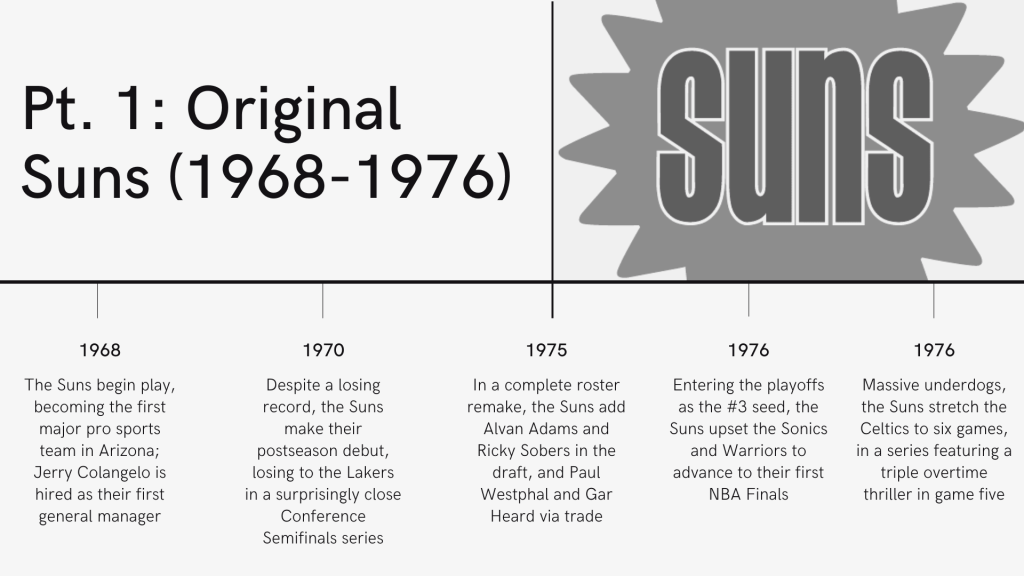
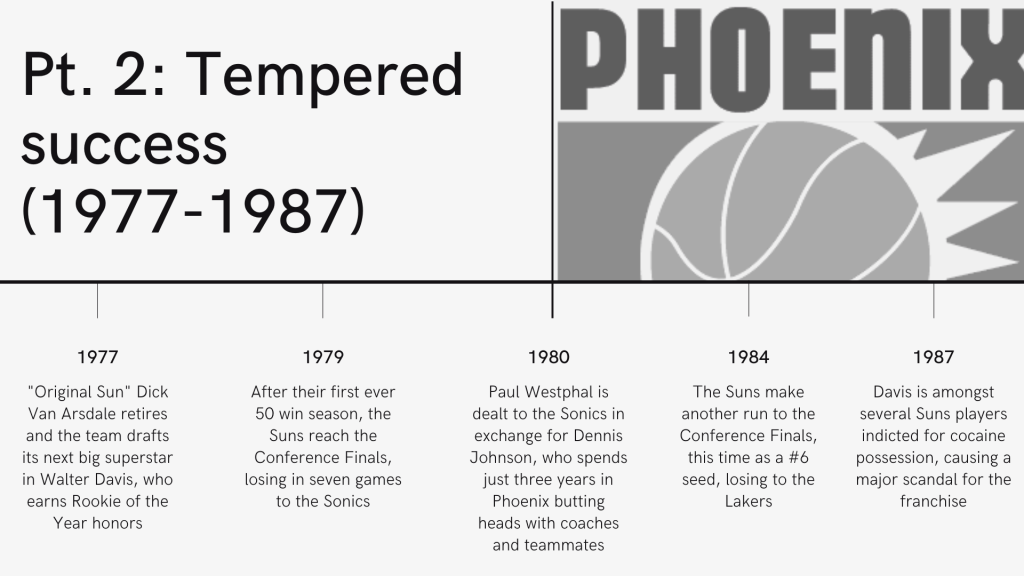
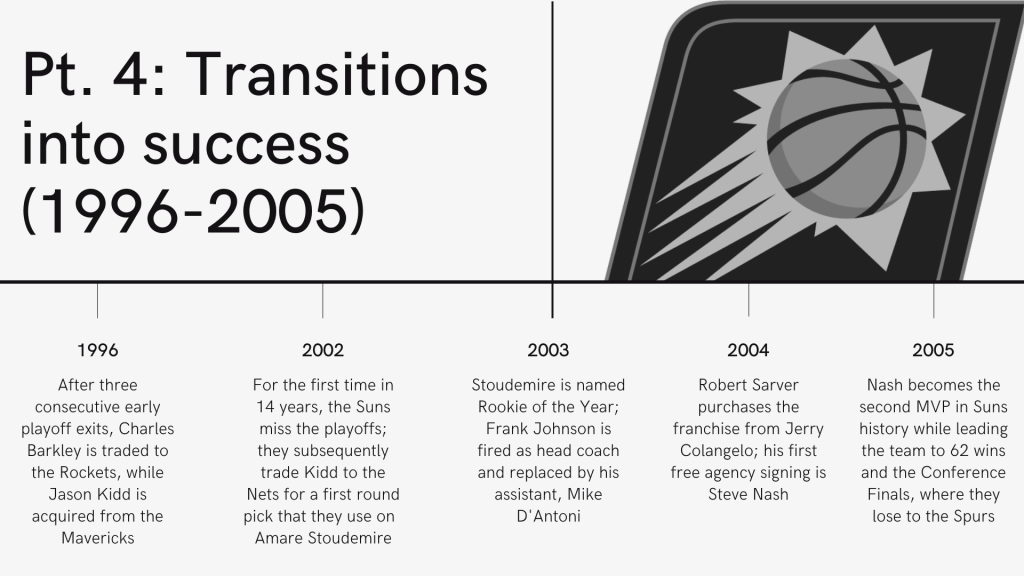
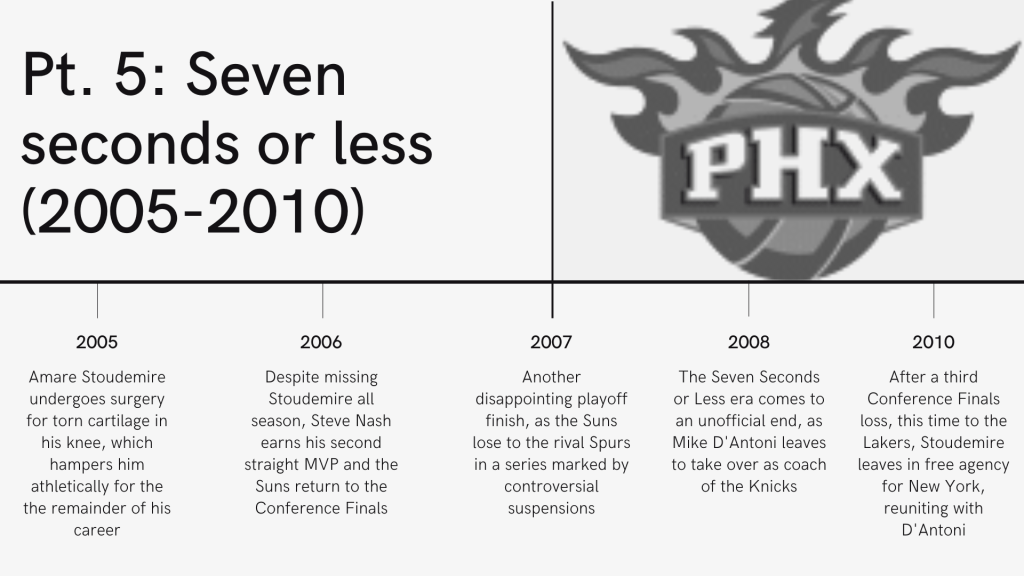
A visual timeline of Suns franchise history

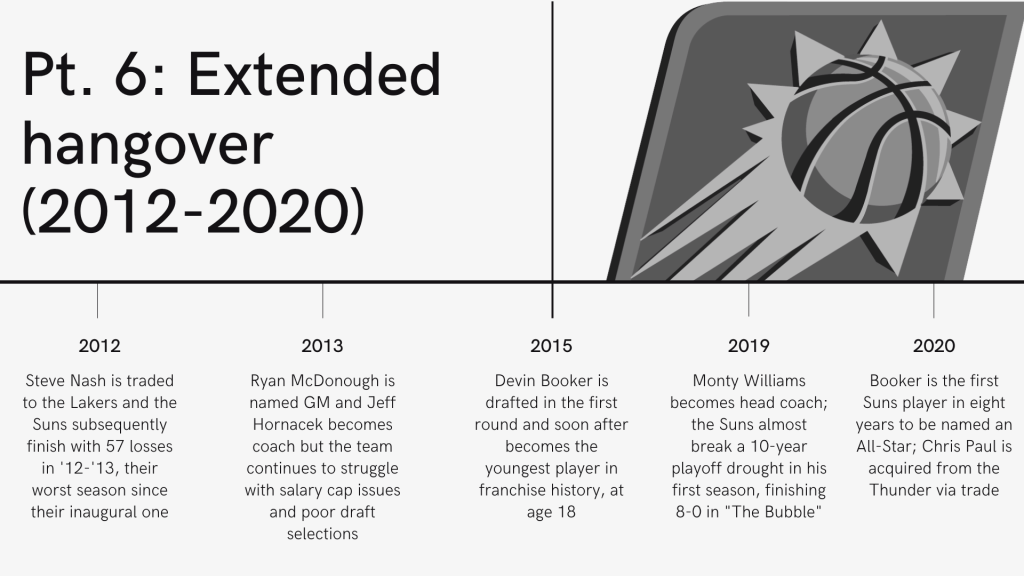
10) Dan Majerle, 1988-1995 and 2001-2002
Somewhat of an unknown commodity coming out of Central Michigan in 1988, Majerle was booed by Suns fans when the team drafted him #14 overall but eventually became one of the most beloved players in franchise history. Nicknamed “Thunder Dan” not for his signature three-point shooting but for his thunderous dunking (which waned as his career went on), Majerle was a three-time All-Star for the Suns, 2nd-Team All-Defensive twice, and led the NBA in three-point field goals twice. He was a jack-of-all-trades for the ’92-’93 team that reached the NBA Finals, finishing second on the team in rebounding, and third in points, assists, blocks, and steals, and matching up defensively against Michael Jordan and Scottie Pippen. Traded to the Cavs in 1995, Majerle spent one season in Cleveland and four in Miami before returning to Phoenix for his final campaign in ’01-’02. Majerle is second all-time in Suns franchise history in three-point field goals, in the top 10 in points, rebounds, and steals, and had his jersey #9 retired in 2003. In addition to his exploits on the court, he also lives on in the Phoenix area thanks to his sports bar and grill chain Majerle’s, which he opened during his playing career and now has four locations in Arizona.
9) Paul Westphal, 1975-1980 and 1983-1984
Though the Suns have just two appearances in their 52 season history, one man has managed to both play for and coach the team in the NBA Finals. That man is Westphal, whom the Suns acquired from the Celtics in 1975 in exchange for Charlie Scott. About a year later, the former lightly used swingman had developed into one of the NBA’s deadliest scorers, and led the Suns to a surprise NBA Finals match-up against his former Boston teammates (one year earlier they had missed the playoffs entirely). Westphal was terrific in that series, pouring in 28 points in games two and four and adding 25 in the infamous game five triple overtime loss, but the Suns dropped the series in six games. Over the next four seasons, he averaged 20+ points and five-plus assists per game, played in four All-Star Games, and was named 1st-Team All-NBA three times. Though he was traded to the Sonics for Dennis Johnson in 1980, Westphal returned to the Suns twice, first as a player, finishing his career with the team in ’83-’84, then as a coach. He took an assistant job under Cotton Fitzsimmons in 1988 and then replaced him in ’92-’93, leading the Suns to the NBA Finals in his first season in charge. Westphal’s jersey #44 was retired by the Suns in 1989 and in 2019 he became the 11th Suns player inducted into the Naismith Hall of Fame.
8) Charles Barkley, 1992-1996
One could argue that Paul Westphal and Steve Nash had bigger impacts in the standings upon joining the Suns, but no player has ever completely reshaped the team like Barkley did in ’92-’93. His first season in Phoenix was the greatest in franchise history by any player, earning MVP with 25.6 points, 12.2 rebounds, and 5.1 assists per game. Barkley was somehow even better in that postseason, especially in close out games: 31 points and 14 rebounds in the first round against the Lakers, 28 points and 21 rebounds in round two against the Spurs, and 44 points and 24 rebounds in the Conference Finals against the Sonics. He almost single-handedly upset the Bulls in the subsequent NBA Finals, as Kevin Johnson struggled in the series. Despite some injury woes, Barkley remained about as effective for the next three seasons but the Suns kept falling short in the postseason, losing frustrating seven game Conference Semifinals series to the Rockets in 1994 and 1995. Almost as quickly as he had come the superstar was then gone, traded to those same Rockets in 1996 as the Suns looked to rebuild. One of just two MVP winners in franchise history (along with Steve Nash), Barkley had his #34 retired in 2004.
7) Dick van Arsdale, 1968-1977
Nicknamed “The Original Sun” for good reason, Van Arsdale was selected by the team in the 1968 expansion draft (from the Knicks), scored the first basket of their inaugural game, soon after became their first All-Star, and held the franchise scoring record for several years after his 1977 retirement (Walter Davis eventually broke it, but Van Arsdale is still fifth all-time). The shooting guard’s best stats came in his early days when the Suns mostly struggled, save for a surprise playoff appearance in ’69-’70. Though his role reduced some later on, Van Arsdale was in the starting back court with Paul Westphal on the ’75-’76 team that reached the NBA Finals. Not only was he the franchise’s leading scorer for a little while, Van Arsdale is also still in the Suns’ top 10 in free throws, field goals, and assists and had his jersey retired almost immediately after his retirement. He would later serve several roles in the team’s front office, including general manager and vice president of player operations. In his final season, ’76-’77, Van Arsdale was able to team up with his identical brother Tom for the first time in the NBA, when the latter was acquired via trade.
6) Amare Stoudemire, 2002-2010
One of three players in Suns history to win Rookie of the Year and one of just two players in NBA history to capture it after joining the league straight out of high school, Stoudemire was a revelation in ’02-’03. His true calling came a couple years later, when the Suns fashioned the “Seven Seconds or Less” offense around new point guard Steve Nash. An athletic big man who could run the floor, hit short jumpers, and finish fast breaks, Stoudemire was essentially unstoppable offensively in ’04-’05 and helped the Suns reach the brink of an NBA Finals appearance. Unfortunately, injuries would mount from there, starting with knee cartilage damage that cost him essentially the entire ’05-’06 season and a rush back to action that likely hampered the rest of his career. Despite the ailments he put together quite a resume in Phoenix, averaging 21.4 points and 8.9 rebounds per game over eight seasons, and getting named 1st-Team or 2nd-Team All-NBA four times before departing as a free agent for the Knicks in 2010. Stoudemire stands third all-time in Suns franchise history in total rebounds, and sixth in points.
5) Walter Davis, 1977-1988
The all-time Suns scoring leader, Davis is also tied with Steve Nash for most All-Star appearances by a Suns player, with six. He won Rookie of the Year for the team in ’77-’78 after getting drafted fifth overall, was 2nd-Team All-NBA twice, and averaged 20+ points per game in six different seasons. So why isn’t he higher on this list? Well, Davis was also inconsistent, the result of recurring back injuries and abuse of alcohol and cocaine. His time with the Suns ended with a drug scandal, as he and several teammates were indicted for cocaine use in 1987, sending Davis back to rehab for the third time in his career. He also never reached the NBA Finals with the team, though he did help them advance to the Conference Finals in 1979 and 1984. Despite his ugly exit from the franchise, Davis’ #6 jersey was retired by the team in 1994.
4) Alvan Adams, 1975-1988
One of just two players on this list to spend his entire career with the Suns, Adams was their fourth overall pick in 1975 and hung around for 13 seasons, becoming the franchise’s all-time leader in games played, with 988. He’s also first all-time in rebounds and steals, second in points, and third in blocks. Adams’ rookie season was definitely his peak, winning won Rookie of the Year for averaging career highs in scoring (19.0 points per game) and rebounding (9.1 per game), getting named to his only All-Star team, and as the second leading scorer on the Suns as they made a surprise run to the NBA Finals. Though he never reached those peaks again, Adams did average at least 15+ points and seven-plus rebounds per game for the next six seasons. The Suns retired his jersey #33 just months after his 1988 retirement but Adams allowed Grant Hill to borrow it for a few years when he joined the team in 2007.
3) Shawn Marion, 1999-2008
A true one-of-a-kind player who was also ahead of his time, Marion racked up stats all across the board for the Suns for seven-plus seasons, from his drafting in 1999 to his trade to Miami for Shaquille O’Neal in 2008. He earned the nickname “The Matrix” for that stat sheet-stuffing ability and was a key element of the Suns teams that reached the Conference Finals in 2005 and 2006 and an All-Star four years in a row starting in 2003. In addition to Ron Lee, Marion is one of two Suns to lead the NBA in total steals, doing so in ’03-’04 and ’06-’07 and he came up just short of breaking Alvan Adam’s franchise record in the category. Befitting his statistical aptitude, Marion is all over the Phoenix career leaderboard, finishing in the top five in points, rebounds, steals, blocks, field goals, PER, and win shares. Though he never reached the NBA Finals with the Suns, he did eventually earn a championship with the Mavericks in ’10-’11.
2) Kevin Johnson, 1988-2000
Like so many Suns legends, Johnson’s star-crossed career is defined in large part by devastating injuries and playoff disappointments. Though he was drafted by the Cavaliers in 1987, Johnson was essentially a career long Sun, spending the remainder of his time with the team after they traded Larry Nance to Cleveland for him during his rookie season. Over that span, Johnson was 2nd-Team All-NBA four times, won the Most Improved Player award in ’88-’89, and racked up 6,518 assists, a franchise record that stood for about a decade before Steve Nash surpassed it. He also dealt regularly with muscle pain and other complications from a hernia, most notably in the 1993 NBA Finals, when he struggled in losses in games one and two. In addition to his assists total, Johnson is third in franchise history in scoring, second in win shares, fourth in steals and PER, and the all-time leader in free throws.
1) Steve Nash, 1996-1998 and 2004-2012
It’s only fitting that a Suns player sits near the top of our list of greatest players without an NBA Finals appearance. Nash joined Charles Barkley as the only MVPs in Suns history in ’04-’05, then he bested him, winning a second one the next season. Originally drafted by the Suns #15 overall in 1996, Nash spent his first two seasons on the team before they traded him to Dallas. The Suns weren’t sure what they had in the Canadian dynamo but they certainly made no mistakes about his level when they managed to bring him back as a free agent in 2004. Over the ensuing eight year span, in addition to his MVPs, Nash was also an All-Star six times, 1st-Team All-NBA three times and 2nd-Team All-NBA twice, and led the league in assists five times and free throw percentage twice. He is the all-time franchise leader in assists, three-point field goals, free throw percentage, and offensive win shares.
Next up in Suns
- Thanks for your service, we got it from here: 13 NBA coaches fired mid-season with a winning record
- Foundational pieces: 30 notable NBA expansion draft picks
- Golden voices: Eight NBA announcers with retired microphones
- Lions and tigers and Clutch the Bear, oh my!: Ranking the 26 NBA mascots
- Foregone conclusion: 10 playoff series that were considered “virtual” NBA Finals
- Slamming the door shut: 19 winner-take-all NBA playoff game blowouts
- Testing the waters and creating a ripple: 15 free agency signings that changed the NBA
- Meet the new boss, same as the old boss: 22 NBA coaches who had multiple stints with the same franchise
- Brand disloyalty: 12 ill-fated NBA arena naming rights deals
- Lowered from the rafters: Seven retired NBA jerseys that were later “un-retired”
Next up in Franchise Legend Rankings
- Mamba’s den mates: Ranking the 31 players who won a title as Kobe Bryant’s Lakers teammate
- Itttttttt’s Showtime!: Ranking the 30 players who won a title as Magic Johnson’s Lakers teammate
- Bird is the word: Ranking the 21 players who won a championship as Larry Bird’s Celtics teammate
- Sonic boom: Ranking the 23 greatest players in Seattle SuperSonics history
- Dream weavers: Ranking the 16 players who won a title as Hakeem Olajuwon’s Rockets teammate
- Cleveland’s rocks: Ranking the 23 greatest players in Cavaliers franchise history
- Heat check: 23 greatest players in Suns franchise history
- Bad boys for life: Ranking the 15 players who won a title as Isiah Thomas’ Pistons teammate
- King of the hill, top of the heap: 29 greatest players in Knicks franchise history
- Bulls on parade: Ranking the 30 players who won a championship as Michael Jordan’s Bulls teammate
 Basketball, Listed