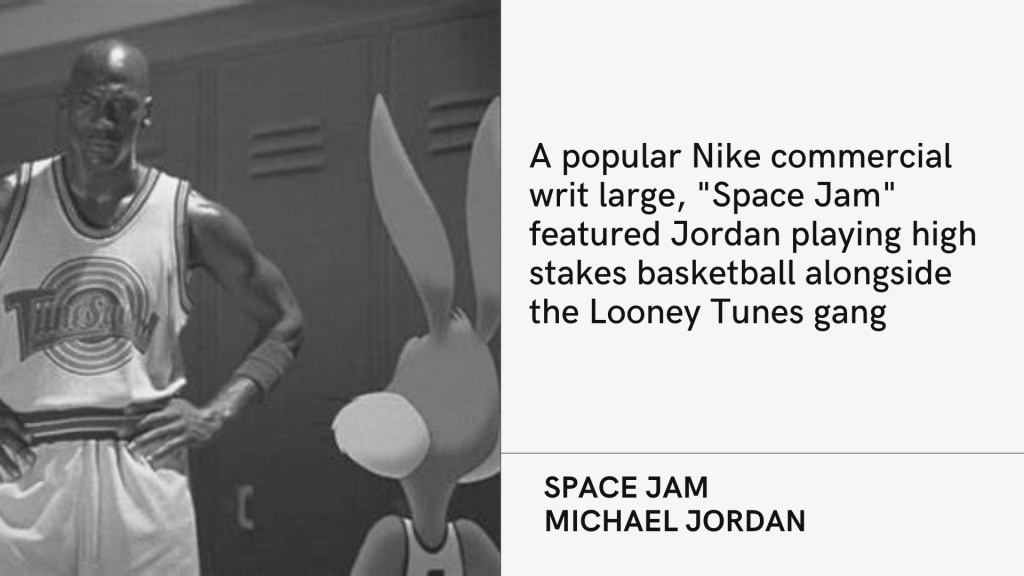
1) “Space Jam” 1996 (Michael Jordan, Charles Barkley, Larry Bird, Patrick Ewing, Larry Johnson, Muggsy Bogues and Shawn Bradley)
2) “Trainwreck” 2015 (LeBron James and Amare Stoudemire)
What is the allure of Hollywood fame to superstar athletes? You can trace it back to 1917, when Ty Cobb starred in “Somewhere in Georgia,” a 30-minute silent film written by Grantland Rice. Jordan was far from the first athlete or even NBA player to make a go at Hollywood fame and fortune but he was easily the most famous. When a Nike Super Bowl commercial starring Jordan alongside Bugs Bunny was a big hit, the gears started turning towards a full length feature. The end result was “Space Jam,” with not just the iconic rabbit but also the rest of the Looney Tunes gang interacting with the Bulls legend. Plenty of other NBA stars were along for the ride, including Charles Barkley, Muggsy Bogues, Larry Johnson, Shawn Bradley, and Patrick Ewing as players whose life force has been sapped by transmogrifying alien creatures in order to transform into basketball dominating monsters. The movie was oddly timed, released in the fall of 1996 when Jordan had already retired from basketball and triumphantly returned. But it was a huge hit, grossing nearly $100 million worldwide.
With ’90s nostalgia running rampant and LeBron James ascending into the NBA pantheon of greatness more and more every year, the calls for a Space Jam sequel starring James have become a clarion at this point. Rumors were revived in the summer of 2018 when James joined the Lakers, and sure enough it was recently announced that the new film will be filmed in 2019 and released the next year. But in the meantime, James managed to show off his acting ability in 2015 in the romantic comedy “Trainwreck.” The movie starred Amy Schumer as a hard-partying, heavy-drinking, relationship-phobic journalist who finds herself falling for a sports doctor played by Bill Hader. His highest-profile client and best friend is James, playing himself, in an understated and surprisingly funny performance. Amar’e Stoudmire also stars as himself, having a surgery performed by Hader’s character go wrong. James’ performance was praised almost universally, with the New Yorker stating “it seems safe to declare that he has given the greatest motion-picture acting performance by an active professional basketball player of all time.”
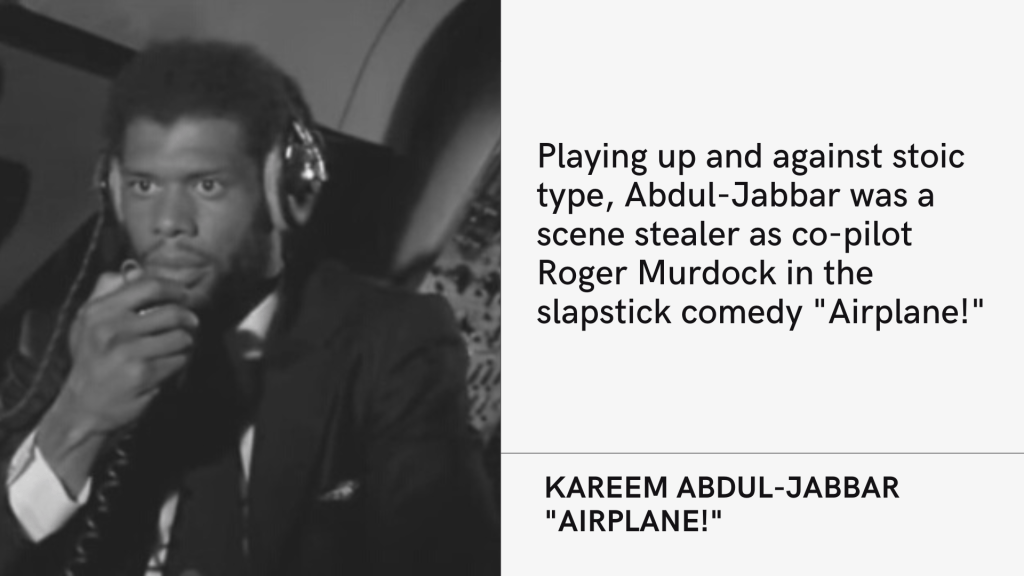
3) “Airplane!” 1980 (Kareem Abdul-Jabbar)
“I’m sorry son, but you have me confused with someone else. My name is Roger Murdock. I’m the co-pilot.” There was absolutely no precedence for a self-deprecating, winking, fun performance from Abdul-Jabbar before “Airplane!” was released in 1980. He did have previous acting credits, but those were all either playing a strait-laced version of himself, or as a dour kung fu fighter in Bruce Lee’s “Game of Death.” Mix that together with Kareem’s introspective and prickly personality and it was a shock to fans and moviegoing audiences to see him cracking wise as an airplane pilot constantly getting mistaken for a basketball superstar. Still one of the funniest movies ever made, “Airplane!” made great use overall of against-type casting choices (including Peter Graves, Barbara Billingsley, and Ethel Merman) to create humor out of simple juxtaposition. Abdul-Jabbar’s part was small but memorable, highlighted by a fourth-wall-shattering exchange where a young boy visiting the cockpit recognizes him as a moonlighting basketball star and accuses him of loafing during regular season games. Kareem grabs the boy by the lapel and hilariously breaks character, imploring “I’ve been hearing that crap ever since I was at UCLA.” Later, after being poisoned by the in-flight meal, Kareem is carried out of the cockpit suddenly wearing his full Lakers uniform, knee pads included.

Our second volume will be published throughout the ’19-’20 NBA season
4) “The Fish That Saved Pittsburgh” 1979 (Julius Erving)
When once asked to name his favorite movie of all time, Erving responded with “The Great Escape” at number one, with “The Fish That Saved Pittsburgh” a close second. You can’t blame the guy for appreciating his own body of work. As for the rest of us, this is a tough watch, an absolute relic of ’70s excess and a huge rip-off of much more successful sports films like “The Bad News Bears” and “Slap Shot.” It’s still a historic curio though, as Erving was breaking ground as a high profile athlete acting in a major movie while his career was not just active, but in its prime. “Acting” maybe belongs in quotation marks though, as Erving’s charisma only went so far in his role as a star basketball player who drives all his teammates to quitting with his egotistical behavior. The owner (played by the great Jonathan Winters) of the fictional team (based in Pittsburgh) turns to an astrologer (played by the also great Stockard Channing), who re-brands them as the Pittsburgh Pisces (hence the film title), with a roster filled out entirely by players with that specific astrological sign. The film culminates in a big game against a Los Angeles team coached by Jerry Tarkanian and stocked with NBA superstars making cameos, including Kareem Abdul-Jabbar, Mychal Thompson, Spencer Haywood, Bob Lanier, Connie Hawkins, Lou Hudson, and Cedric Maxwell (Chic Hearn, Marv Albert, and Meadowlark Lemon also pop up). Broadway legend Debbie Allen, who did the choreography for the film (it featured a lot of disco set pieces, for some reason) and had a cameo as one Pisces player’s girlfriend, met her future husband, Lakers star Norm Nixon, on the set.
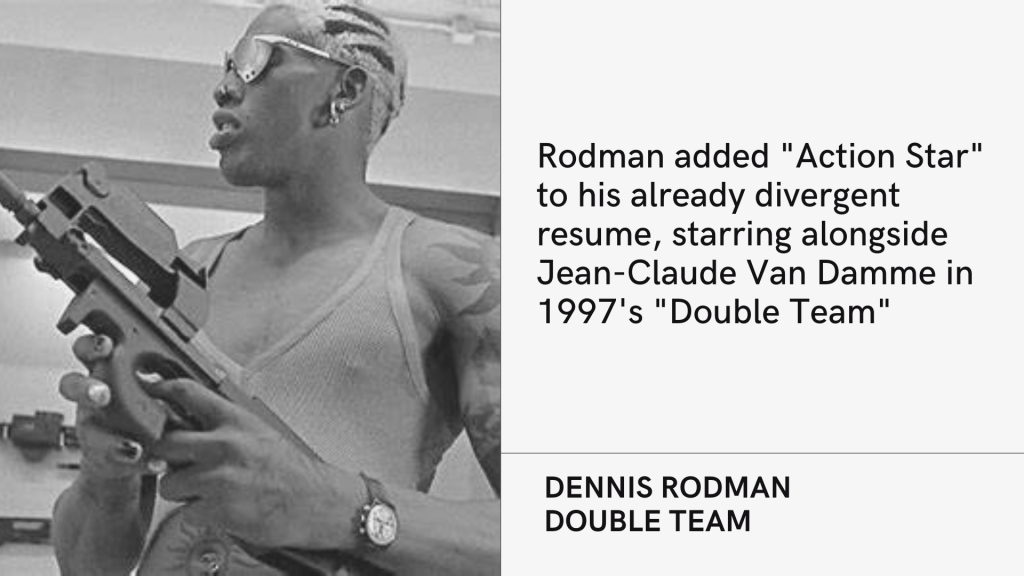
5) “Double Team” 1997 (Dennis Rodman)
Dennis Rodman was always a basketball player destined for other endeavors. His first major foray into film came in 1997 in “Double Team.” A buddy cop action movie in the “Lethal Weapon” vein, it paired Rodman as a weapons dealer teaming up with martial arts legend Jean-Claude Van Damme as a government agent (for which government? It’s never specified) trying to take down a terrorist played by Mickey Rourke. As you could imagine, it was an awful movie and Rodman’s performance is especially slipshod, weighed down by ostentatious wardrobe and hair choices (even by his standards) and a series of stale basketball puns as catch phrases (“offense gets the glory but defense wins the game”). There is, however, also a scene where Rodman swoops into a tiger-infested minefield on a motorcycle to save a baby so who’s to say if this was actually “good” or not? Well, the Academy Awards passed on “Double Team” but Rodman did become the first NBA player to win a Razzie, taking it home for Worst Supporting Actor. He made a couple more attempts at action stardom in “Simon Sez” and “Cutaway” before concentrating more on television appearances for the remainder of his media career.
6) “Just Wright” 2010 (Dwyane Wade, Dwight Howard, Jalen Rose and Rajon Rondo)
Say this about “Just Wright”: at least they got the NBA team licenses. While so many pro basketball movies have had to resort to fake team names and logos to avoid paying licensing fees, “Just Wright” had its star, Common, playing for the actual New Jersey Nets (a choice that’s already woefully dated, as the Nets officially relocated to Brooklyn two years later). One could take a pessimistic view of this, pointing out that it was a calculated move to add some crossover appeal to a listless, featherweight romantic comedy. Some evidence to back up that thought process is found in the unnecessary cameo appearances by several NBA stars, most notably Dwyane Wade. The film’s leads are at least game, as Common and Queen Latifah, who both easily deserve better, slog admirably through trite material. Common is convincing on the court, no surprise as the rapper-cum-actor has been a standout mainstay of the All-Star Celebrity Game over the years, and his father, Lonnie Lynn, was good enough to play for the Pittsburgh Pipers of the ABA. The film’s climactic scene comes when Common’s character, his knee and (sigh) heart both rehabilitated by Queen Latifah’s personal trainer, hits the game winning shot over Wade in game seven of a playoff series versus Miami. It took Common three takes to bury the movie-capping shot but Wade was supposedly impressed with his ball handling and overall game.
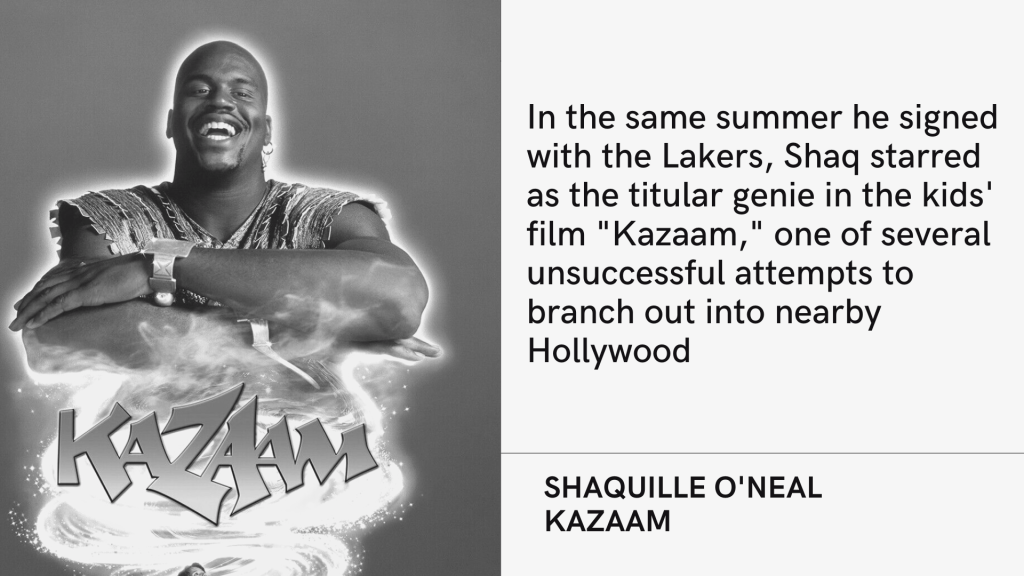
7) “Kazaam” 1996 (Shaquille O’Neal)
8) “Steel” 1997 (Shaquille O’Neal)
9) “Freddie Got Fingered” 2001 (Shaquille O’Neal)
Perusing the Wikipedia plot entry for “Kazaam,” the film that launched Shaquille O’Neal’s acting career, one can’t help but enjoy this tidbit: “Max confesses to Kazaam that he and his father aren’t really connecting, though Kazaam attempts to shirk the issue with some rapping.” Well, that about sums it up. Shaq made three serious incursions into the world of Hollywood in the mid ’90s. The first attempt was the most successful, as he essentially played himself in “Blue Chips.” In the next two offerings, Shaq starred as a magnanimous rapping genie in “Kazaam,” and a conflicted genius military weapons designer who essentially becomes a poor man’s Tony Stark/Iron Man in “Steel.” It’s hard to say which is more ridiculous, and it’s telling that in his next film, O’Neal gave arguably his most assured performance by playing a gonzo version of himself as a scumbag sleeping with Tom Green’s mom in “Freddie Got Fingered.” “Kazaam” scores a sterling 24 out of 100 on the review compilation site Metacritic, while “Steel” clocks in at a 28. When asked about the roles years later, Shaq responded “I was a medium-level juvenile delinquent from Newark who always dreamed about doing a movie. Someone said ‘Hey, here’s seven million dollars. Come in and do this genie movie.’ What am I going to say? No?” Fair enough, Shaq. Fair enough.
10) “Cornbread, Earl and Me” 1975 (Jamaal Wilkes)
Before Dr. J, Wilt, or Kareem debuted on the big screen, the reigning NBA Rookie of the Year, Jamaal Wilkes, starred in “Cornbread, Earl and Me” in 1975. Wilkes had made some Hollywood connections while starring at UCLA, and worked on the film the summer before his rookie year with Golden State. It centered around Wilkes as Cornbread, a high school basketball phenom from an unnamed inner city about to enter college on scholarship. The Earl in the title is one of Cornbread’s friends and admirers, played by Tierre Turner, a stunt man turned actor, and the Me is another childhood friend, Wilford, played by Laurence Fishburne in his film debut. The main set piece of the film is sadly still a relevant one, as Wilkes’ character is mistaken for a criminal and gunned down extra-judiciously by the police. It builds up from there to the climactic scene when Fishburne has to testify on the witness stand about the police brutality he beheld. Though too maudlin and economical to really hold up as a decent movie, it does sadly have a central topic of police brutality that is more relevant than ever. Though Wilkes would never return to acting, he was eventually named to three All-Star Games, won three NBA championships, and in 2012 was inducted into the Hall of Fame. 1981 Finals MVP Cedric Maxwell received the nickname “Cornbread” from a college teammate after they caught the movie together during its theatrical run.
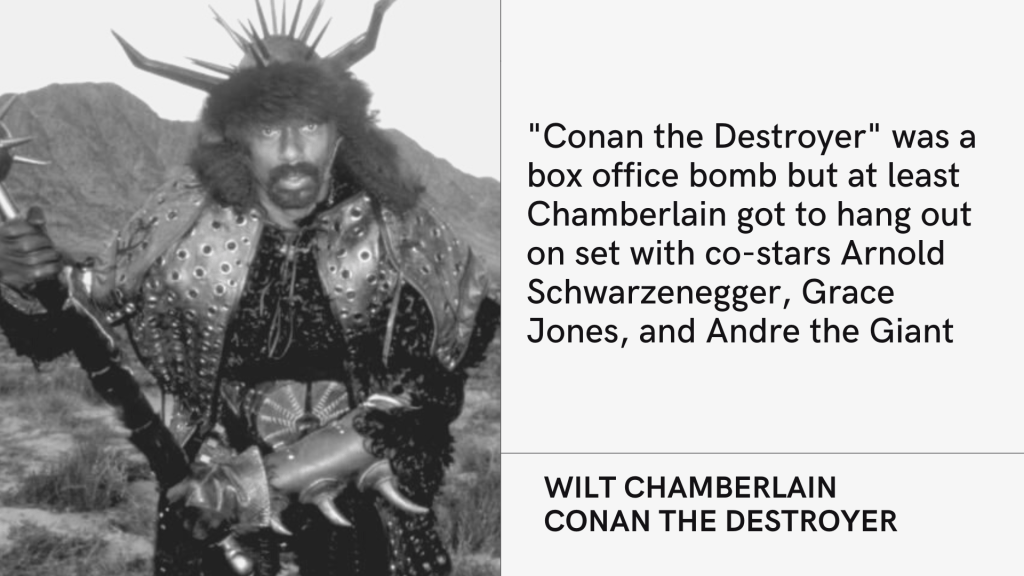
11) “Conan the Destroyer” 1984 (Wilt Chamberlain)
“Conan the Barbarian,” released in 1982, was an enjoyable celebration of B-movie violence and camp, polarizing critics but making a star of Arnold Schwarzenegger as the titular hero. Supporting performances from James Earl Jones and Max Van Sydow brought the film some pathos, as did the directing work of legendary screen writer John Milius. Its box office success spawned the inevitable sequel two years later, a soulless cash-grab affair titled “Conan the Destroyer.” The film retained Schwarzenegger but little else from the original, and featured several stunt casting decisions in major new roles, including singer Grace Jones, wrestler Andre the Giant, and former NBA superstar Wilt Chamberlain. One more important element also gone from the original movie was the violence, which was toned down considerably for the sequel, the better to market it with a PG rating. There’s no need to delve into the labyrinthine and incomprehensible plot, just know that Chamberlain’s character name is Bombaata, he carries a large mace, and late in the movie he turns on Conan, leading to a bizarre fight sequence. Though the film enjoyed mild box office success, Chamberlain’s mostly mute performance apparently wasn’t enough to get his agent’s phone buzzing and any dreams Wilt may have harbored of Hollywood stardom never materialized. One on-set detail that Schwarzenegger would later recall in interviews is just how strong Chamberlain was, and how both he and Andre the Giant could lift Arnold like a rag doll.

12) “Like Mike” 2002 (Various)
13) “Thunderstruck” 2012 (Kevin Durant)
As marketing films directly to kids took hold in the ’80s, it was inevitable that theaters and direct-to-video streams would eventually be deluged with kiddie sports movies. Virtually every American youth plays some sports, and most delight in experiencing played-out fantasies of their own big league dreams. If the idea of a 14-year-old Lil’ Bow Wow playing an orphan who becomes an instant NBA superstar after discovering an old pair of shoes that presumably belonged to Michael Jordan seems preposterous, then consider that it came out five full years after “Air Bud.” The Wikipedia entry, prescient as always, compares “Like Mike” to the similar screenplay of “Slam Dunk Ernest” (which stars Kareem Abdul-Jabbar as Ernest’s guardian angel, but was too depressing to detail even for this list), and the plot was also largely rehashed from the 1997 baseball movie “Rookie of the Year.” No NBA players had a major role in the film, but a large number of them starred as themselves in cameos, and the film was heavily hyped based on their inclusion (the film poster featured Lil’ Bow Wow standing in front of photoshopped images of Allen Iverson, Jason Kidd, Dirk Nowitzki, Steve Nash, and Chris Webber). A modest box office success, “Like Mike” did precipitate a direct-to-DVD sequel but no basketball-related imitators until “Thunderstruck” came along in 2012. The market for kids’ sports films dried up in the ’00s, as Hollywood realized the international market wasn’t nearly as lucrative as it was for non-sports family movies. It was therefore a surprise for many to see “Thunderstruck” hit theaters. Directed by John Whitesell, best known for his work on the “Big Momma’s House” sequels, the movie combined elements of the “kid suddenly acquires professional star level skills” plot that was prevalent in “Like Mike,” mixed with a classic body-switch comedy, as the main character receives his talent in a swap with Kevin Durant. The movie was released on a limited basis late in the summer of 2012, and was mostly ignored outside of Oklahoma.
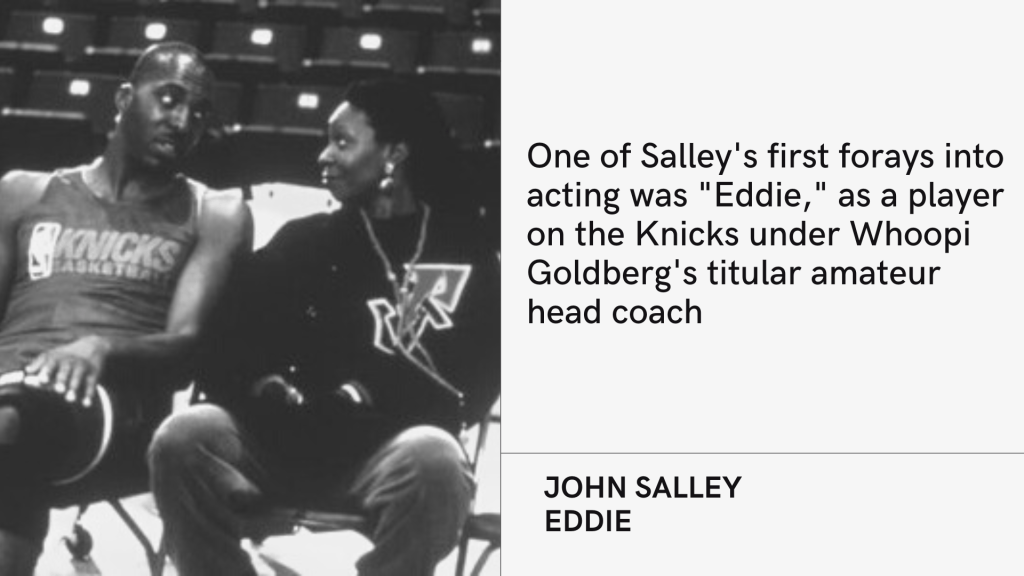
14) “Eddie” 1996 (Mark Jackson, John Salley, Rick Fox, Gary Payton, Greg Ostertag and Dwayne Schintzius)
The fantasy fulfillment of seeing an ordinary person getting their chance to be a sports superstar thanks to some kind of magical circumstances is well-trod territory, but what about if some schlub got to try their hand at coaching? It’s an intriguing concept, as almost any hardcore fan has fancied themselves a better tactician than the coach of their favorite team. Kudos to “Eddie” for bringing the stilted fantasy to its likely unsuccesful conclusion, when Whoopi Goldberg takes over as coach of the Knicks. Of course, everything ends up just fine in the end, with Whoopi’s boisterous personality winning over her players and fans and the film manages to go completely off the rails while still remaining cliche and predictable. The film’s key Knicks are all played by NBA players, with Malik Sealy as a petulant star, John Salley as his washed-up replacement, Dwayne Schintzius as Russian center Ivan Radmonovich, plus Mark Jackson, Rick Fox, and Greg Ostertag. There were also appearances from Gary Payton, Anthony Mason and John Starks as pick-up ball players, plus Dennis Rodman, Muggsy Bogues, Larry Johnson, Dennis Rodman, Walt Frazier and plenty more in cameos as themselves. In a movie full of ludicrous plot anchors, including a woman getting a chance to coach the Knicks because she won a lottery, perhaps the silliest is that New York’s owner is a Texas cowboy looking to re-locate the franchise to St. Louis.
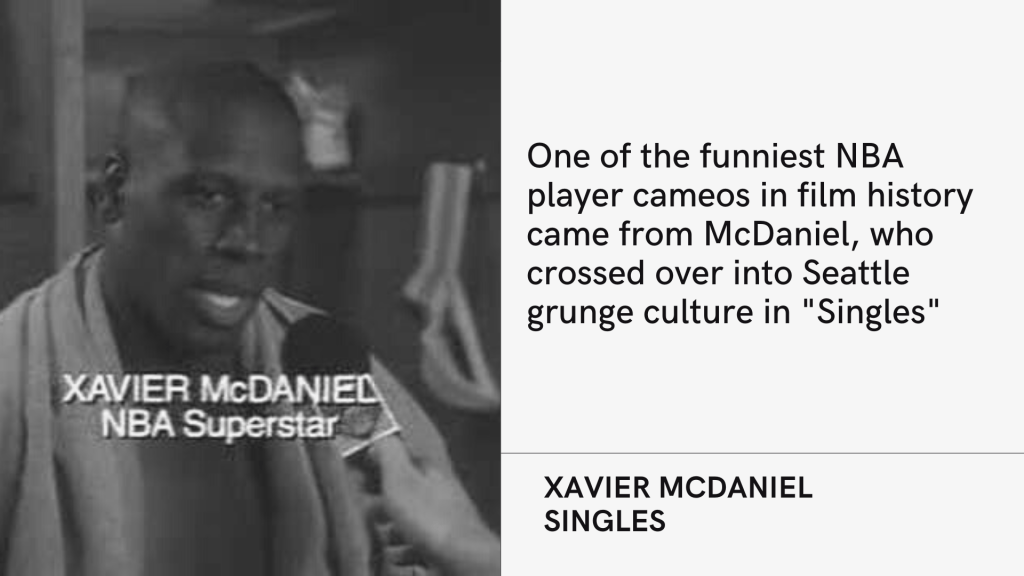
15) “Singles” 1992 (Xavier McDaniel)
The film “Singles” wasn’t quite the watershed moment in Seattle grunge culture that it purported to be, but it was an enjoyable coming-of-age indie film in the grand Cameron Crowe tradition. True to its musical nature, the movie featured cameos from Soundgarden, Tad, and Alice in Chains, plus Pearl Jam founding members Eddie Vedder, Jeff Ament, and Stone Gossard popping up as the backing band to Matt Dillon’s singer character. At the time of filming, the group was still known as Mookie Blaylock, with the change to Pearl Jam coming later over fears of potential litigation. But that’s not the only basketball connection in the film. It also features a cameo from Sonics cult hero Xavier McDaniel, better known as The X-Man. When the character Steve, played by Campbell Scott, is trying to hold out longer during sex with his girlfriend (played by Kyra Sedgwick), he attempts to distract himself by envisioning a typical McDaniel post-game locker interview. In a clever bit of fourth wall destruction, McDaniel turns to the camera and implores Steve not to finish just yet.
16) “Forget Paris” 1995 (Reggie Miller, David Robinson, Charles Barkley, Patrick Ewing, Spud Webb, Isiah Thomas, Kareem Abdul-Jabbar)
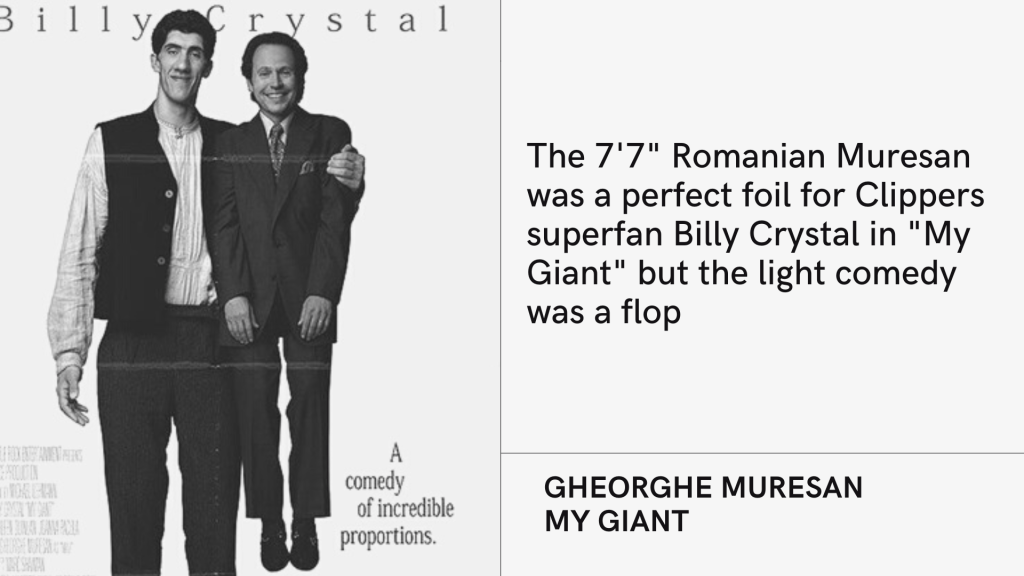
17) “My Giant” 1998 (Gheorghe Muresan)
Thought of as a baseball fan first, as his painstaking work on the movie “61*” would attest, Billy Crystal has always been just as big of an NBA acolyte. Though Crystal retained the Yankees fandom of his Long Island upbringing, in basketball he switched allegiances to the Clippers after becoming a movie and TV star in Los Angeles in the ’80s. Generally known now as the Clippers’ most famous supporter, he stands in stark contrast to the lionized Lakers fans that inhabit the same building on separate nights, like Jack Nicholson, Leonardo DiCaprio, and Denzel Washington. After his directorial debut, the black comedy “Mr. Saturday Night,” was a critical and financial flop, Crystal decided that his follow-up would return to the romantic comedy well that he mined so successfully in “When Harry Met Sally.” The resulting film was “Forget Paris,” starring Debra Winger as Crystal’s love interest. Wisely jettisoning any possible concept of positing himself as a basketball player, Crystal made the next logical leap by playing an NBA referee. That allowed him to work in sizable cameos for Charles Barkley (who is convincingly menacing when arguing with Crystal over a call), David Robinson, Isiah Thomas, Kareem Abdul-Jabbar (whom Crystal hastily ejects from a game during his retirement ceremony season), Patrick Ewing, Reggie Miller, Kurt Rambis, and Spud Webb, amongst others. Three years later Crystal was again acting alongside an NBA player, but this time the movie had nothing to do with basketball. In “My Giant,” Crystal plays a Hollywood agent who stumbles upon a Romanian giant named Max, portrayed by the 7’7″ Gheorghe Muresan. Muresan had spent a few years with the Bullets by then and developed into a solid contributor despite the sideshow oddity of his stature. The movie centers around Crystal’s character’s attempts to get Max a starring role in a Steven Seagal (who plays himself) action flick and turn him into a star, indubitably the conceit in real life of giving the role to Muresan. Though Max nails the portrayal, the film ends on a maudlin note, as a genetic heart disease causes him to cut his career short after one film. In a case of life imitating art, Muresan never made another appearance on screen (it didn’t help that “My Giant” was a flop), though his actual life had a happier ending. His NBA career continued until 2000, and he now runs a basketball academy for children while working in the Wizards’ marketing department.
18) “White Men Can’t Jump” 1992 (Marques Johnson and Freeman Williams)
Few basketball movies have approached the loving authenticity of “White Men Can’t Jump.” Director Ron Shelton accomplished this foremost by basing the story in the easier-to-capture world of street ball rather than the college or pro ranks and he upped the quotient by using several former NBA stars in supporting roles. The film’s leads, Woody Harrelson and Wesley Snipes, went to a month-long basketball boot camp with the supporting cast, which included Marques Johnson and Freeman Williams. Williams, a two-time NCAA scoring champ at Portland State who played six years in the NBA, mostly for the Clippers, starred as the “fowl” half of the legendary “Duck and King” duo whom Snipes and Harrelson defeat at the end of the film (“The King” was played by Louis Price, former member of the Temptations). Johnson, an NCAA champion at UCLA and later a five-time NBA All-Star with the Bucks and Clippers, had a brief but memorable role as Raymond, a menacing baller who heedlessly robs a local liquor store to procure collateral funds for a street game, even though the clerk instantly recognizes him. The story was inspired by a real life incident involving Reggie Harding, a promising talent who burned out of the NBA by age 25 and was committing regular armed robberies to support his drug habit.
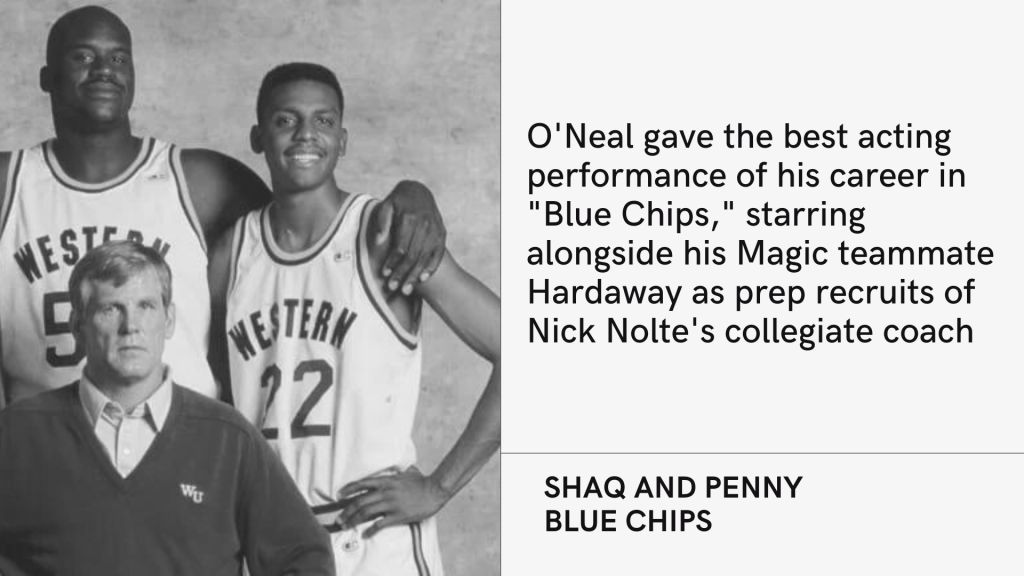
19) “Blue Chips” 1994 (Shaquille O’Neal, Penny Hardaway, Larry Bird and Bob Cousy)
Billy Friedkin entered the ’90s in a prolonged slump. The director had become the toast of Hollywood in the early ’70s for his consecutive directing efforts in “The French Connection” and “The Exorcist.” His big-budget follow-up, the adventure thriller “Sorcerer,” was an unmitigated disaster in production, and was blown off the screen by the just-released “Star Wars.” Friedkin reverted to making low-budget think pieces throughout the ’80s and early ’90s, mostly well received by critics but ignored by general audiences. It was a surprise when he returned to Paramount to work on an expensive new movie about the high-stakes challenge of college basketball recruiting. “Blue Chips” starred Nick Nolte as a Bobby Knight-type coach named Pete Bell (Knight appears briefly in the movie as himself, coaching Indiana) at a made-up school called Western, who spends the film in an existential crisis, torn between breaking recruiting rules to easily better his team, or sticking to his ethics knowing that failure on the court would cost him his job and reputation. Shaquille O’Neal and Penny Hardaway, who were then star teammates on Orlando, played two highly sought-after recruits that accept gifts to play at Western. O’Neal is ostensibly the center of the movie, radiating superstar charisma and producing easily his career best performance, by playing an eased version of himself with the superb character name Neon Boudeaux. Larry Bird also makes an appearance as himself, while Bob Cousy stars as Western’s Athletic Director. In one scene, while Cousy is conversing with Nolte, his character nonchalantly sinks several free throws in a row. The possibly apocryphal story goes that the then 65-year-old Cousy stepped on to the court for the first take and hit 21 straight, but after an extended bit of downtime in his trailer, couldn’t hit more than two in a row for subsequent takes. It wound up taking almost a month for Cousy to film his six scenes, and afterwards he vowed that his film career was over, as apparently the stresses of a Hollywood set were preeminent to those of the Boston Garden during an NBA Finals. Blue Chips was panned by critics and only a moderate box office success, but Friedkin has eventually experienced a creative renaissance, directing the well-received films “Bug” and “Killer Joe” in more recent years.
20) “Uncle Drew” 2018 (Kyrie Irving, Lisa Leslie, Shaquille O’Neal, Reggie Miller, Chris Webber and Nate Robinson)
While his longtime teammate LeBron James was working to get a Space Jam sequel off the ground, Irving quickly swooped in and created his own full length movie based on a commercial. The ad in this case was a series of Pepsi spots where Irving donned prosthetics and makeup to play the titular Uncle Drew, a geriatric street baller who revels in showing up young competitors. In a bit of capitalistic hubris, Pepsi opted to turn these commercials into a full length movie starring Irving and several former NBA stars that, of course, heavily featured Pepsi products. As shocking as it is that this happened, it’s even more shocking that the final product, though not great, at least wasn’t terrible. “Uncle Drew” received decent reviews from critics, even as they noted the formulaic plot and blatant product placement, and did ok in the box office. In the film, Irving joins a semi-pro team and reunites with his former teammates, who are all former stars in old man makeup: Shaq, who now runs a martial arts center, Miller, who is now blind, Webber, who is now a preacher, and Robinson, who is now wheelchair-bound in a retirement home. It also stars Leslie as Webber’s wife, who steps in to play in the big game when O’Neal’s character suffers a heart attack, as well as comedy ringers JB Smoove, Lil Rey Howery, Nick Kroll, and Tiffany Haddish. Several other NBA Hall of Famers, including David Robinson, Earl Monroe, Jerry West, Bill Walton, and George Gervin, also make cameo appearances. With filming happening during the summer of 2017, so as not to interfere with Irving’s playing schedule, the star supposedly was on set when he found out about his trade from the Cavaliers to the Celtics.
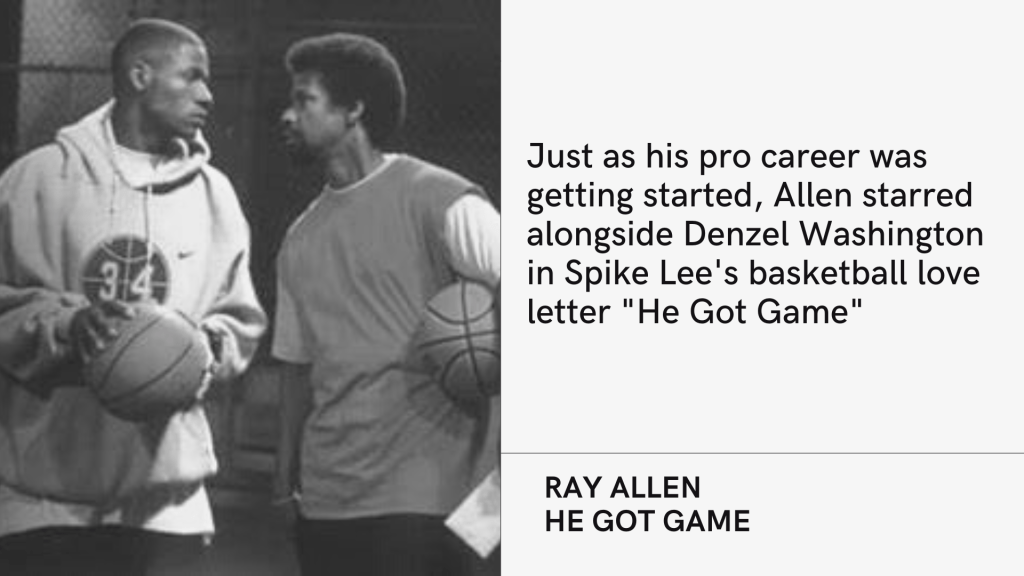
21) “He Got Game” 1998 (Ray Allen and Rick Fox)
It was an audacious idea, but if anyone was going to pull it off, we had to assume Spike Lee was the man for the job. A lifelong NBA fanatic, as well as a de facto Hollywood voice for the African-American experience, Lee seemed equipped to finally bring a legitimacy to a modern basketball movie. Just as Kevin Garnett and Kobe Bryant were revolutionizing the direct jump from high school to the pros, the film centers on a prep star named Jesus Shuttlesworth, and his impending decision to play at a major college or hire an agent and declare for the draft. Primed to rise above his upbringing in the projects of Coney Island, Shuttlesworth finds himself already pulled in myriad directions by coaches, family members, recruiters, agents, friends, hangers-on, and his girlfriend. Matters are muddied even further by the sudden appearance of his incarcerated father, played by Denzel Washington, who could possibly receive parole if he can convince his son to attend his prison warden’s alma mater. When the film first hit the public consciousness, the big controversy was Lee’s decision to cast young NBA star Ray Allen in the lead role. That turned out to be only the fourth or fifth strangest and most distracting directorial choice he made, coming in behind the soundtrack heavily leaning on Aaron Copland, the implausible plot for Washington’s character, the overt cartoon sleaziness of the college recruiters, and a momentum-killing hooker-with-a-heart-of-gold side plot with Milla Jovovich. Not that “He Got Game” was a bad movie, but those shortcomings prevented it from rising to the level of a great one. Rick Fox shows up as the star player for a college Shuttlesworth is considering attending, while Walter McCarty, Travis Best, and John Wallace play his high school teammates. There’s also blink-and-you’ll-miss-it cameo appearances from Shaquille O’Neal, Reggie Miller, Scottie Pippen, Charles Barkley, Bill Walton, and even Michael Jordan, though no one from Lee’s beloved Knicks. The climactic scene is a Faustian game of one-on-one between the son and father to determine both their futures. The script called for the game to finish with an 11-0 victory for Allen, but as the actors fully improvised, Washington managed to score the first few points before Allen rallied and blew by him for the win. It’s a classic goosebump-inducing sequence but one that grows and pays off organically as opposed to the typically manufactured heroics prevalent in sports movie final acts. It’s a perfect scene in an otherwise flawed movie, maybe the best representation of the allure, majesty and importance of basketball ever put in a film.
Next up in Entertainment and Media
- Dead air: Eight legendary NBA players who struggled as television broadcasters
- Primetime players: 14 notable NBA crossovers with Saturday Night Live
- Won’t see my picture on the cover: 10 NBA Finals that weren’t featured on a Sports Illustrated cover
- Faces in the crowd: 12 NBA celebrity superfans
- Boomshakalaka!: Ranking the 27 rosters from the original NBA Jam (1993 arcade edition)
- Soles power: 16 notable signature basketball shoes
- Media matters: A history of the NBA in 12 television rights contracts
- Golden voices: Eight NBA announcers with retired microphones
- Video killed the radio star: Seven notable VHS releases from NBA Entertainment
- Strictly commercials: 19 memorable television advertisements starring NBA players
Next up in Shaquille O’Neal
- Separated laundry: 18 NBA players with a jersey retired by multiple franchises
- First quarter check in: 101 greatest NBA players of the 21st century (so far)
- Tough act to follow: 23 (mostly) forgotten NBA players who replaced departing legends
- Mamba’s den mates: Ranking the 31 players who won a title as Kobe Bryant’s Lakers teammate
- Primetime players: 14 notable NBA crossovers with Saturday Night Live
- Strictly commercials: 19 memorable television advertisements starring NBA players
- Us against the world: Ranking the 18 U.S. FIBA World Cup teams
- Testing the waters and creating a ripple: 15 free agency signings that changed the NBA
- Keep your bags packed: 15 legendary players who switched NBA teams twice or more in their prime
- Better luck next time, kid: 19 greatest rookie performances that didn’t earn Rookie of the Year
 Basketball, Listed