29) Latrell Sprewell (1998-2003)
Winning over Knicks fans was a tall order for Sprewell, after he was traded to the team on January 21, 1999, the day after the lockout ended. Already a pariah for his choking former coach P.J. Carlesimo, Sprewell also had to overcome being exchanged for New York folk hero John Starks. A calendar year removed from his last competitive basketball with the Warriors, Sprewell slowly transitioned into the Knicks lineup, mostly backing up Kurt Thomas and Allan Houston at the wing positions during the regular season. Once the playoffs started, Sprewell wrote his own Knicks legend, averaging a team high 20.4 points per game and leaving it all on the court nightly as the Knicks reached the NBA Finals. He eventually spent five seasons with the team, going to the All-Star Game once, in 2001, but the relationship eventually soured when he showed up to training camp in 2002 with a broken hand he claimed was suffered by slipping on his yacht.
28) Charlie Ward (1994-2004)
Easily the greatest Knicks player of all time who also happens to be a Heisman Trophy winner (in fact, he’s the only NBA player in history with that award), Ward was a bigger football star than basketball at Florida State but opted to go pro in the latter after he was New York’s first round pick in 1994 (he went un-drafted in the NFL). Joining a team that already had three solid, veteran point guards in Derek Harper, Doc Rivers, and Greg Anthony, Ward found slight playing time at first but eventually took over the starting spot in ’97-’98 and held it for three eventful seasons. Though he was never a star player, Ward was popular with fans for his unselfish play, long range shooting, and accurate passing that earned him the nickname “best quarterback in New York” (the Jets and Giants were both struggling at the time). He never averaged more than six assists in a season but Ward hung around long enough to be seventh all-time in Knicks history in total assists, as well as fifth in steals and three-point field goals.

Our second volume will be published throughout the ’19-’20 NBA season
27) Micheal Ray Richardson (1978-1982)
One year after trading away franchise legend Walt Frazier to the Cavaliers, the Knicks selected Richardson third overall in the draft to replace him. It was a tough spot for any young player to be in and though he hardly lived up to those lofty expectations, Richardson was an impressive player for New York. He lasted just four seasons with the team but stands 10th in franchise history in assists, third in steals, and second in triple-doubles, trailing only Frazier. In ’79-’80, Richardson became the first player in NBA history to lead the league in both assists and steals, while carrying on Frazier’s tradition of Knicks point guards being an annual presence at the All-Star Game and on the All-Defensive team. Despite his individual success, Richardson did little to improve New York’s fortunes in the standings and by ’81-’82 was losing support in the franchise for his erratic behavior, which would later be tied to excessive cocaine use. He was traded to the Warriors in 1982 for Bernard King, kicking off a new era in Knicks basketball. Richardson’s 265 steals in ’79-’80 is the Knicks franchise record, as are his 359 turnovers that same season.
26) Nat Clifton (1950-1957)
Though his metric contributions place him only 26th on this list, Clifton had a much larger intangible impact as the first Black player in Knicks history. He was actually the first Black player to be signed by any team, after the Knicks drafted him in 1950. Before his NBA days, Clifton already had a lengthy pro career under his belt with various barnstorming teams, including the legendary Harlem Globetrotters and New York Rens, and even played a little Negro League Baseball, for good measure. Filling in immediately as the starting power forward, Clifton was a crucial part of the Knicks teams that reached three consecutive NBA Finals, starting in his rookie year, ’50-’51. Though the team lulled later on in the ’50s, Clifton remained a force, even getting named an All-Star in 1957 at the age of 34.
25) David Lee (2005-2010)
Knicks fans certainly don’t look at his time with the team as the fondest era in franchise history. In fact, Lee never reached the playoffs in his five seasons with New York, saving his long postseason runs for later in his career with the Warriors and Spurs. But Lee was a rare bright spot for the Knicks in those Isiah Thomas years, peaking in his final season with the team, ’09-’10, when he averaged a career high 20.2 points per game and was the team’s first All-Star representative in nine years. An incredibly efficient player in a league that was increasingly prioritizing advanced statistics, Lee had some of the greatest seasons in Knicks history for rebounding percentage, field goal percentage, and offensive rating. He was traded to the Warriors in 2010 in an attempt to free up salary space to sign Dwyane Wade or LeBron James, and neither the trade nor the free agency gambit worked out.
24) Walt Bellamy (1965-1968)
Though his early years with the Baltimore Bullets are what got him inducted into the Naismith Hall of Fame, Bellamy also had three great seasons with the Knicks in his prime. He was traded by the cash-strapped Bullets to New York early in the ’65-’66 season and formed an overwhelming front line with Jim Barnes and a young Willis Reed. Bellamy averaged 18.9 points and 13.3 rebounds for the Knicks over three seasons but the coaching staff rightly identified him as an unnatural fit next to Reed, leading to early playoff exits in 1967 and 1968. Halfway through the ’68-’69 season, Bellamy was dealt to the Pistons for Dave DeBusschere, a trade that many point to as the moment the Knicks put themselves into position to win championships in 1970 and 1973. Thanks to a quirk in the schedule, Bellamy set a now impossible-to-break NBA record by appearing in 88 games in ’68-’69 with the Knicks and Pistons. His 13.3 rebounds per game are still the Knicks career franchise record, and he also holds the single season franchise record with 16.0 rebounds per game in ’65-’66.
23) Johnny Green (1959-1965)
Nestled in between the careers of franchise legend power forwards Nat Clifton and Willis Reed was Green, who held down the fort for six seasons after the Knicks drafted him in the first round in 1959. New York never reached the postseason while he was there but it wasn’t due to a lack of individual success for Green, who was named to three All-Star Games in that span. He averaged a double-double for four consecutive seasons for the Knicks, peaking in ’62-’63 with 18.1 points and 12.1 rebounds per game, and generally was the only consistent offensive threat on the team. When the Knicks drafted Reed in 1964 and he showed instant promise, Green was expendable and quickly traded to the Bullets for Walt Bellamy. He found a surprising second wind later in his career, leading the NBA in field goal percentage twice in the early ’70s, and getting named an All-Star for the Royals in 1971 at age 37.
22) Anthony Mason (1991-1996)
One of the most popular players in Knicks history, Mason was a long shot to even make the roster when they signed him in 1991. He was already 24 years old and had flamed out in brief stints with the Blazers, Nets, and Nuggets, plus stints in the CBA and in Turkey, but Pat Riley quickly recognized how to weaponize his toughness and versatility. Mason was never a top offensive threat for the Knicks but he blossomed into a defensive force. Adjustable enough to guard basically any position, he would get deployed off the bench as the ultimate cooler, and usually closed out games covering the opposing team’s best scorer. In ’94-’95, Mason became the first Knicks player to earn Sixth Man of the Year honors and though they ultimately fell short in the NBA Finals, his defensive intensity in the 1994 playoffs is legendary to this day amongst the Knicks faithful. He was inserted into the starting lineup and averaged a career high 14.6 points per game in ’95-’96 before getting traded to the Hornets for Larry Johnson.
21) Mark Jackson (1987-1992, 2001-2002)
It almost seemed too good to be true that a New York playground legend, who played his high school ball in Brooklyn and spent his college days at St. John’s, would fall to the Knicks with the 18th pick of the 1987 NBA Draft. Even better, Jackson slotted in instantly at point guard, taking control of a position where the Knicks had been struggling in recent years with stopgap solutions like Rory Sparrow and Darrell Walker. He joined Willis Reed and Patrick Ewing as the only Knicks players to earn Rookie of the Year, by averaging 10.6 assists per game in ’87-’88, good for second in the NBA, and was an All-Star in the ’88-’89 season while helping New York reach the second round of the playoffs. Things stalled a bit for there for Jackson, as he fell out of favor under coach Stu Jackson, who took over for Rick Pitino in ’89-’90, and lost playing time to veteran signee Mo Cheeks. After getting traded to the Clippers in 1992, Jackson continued on for 17 total seasons in the NBA, ultimately ending up fourth in league history in career assists. He seemed to delight in tormenting his former Knicks team, doing so especially during the 2000 Conference Finals with the Pacers. He eventually returned to New York via trade and started all 82 games for the Knicks in ’01-’02 at age 36. Jackson holds the franchise record for assists in a season, and is second in total career assists behind only Walt Frazier.
20) Kurt Thomas (1998-2005, 2012-2013)
During a career lasting 18 seasons with nine different franchises, Thomas spent the bulk and the prime of his playing days with the Knicks. He actually spanned both sides of the Knicks-Heat rivalry of the late ’90s, starting his career with Miami and playing against New York in the 1997 playoffs before signing with the Knicks before the ’98-’99 season. Thomas was the starting power forward on the ’98-’99 Knicks team that reached the NBA Finals and he held that job, more or less, for the next seven years. Not much of a stat sheet filler, Thomas was hard-nosed and a jack-of-all-trades type, adding rebounding, passing, defense, and the occasional scoring outburst. He is ninth in franchise history in total rebounds and fourth in blocks. After getting traded to the Suns in 2005 and subsequently spending time with the Sonics, Spurs, Bucks, Bulls, and Blazers, Thomas returned to New York in 2012 and played his final season with the team before retiring at age 40.
19) Bernard King (1982-1987)
Though he played college ball at Tennessee, was drafted by the Nets, and had his breakout season with the Warriors, the Brooklyn-born King was always destined to be a Knicks star. With an absurd bag of tricks that he had honed on the playgrounds of New York, King was arguably the premier offensive threat of the ’80s until suffering a devastating ACL tear. King was traded to the Knicks from Golden State in 1982, in exchange for Micheal Ray Richardson, and jump started a previously anemic offense. He almost single-handedly stunned the Celtics in a Conference Semifinals series in 1984, then led the NBA in scoring in ’84-’85 with 32.9 points per game. But tragedy struck during that ’84-’85 season and King was never the same after his injury, missing essentially two-and-half seasons of play and forcing the Knicks to waive him. He was 1st-Team All-NBA twice for New York, finished second in MVP voting in ’83-’84, and his scoring average in ’84-’85 is still the franchise record.
18) Willie Naulls (1956-1962)
10 years after they signed the first Black NBA player in Nat Clifton, the Knicks named Willie Naulls as the first Black captain in league history. One of the earliest stars under John Wooden at UCLA, Naulls left the school as the all-time leading scorer and rebounder and was drafted by the Hawks in 1956. As a kid, he had moved with his family from Dallas from L.A. to escape segregation, so the racist environment in St. Louis was a real culture shock. Luckily, Naulls was traded just 19 games into his career to New York, where he thrived over six seasons as a team leader. He averaged 18.2 points and 11.1 rebounds per game during his time with the Knicks, was named to four All-Star teams, and in ’61-’62 set the franchise record by scoring 30+ points in seven consecutive games. Though Naulls reached the postseason just once with the Knicks, he eventually won three titles as a role player with the Celtics. He is one of just five Knicks players to total over 5,000 rebounds for the club.
17) John Starks (1990-1999)
Though Patrick Ewing was obviously the biggest star and face of the franchise, arguably no player exemplified the ’90s Knicks more so than Starks. His road to the Knicks exemplifies everything about him, expelled from two different colleges, un-drafted out of Oklahoma State, cut by the Warriors, and toiling in the CBA when the Knicks signed him in 1990. He was supposedly not going to make the ’90-’91 Knicks team but managed to injure his knee trying to dunk on Ewing in a preseason practice, and therefore had to stick on the roster because of the injury. It ultimately paid off for both sides, but never without some controversy. Starks was Sixth Man of the Year in ’95-’96, an All-Star in 1994, and averaged as many as 19.0 points per game in his prime. He was also notoriously temperamental and dangerously overconfident, which led to numerous playoff disappointments, most notably a 2-of-18 shooting performance in the game seven loss of the 1994 NBA Finals. Knicks fans always had a love-hate relationship with him, cherishing his aplomb, toughness, and thunderous dunks while always acknowledging deep down that the Knicks likely had a better title shot in the ’90s with a more reliable secondary offensive weapon. Though he played in an era when it wasn’t nearly as popular a weapon as it is now, Starks is still the all-time franchise leader in total three-point field goals.
16) Kenny Sears (1955-1962)
From their string of three consecutive Finals appearances in the early ’50s through their mid ’60s rebuild around Willis Reed, the Knicks struggled in the standings but did have a breakout star in Sears. A first round pick out of Santa Clara in 1955 (while in college, he notably became the first basketball player featured on the cover of Sports Illustrated), Sears joined a team in transition and quickly became a cornerstone of their offense. He led the Knicks in scoring in ’57-’58 and in ’58-’59, with a career high 21.0 points per game in the latter, and was an All-Star in both those seasons. Sears also became the first Knicks player to lead the league in field goal percentage, doing so in ’58-’59 and ’59-’60 (the only Knicks player to accomplish it since was Tyson Chandler in ’11-’12) and finished in the top 10 in MVP voting twice. Frustrated with New York’s losing ways (they reached the playoffs just once in his time there), Sears absconded back home to California in 1961, signing with the San Francisco Saints of the ABL. He actually came back to the Knicks briefly when the ABL folded (even though the Knicks sued him for breach of contract) before closing out his NBA career by playing in the 1964 Finals with the Warriors.
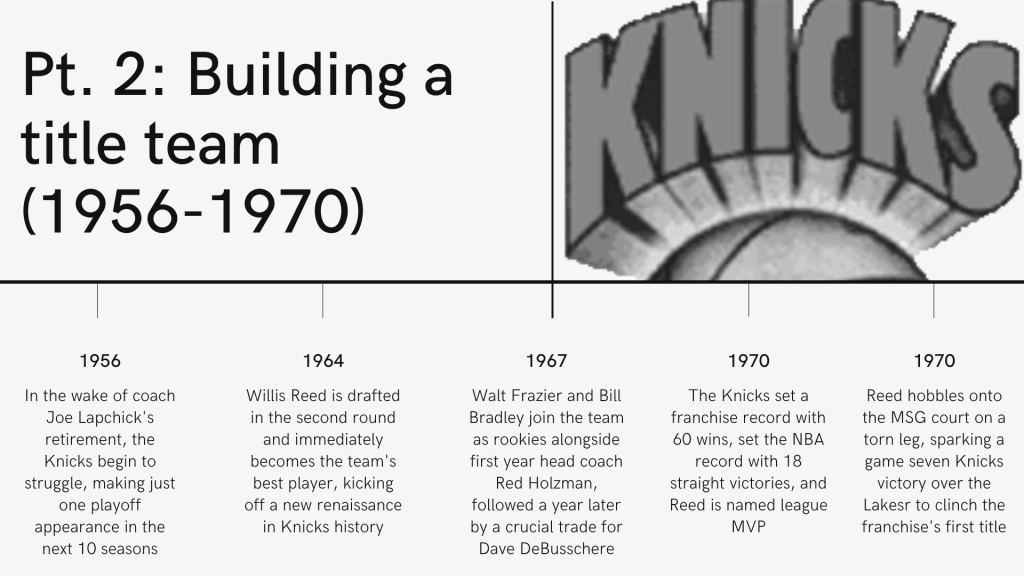
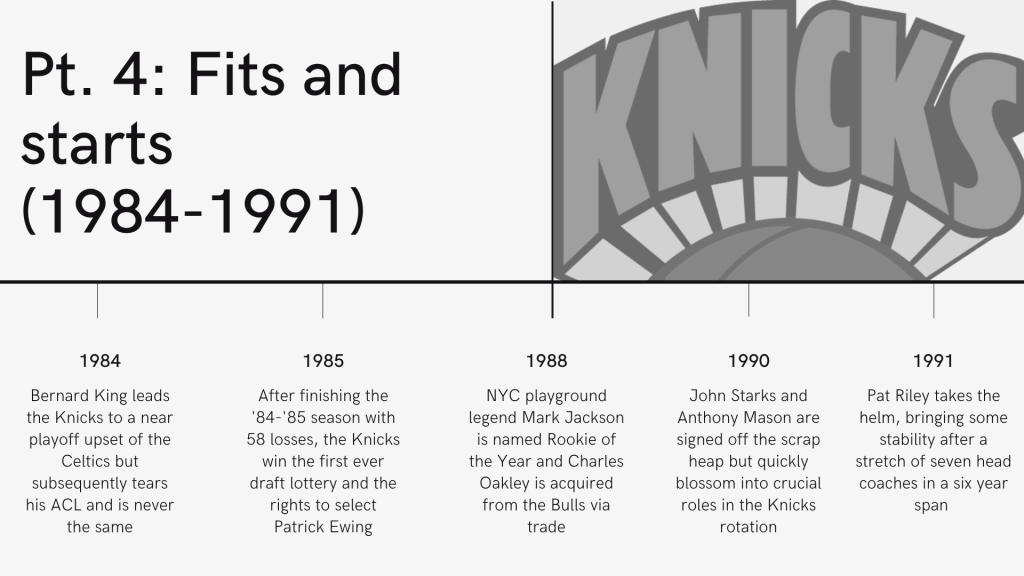
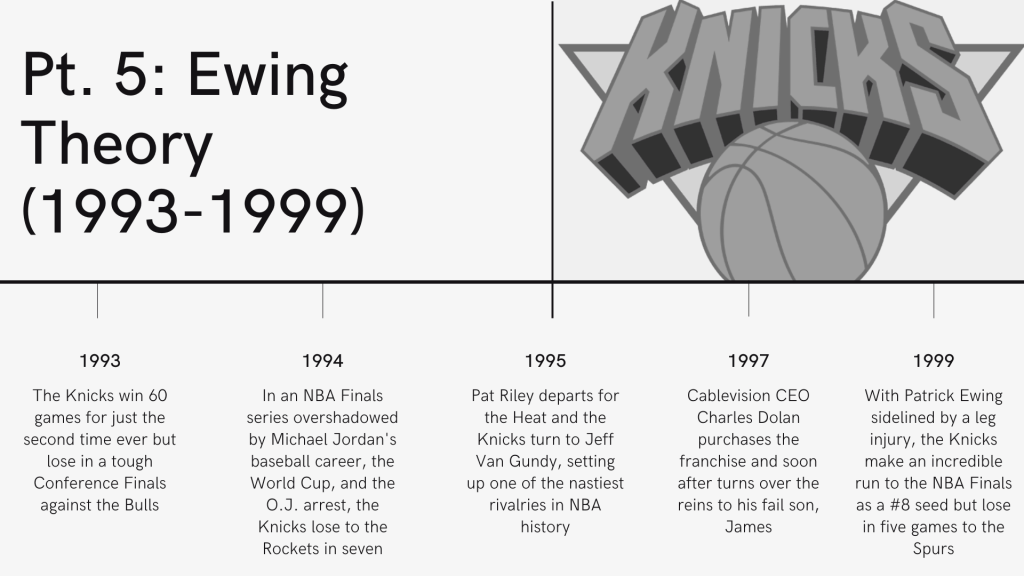
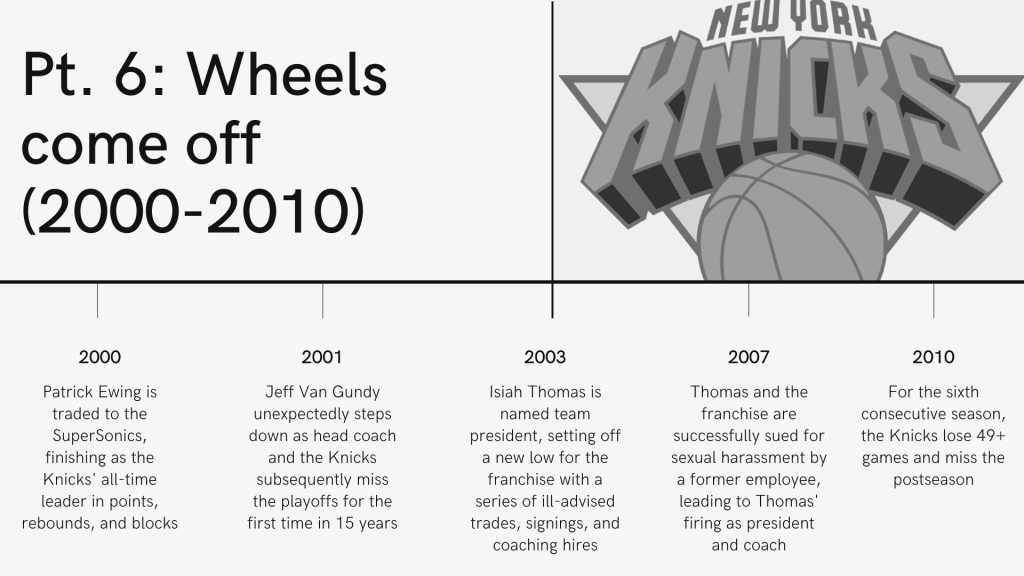
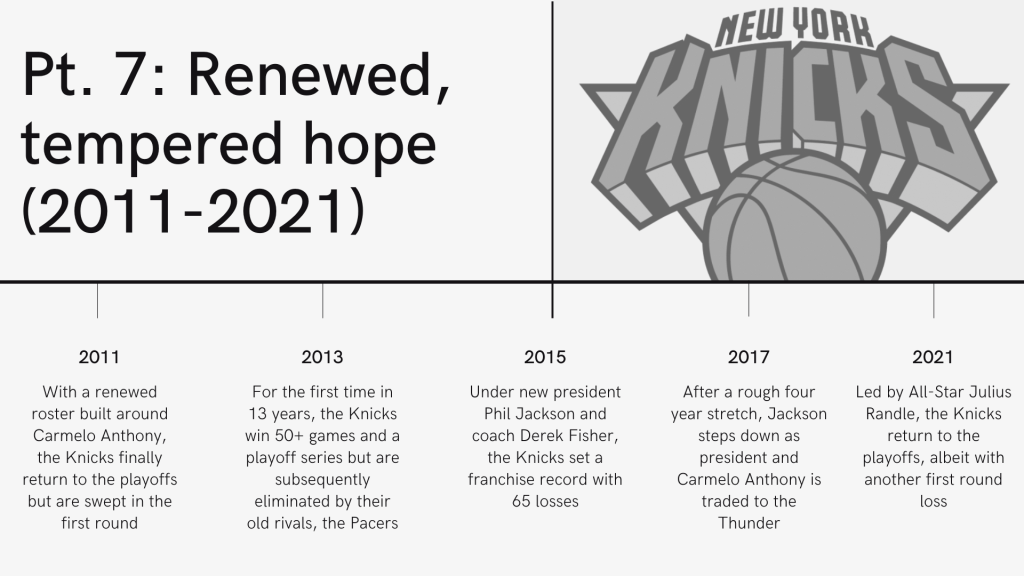
A timeline of Knicks franchise history


15) Bill Cartwright (1979-1988)
Most fans remember him first and foremost as the starting center on the first trilogy of Michael Jordan Bulls championships, but Knicks fans (of a certain age) also know Cartwright as a one-time potential franchise savior who struggled with injuries. Despite major issues with his feet, he was still a quantifiable success for New York, getting named an All-Star as a rookie, averaging 15+ points and seven-plus rebounds per game in six different seasons, and totaling a franchise record 543 blocks (that was soon after smashed by Patrick Ewing, but Cartwright is still second in the category). But he wasn’t Willis Reed and he wasn’t leading the Knicks to much playoff success, and when Cartwright missed essentially the entire ’84-’85 and ’85-’86 seasons with foot injuries, he was replaced by Ewing. After a couple seasons backing up Ewing, Cartwright was traded to the Bulls in 1988 in exchange for Charles Oakley.
14) Allan Houston (1996-2005)
We might as well start with that contract, signed by Houston in 2001 for six years, $100 million. He had just two All-Star appearances at that point and was already 29 years old and it became an albatross around the neck of the Knicks front office for years and arguably set in motion all the failures of the last two decades. But let’s also come to praise Houston, the playoff hero, whose dramatic game five buzzer beater capped off a huge first round upset of the Heat and who eventually propelled the Knicks to the NBA Finals with a huge performance in the clinching game six of the Conference Finals. He was the second leading postseason scorer on those ’98-’99 Knicks, forming a dynamic wing duo with Latrell Sprewell and it was the peak of his career. Though he was paid like a superstar, Houston averaged 20+ points per game just twice in his career and struggled with injuries in his later days. He is the fourth all-time leading scorer in franchise history, second in three-point field goals, and fifth in free throw percentage. Having played on the 2000 squad that won gold in Sydney, Houston is also one of just four players (along with Carmelo Anthony, Tyson Chandler, and Patrick Ewing) to represent Team U.S.A. at the Olympics while playing for the Knicks.
13) Dick McGuire (1949-1957)
One of just two Knicks, along with Micheal Ray Richardson, to lead the NBA in total assists in a season, McGuire did so in ’49-’50 with a then all-time record of 386. Though he never was the league leader in assists per game, McGuire finished in the top five in that category in his first six seasons, peaking at 7.6 per game in ’54-’55. A forebear to guys like Mark Jackson and Rod Strickland, McGuire (along with his brother and Knicks teammate, Al) was a New York playground legend, wowing onlookers (including a young Bob Cousy, who picked up a thing or two from him) with an array of play making moves that earned him the nickname “Tricky Dick.” He tempered that flamboyant style a bit with the Knicks, but was still one of the team’s most popular players as they reached three consecutive NBA Finals, starting in 1951. Named to seven All-Star teams, McGuire was eventually inducted into the Naismith Hall of Fame and had his jersey #15 co-retired by the Knicks with Earl Monroe.
12) Carmelo Anthony (2011-2017)
After famously striking out in the 2010 free agency frenzy, landing only an injury-prone Amare Stoudemire, the Knicks attempted to make a splash at the 2011 trade deadline. As part of a massive three-team trade, they brought in Anthony, who had grown up in Brooklyn before attending high school in Maryland. The results were mixed. He had arguably the best season of his career with New York, winning the scoring title in ’12-’13 with 28.7 points per game, finishing third in MVP voting, and leading the Knicks to their only second round playoff appearance of the last 20 years. As to be expected, he also racked up plenty of scoring in his six seasons with the Knicks, and is seventh in franchise history in total points and third in three-point field goals. He also reportedly clashed with coach Mike D’Antoni, bristled at management’s inability to build around him, and, as mentioned, couldn’t get past the Conference Semifinals and ultimately reached the playoffs just three times in six years.
11) Charles Oakley (1988-1998)
He was an All-Star only once, averaged just 10.4 points per game in his 10 years in New York, never won a title, and improved the team in 1998 by virtue of getting traded to the Raptors for Marcus Camby, but Oakley is still one of the most popular players in Knicks history. This is due to his toughness, grit, and unselfish play that helped define the team’s successful run of title contention in the ’90s. Traded to the Knicks from the Bulls in 1988 in exchange for Bill Cartwright, “Oak” was a mainstay at power forward alongside Patrick Ewing for a decade. He was one of the NBA’s best rebounders and defenders in his prime, averaging 8.5 rebounds per game or higher in every season he played with the Knicks, and getting named twice to the All-Defensive team. Oakley is the franchise’s all-time leader in offensive rebounds, and is third in total rebounds, second in steals, and second in defensive win shares (he’s also, appropriately, second in personal fouls). Though he finished his career with stops in Toronto, Chicago, Washington, and Houston, Oakley is no doubt a Knick for life, and has recently engaged in a bizarre feud with James Dolan, even getting arrested during a game in 2017 for allegedly assaulting the owner.
10) Richie Guerin (1956-1963)
Drafted by the Knicks in 1954, when the team had made eight consecutive playoff appearances and three recent trips to the NBA Finals, Guerin joined them two years later due to a stint in the U.S. Marines. It was a completely different team by then, with former superstars Dick McGuire, Harry Gallatin, and Nat Clifton on the wrong side of 30, and Guerin ultimately reached the postseason just once in seven seasons in New York. But individually, he was a superstar, playing in six consecutive All-Star Games, named 2nd-Team All-NBA three times, and averaging as many as 29.5 points per game in his prime, in ’62-’63. He also set the single game franchise record with 57 points in a 1959 win over the Nationals, which stood for 25 years before Bernard King broke it. Despite being one of the final holdouts of the two-handed set shot in the NBA, the Bronx-born Guerin is sixth in Knicks history in total points, and fifth in assists.
9) Earl Monroe (1971-1980)
Though he first built his legend on the outdoor courts of Philadelphia (where he was nicknamed “Jesus”), played his college ball in North Carolina, and started and peaked in his pro career with Baltimore, Monroe eventually became a paragon of New York basketball. Unhappy with the Bullets and threatening to defect to the ABA, he was traded to the Knicks in 1971 for pennies on the dollar and formed the “Rolls Royce Back Court” with Walt Frazier. Monroe was struggling with knee and hip issues already at this point but lasted the rest of the ’70s with New York, getting named to two All-Star teams, and compiling 9,679 points, which places him eighth in franchise history. He was also a key component of the ’72-’73 title team, especially when he was the team’s leading scorer in the clinching game five of the NBA Finals. Prior to that, Monroe had been a postseason Knicks killer, dominating them with 24.4 points per game in the Bullets’ 1971 Conference Finals upset over New York.
8) Bill Bradley (1967-1977)
One of just two players on this list, along with his longtime teammate, Willis Reed, who spent his entire NBA tenure with the Knicks, Bradley actually started his pro career in Italy, winning a EuroLeague title while attending Oxford on a Rhodes Scholarship. Prior to that, he was a two-time All-American at Princeton and a gold medalist for the U.S. at the 1964 Tokyo Olympics before the Knicks drafted him with their territorial pick in 1965. He joined the team in the middle of the ’67-’68 season, just as they hired Red Holzman and were rounding into title contenders. Whether as the starting small forward or the sixth man, Bradley played a big part on the Knicks teams that reached three Finals in four years, winning championships in 1970 and 1973. He was never a big scorer, peaking at 16.1 points per game in ’72-’73, also his only All-Star season, but was a well-rounded player and a consummate teammate. Upon retiring from basketball in 1977, he moved immediately into politics, serving as a U.S. Senator from New Jersey for almost two decades, running for president in 2000, and delivering a keynote address at the 1992 Democrat National Convention in a familiar venue, Madison Square Garden.
7) Dick Barnett (1965-1973)
It was a long road to the Knicks for Barnett, who was a fourth round pick of the Nationals out of Tennessee State in 1959. With his signature jump shot, labelled as the “Fall Back” by Chick Hearn, in which he kicked out his legs mid-air, Barnett was one of the NBA’s top scorers by his second season, but defected to the fledging ABL due to disgruntlement with his Nats contract. He eventually returned to the NBA with the Lakers, playing in two NBA Finals, and then reached New York via trade in 1965. Going from the dominant Lakers to the struggling Knicks, Barnett had a career high 23.1 points per game in ’65-’66 as New York finished dead last in the Eastern Conference. They quickly improved, rebuilding around Willis Reed and Walt Frazier, and Barnett settled nicely into a more secondary scoring and ball handling role. He was the starting shooting guard and second on the team in playoff scoring and rebounding on the ’69-’70 title team, and later came off the bench for the teams that returned to the Finals in 1972 and won another championship in 1973. One of just nine players in Knicks franchise history to total over 9,000 points, he was also an accomplished defender and renowned for his basketball IQ.
6) Carl Braun (1947-1961)
A long range bomber who averaged 14+ points per game in his first seven seasons, it’s arguable that Braun could have been a difference maker for the Knicks in 1951 and 1952 NBA Finals. But he wasn’t present with the team, instead serving in the U.S. Army for two years, putting a then three-season career on hold. He returned for the ’52-’53 season and was New York’s leading scorer in those NBA Finals, but it wasn’t enough as they were defeated by the Lakers. That was basically just the start of Braun’s career though, as he would appear in five straight All-Star Games after his return from military duty, was named 2nd-Team All-NBA twice, and finished in the top 10 in the league in scoring four times. He was the first Knicks player to reach 10,000 career points, and still sits fifth in franchise history in scoring and fourth in assists. After spending 12 seasons with New York, Braun was waived in 1961 and signed with the Celtics, finally earning a title in ’61-’62 as a lightly used 34-year-old bench guard. In addition to his basketball prowess, Braun was also a minor league pitcher for the Yankees and is credited by legendary announcer Marty Glickman for coining the term “swish” to denote a perfect basket.
5) Harry Gallatin (1948-1957)
Famously nicknamed “Horse” in part for his durability but also in reference to his pastoral childhood in rural Illinois, Gallatin must have experienced some culture shock in post-war New York. He certainly didn’t show it on the court, instantly locking down the starting power forward position for a decade and developing into one of the league’s premier front court players. Starting in his third season, ’50-’51, when the NBA began tracking rebounds, he averaged a double-double for seven straight seasons for the Knicks, peaking at 15.0 points per game in ’56-’57 and a league-leading 15.3 rebounds per game in ’53-’54. Teaming up on the front line with Connie Simmons, Gallatin was the second-leading scorer and leading rebounder across the three consecutive seasons in the early ’50s that the Knicks reached the NBA Finals. For whatever reason though, Gallatin did tend to struggle in the NBA Finals, especially in decisive games, as the Knicks lost all three of those ultimate series. He was an undeniable star though, named to seven All-Star teams, 1st-Team All-NBA in ’53-’54, and 2nd-Team All-NBA in ’54-’55. In addition to being fourth in Knicks history in rebounds and win shares, Gallatin also holds the franchise record for most consecutive games played, truly earning his “Horse” moniker with 610 straight appearances.
4) Dave DeBusschere (1968-1974)
Born, raised, and matriculated in Detroit, playing for the Pistons, who drafted him with a territorial pick in 1962, was a birthright for DeBusschere, but his true calling came in the back half of his career with the Knicks. An efficient scorer, apt rebounder, and lockdown defender, DeBusschere slotted in perfectly as the starting power forward when the Knicks traded for him during the ’68-’69 season. The fans seemed to recognize immediately that he was the final chess piece of a title contender, and sure enough DeBusschere was a key component of the ’69-’70 and ’72-’73 title teams. He was third in postseason scoring and second in rebounding on the first champions, and then the leading rebounder, while still third in scoring, in ’72-’73. He was also named an All-Star and 1st-Team All-Defensive in all five full seasons he played in New York, while averaging a double-double every season. In fact, his best statistical finish came at the end, in ’73-’74 at age 33, when he averaged a career high 18.1 points per game but still opted to retire to transition into front office positions. Initially a general manager of the Nets (then in the ABA), DeBusschere eventually became a director of basketball operations for the Knicks and was responsible for drafting Patrick Ewing in 1985. DeBusschere is seventh in franchise history in total rebounds and his jersey #22 was retired to the Madison Square Garden rafters.
3) Walt Frazier (1967-1977)
He may be #3 on this list, but there’s no doubt Frazier better exemplified the glamour and cool of New York better than arguably any other athlete in any sport. He first made a name for himself at Madison Square Garden as a star for Southern Illinois, leading them to a surprising NIT title in the famed venue in 1967 and catching the eye of pro scouts. The Knicks drafted him fifth overall in 1967 and Frazier was a perfect fit, an absolute offensive and defensive catalyst from the point guard position. Starting in his third season, ’69-’70, Frazier averaged 20+ points, six-plus rebounds, and five-plus assists for six consecutive years, securing himself as the league’s premier point guard of the ’70s. He was named 1st-Team All-NBA four times, 2nd-Team All-NBA twice, 1st-Team All-Defensive seven times, and a seven-time All-Star. His 4,791 assists are by far the franchise record, and he’s also second in Knicks history in points, eighth in rebounds, and the all-time leader in triple-doubles, with 23. While Willis Reed took home the Finals MVP trophies, Frazier was the guy the Knicks turned to for big plays on both ends of the court in their runs to the 1970 and 1973 championships. Nicknamed “Clyde” for his Clyde Darrow style fedoras, he still radiates divinity as the color commentator for Knicks television broadcasts.
2) Patrick Ewing (1985-2000)
Easily the most hyped rookie in Knicks history, Ewing came to New York thanks to a fortuitous (suspiciously so?) draft lottery envelope selection in 1985. 15 years later, he left New York without delivering a title but undoubtedly as a franchise legend, first in team history in points, rebounds, steals, blocks, games played, field goals, and win shares. With the last two decades an unmitigated disaster for the franchise, Ewing largely remains synonymous with Knicks basketball for most fans under the age of 50. He was 1st-Team All-NBA in ’89-’90, 2nd-Team All-NBA six times, an All-Star 11 times, and for nine consecutive seasons, averaged 20+ points, 10+ rebounds, and two-plus blocks per game. His era of Knicks history is unfortunately marked in large part by the lack of a championship, but the playoff failures were hardly the fault of Ewing, who was never granted a consistent secondary scorer by team management. He came closest in 1994, when he was outplayed by Hakeem Olajuwon in the NBA Finals as the Knicks fell in seven games, and then in 1999, when New York’s surprise run to the Finals in the wake of his leg injury led credence to the “Ewing Theory.”
1) Willis Reed (1964-1974)
Unlike almost every other player on this list, who came to the Knicks from another franchise or chased fortunes with a different team late in their career, Reed was a New York lifer. He spent his entire 10-year career with the Knicks team that drafted him in the second round in 1964 out of Grambling. That decade was easily the most successful era of team history, with seven postseasons, six Conference Finals, three NBA Finals, and two championships. Reed was Finals MVP in both those title seasons and in ’69-’70 he became the first player in NBA history to capture league MVP and Finals MVP in the same year (to be fair, Finals MVP had been introduced just one year earlier). His performance in the 1970 NBA Finals is the stuff of lore, staggering out of the Madison Square Garden tunnel to start game seven on a torn leg and sparking the Knicks to victory. Despite struggling with injuries throughout his career, Reed is third in franchise history in total points, second in rebounds, and third in win shares, and was the first Knicks player to win Rookie of the Year (in ’64-’65), first and only to win MVP (in ’69-’70), and first and only to win Finals MVP (in ’69-’70 and ’72-’73). With the team struggling in the wake of his 1974 retirement, Reed was lured back to the sidelines as a coach in 1977 and immediately led them back to the playoffs.
Next up in New York Knicks
- Player hater’s ball: Eight players who have antagonized an city’s entire fan base
- Thanks for your service, we got it from here: 13 NBA coaches fired mid-season with a winning record
- Won’t see my picture on the cover: 10 NBA Finals that weren’t featured on a Sports Illustrated cover
- Faces in the crowd: 12 NBA celebrity superfans
- Slamming the door shut: 19 winner-take-all NBA playoff game blowouts
- All the commissioner’s men: Nine enduring NBA conspiracy theories
- Meet the new boss, same as the old boss: 22 NBA coaches who had multiple stints with the same franchise
- Heart of the deal: 10 notable NBA franchise ownership changes
- Squad goals: 75 greatest NBA teams
- One of these things is not like the other: 13 one-sided NBA rivalries
Next up in Franchise Legend Rankings
- Sonic boom: Ranking the 23 greatest players in Seattle SuperSonics history
- Cleveland’s rocks: Ranking the 23 greatest players in Cavaliers franchise history
- Heat check: 23 greatest players in Suns franchise history
- King of the hill, top of the heap: 29 greatest players in Knicks franchise history
- Hollywood walk of fame: 31 greatest players in Lakers franchise history
 Basketball, Listed