1) New York Renaissance (“Rens”)
Named after the Renaissance Ballroom and Casino in Harlem in which they played home games, the Rens were self-styled as the first all-Black, Black-owned professional basketball team. Their founder and coach was Bob Douglas, who earned the nickname “Father of Black basketball” and was inducted into the Naismith Hall of Fame in 1972. With a starting lineup featuring legends like Fats Jenkins and Frank Forbes, who were moonlighting from their day jobs in Negro League Baseball, the Rens ventured far from their home base of Harlem across the United States to barnstorm throughout the Great Depression. They dominated the competition despite dealing with the inequities of segregation, especially while traveling through the South. Seven years before the NBA was founded, the Rens were champions of the inaugural World Professional Basketball Tournament, defeating the Oshkosh All-Stars of the NBL in the title game. Douglas lobbied for years to get his team added to one of the major pro leagues that materialized during the ’30s and ’40s but was unsuccessful, and the Rens were disbanded in the early ’50s, soon after the NBA had broken its color barrier. In 1963, the original roster was collectively inducted into the Naismith Hall of Fame.

Our first volume will be published throughout the ’18-’19 NBA season
2) Commonwealth Big Five (“Commons”)
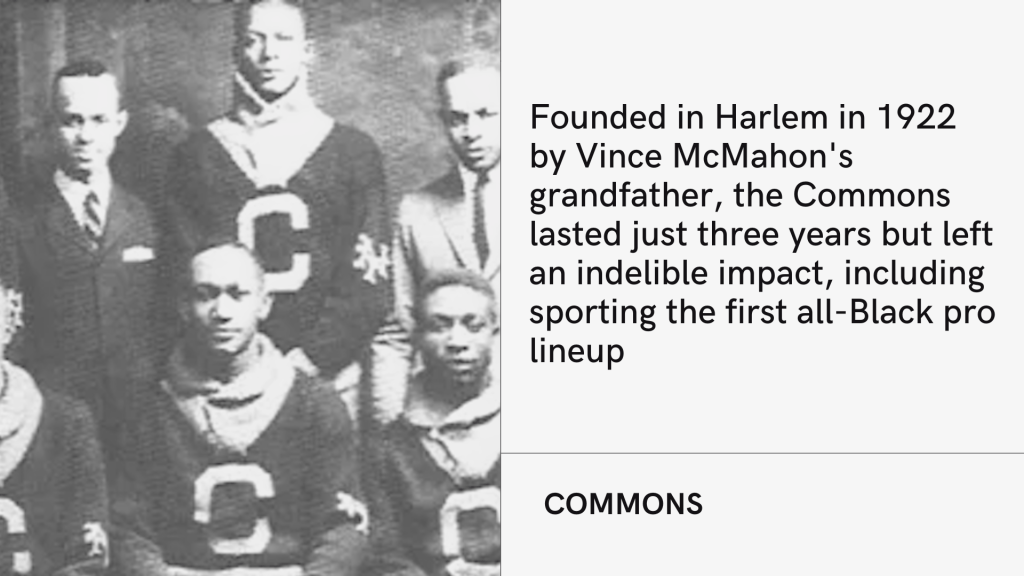
As opposed to popular belief, the first all-Black team was not the New York Rens but the Commonwealth Big Five, colloquially referred to as the Commons, a team that eventually propagated the Rens’ roster (this common misnomer is a result of the more successful Rens being specifically the first all-Black team with a Black owner). The Commonwealth Big Five, which debuted in Harlem in 1922, had white owners, a pair of brothers named Jess and Eddie McMahon. The siblings were already notable sports promoters in New York and revered amongst the city’s Black community for their progressive policies, most notably promoting interracial prize fights, owning the Negro League’s New York Lincoln Giants, and opening their signature Commonwealth Club and Casino in Harlem. That would end up being the home of the Commons, an all-star team they compiled with most of the city’s best Black talent. Over the next three years, the Commons played hundreds of games, including some notable clashes with the Original Celtics, before folding in 1925, after most of their best talent was poached by the New York Rens. As for the McMahons, the older brother, Jess, shifted gears into professional wrestling, eventually founding the World Wide Wrestling Federation, a precursor to the WWE, which is now run by his grandson, Vince.
3) Buffalo Germans
Basketball was played at the Olympics for the first time in 1904 in St. Louis as a test sport. In a tournament featuring the top amateur teams in the U.S., the Buffalo Germans emerged victorious, setting the stage for their domination of early 20th century basketball. Founded in a YMCA in East Buffalo in 1896, just a few years after James Naismith invented the sport itself, the Germans dominated against everything that amateur and pro competition had to offer. In their peak between 1908 and 1910, the Germans won 111 straight games, including an infamous 134-0 drubbing of Hobart College. Another possibly apocryphal story: At the Pan-American Exposition in Buffalo in 1901, the Germans had just three players for a match-up against the vaunted Paterson Five but managed to keep the game close through halftime, when the remainder of the roster arrived and they pulled away for an easy victory. Over their history, the Buffalo Germans compiled a 792-86 record before disbanding in 1925, though it’s notable that they never got a chance to take on Black teams like the Rens.
4) Jim McGregor’s Levi’s All-Stars
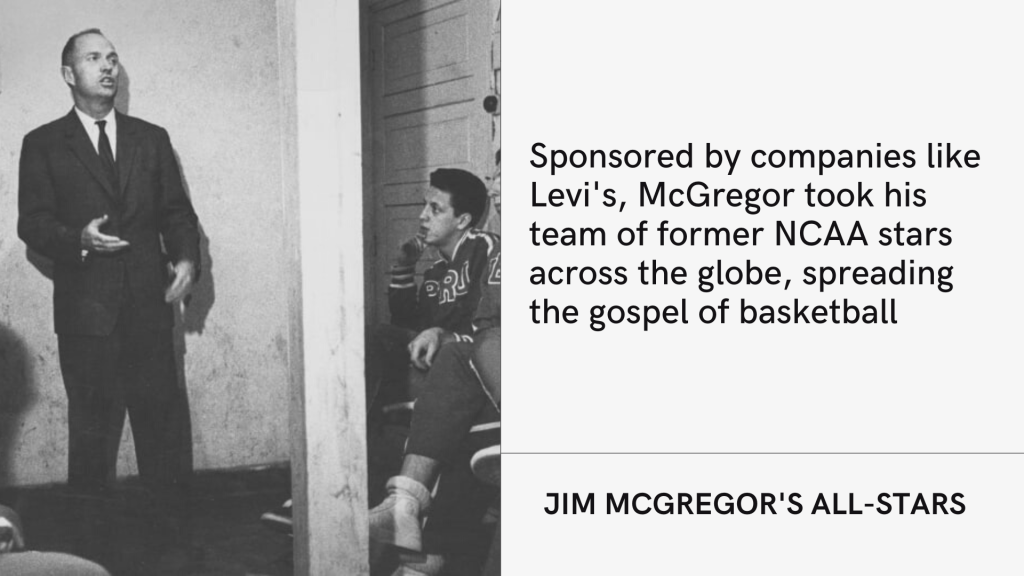
Some of the best players in the NBA now routinely hail from Europe, a trend that was kickstarted by the U.S. Dream Team participating in the 1992 Olympics. But the overseas-to-NBA pipeline traces its roots to well before Michael Jordan, Magic Johnson, and Charles Barkley took Barcelona by storm. One of the biggest bellwethers came in the late ’60s, when McGregor took his barnstorming team of former college stars all across the globe. Originally called the Gulf Oil All-Stars (they changed sponsorships and subsequent team names multiple times, eventually landing on Levi’s in their biggest heyday), the squad was conceived by McGregor in the previous decade he had spent coaching various pro and national teams all around the world. He then returned to the states to coach New Mexico State for one unsuccessful season and realized two truths: 1) the rest of the world was itching to embrace American basketball, and 2) NCAA players that didn’t reach the NBA could still make a living playing on the top European pro teams. Those two concepts converged in his All-Stars teams, which toured the world for just over a decade, bringing approximately 600 American players overseas. McGregor’s roving bands of basketball ambassadors served the dual roles of promoting U.S. basketball around the world while simultaneously selling individual players to club teams (with McGregor taking a cut of the contracts signed). Arguably one of the most unsung influencers in NBA history, McGregor shut down his All-Stars tour in 1977, as other savvy American agents had surpassed his ability to sign their clients on European teams.




5) South Philadelphia Hebrew Association (“SPHAs”)
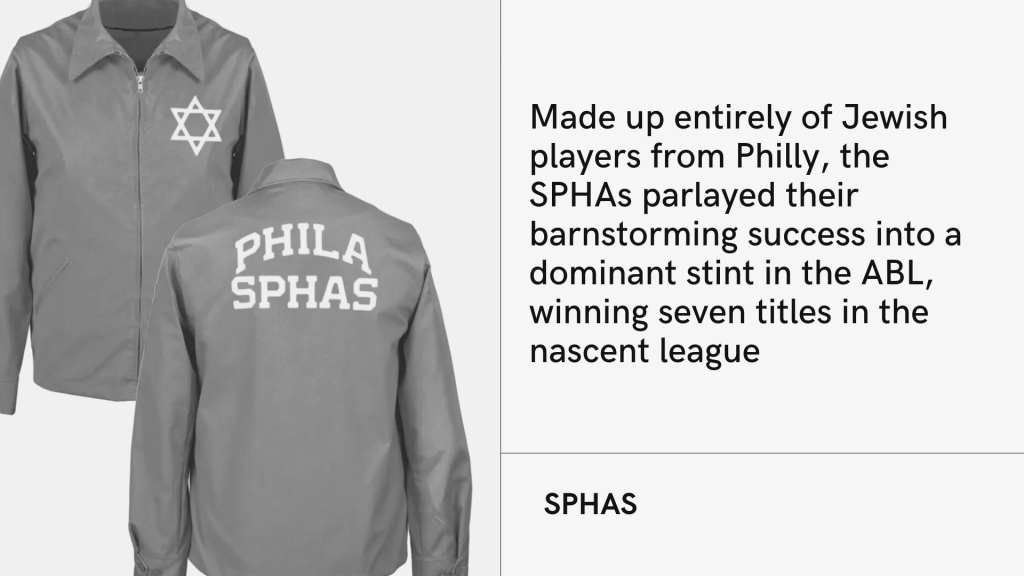
For many immigrants and minorities in the U.S., sports have been a traditional entryway into American cultural assimilation. Basketball was one of the main anabolisms for Jewish-Americans in the first half of the 20th century. It was, after all, a Jewish player, Ossie Schectman of the Knicks, who scored the first NBA basket in 1946, and a Jewish coach, Red Auerbach, who led the league’s first great dynasty in Boston. Long before that, there was the SPHAs, which was an acronym for South Philadelphia Hebrew Association, the organization which sponsored the team. Made up entirely of Jewish players, including founding member and future Warriors coach and owner Eddie Gottlieb, the SPHAs found success in numerous early pro leagues as well as the barnstorming circuit. They started off as champions of the Philadelphia League in 1925, then spent years spanning the U.S. playing in a series of games against teams from the American Basketball League (ABL), as well as barnstorming legends the New York Rens and Original Celtics (both of whom they defeated in best-of-three series, bolstering their reputation). Due to their roving nature and their loss of sponsorship from their titular association (they kept the name anyway, due to branding), the SPHAs earned the secondary nickname “Wandering Jews,” a nod to the historically wayfaring nature of the Jewish people. They joined the ABL permanently in 1933, winning seven titles in their first 12 years in the league and eventually became one of the earliest foils of the Harlem Globetrotters before finally folding in 1959 (there’s a common misnomer that they transitioned into becoming the Washington Generals).
6) Original Celtics
Maybe the most influential pro organization in basketball history, the Original Celtics were the first team to sign players to exclusive contracts. Based not in Boston (and with no relation to the NBA’s Celtics) but in New York, this allowed them to not only lure the city’s best talent but keep those players focused solely on basketball year round. Led by Dutch Dehnert, Joe Lapchick, Nat Holman, and John Beckman (who was nicknamed “The Babe Ruth of Basketball”), the Original Celtics had a home base at Madison Square Garden but spent most of the early ’20s on the road, playing 150-200 games a year all over the U.S. Wherever they landed, the Original Celtics would not only dominate their competition (they reportedly won approximately 90% of their barnstorming games) but spread the latest innovations in basketball, especially post offense and zone defense, both of which eventually led to the invention of the three-second rule. The Original Celtics also spent several seasons in the early days of the ABL, winning back-to-back championships in 1927 and 1928, before folding in the ’30s after an unsuccessful second attempt at barnstorming. They were inducted into the Naismith Hall of Fame as a team in 1959, while individual members Beckman, Holman, Dehnert, and Lapchick have also been individually enshrined.
7) All-American Red Heads
8) Texas Cowgirls
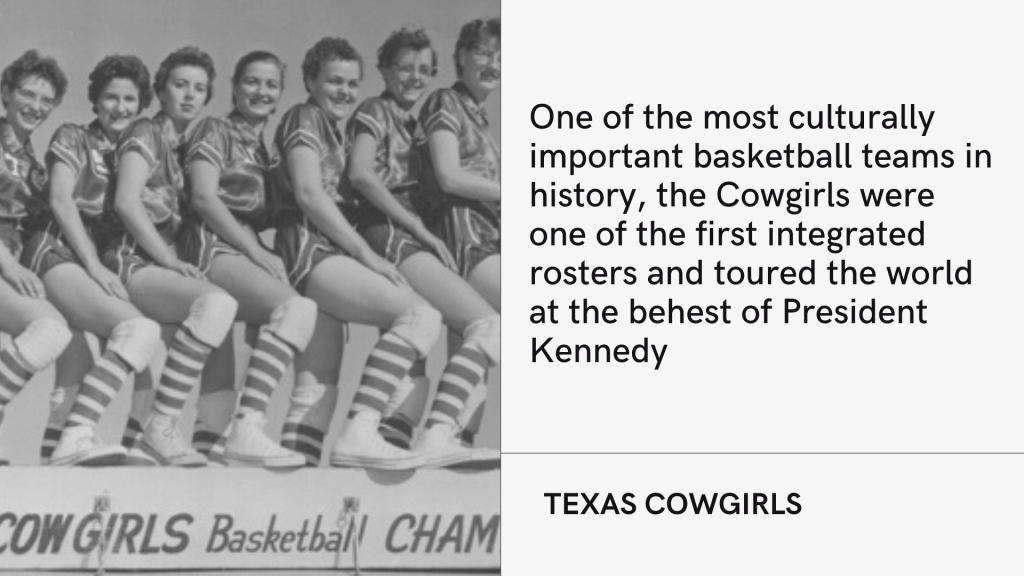
Long before women’s basketball was part of the Olympics, the NCAA, or its own pro league, the best female players were touring the country on these two squads, facing off against and usually defeating men’s teams. The All-American Red Heads were the ingenious idea of Doyle Olson, a Missouri beauty salon owner whose husband, Connie, had found success in the early barnstorming days with a team called the Terrible Swedes. Comprised of AAU athletes and Olympic stars (some of which had natural red hair and others who had it dyed to match at Doyle’s salon), the Red Heads hit the road starting in 1936, playing exclusively against men’s teams with men’s rules and not only winning most games but doing so with a flair and whimsy reminiscent of the Harlem Globetrotters. A decade later in Chicago, another barnstorming veteran in Dempsey Hovland founded the Texas Cowgirls, another all-woman team touring the country playing against men. Both the Red Heads and Cowgirls broke ground not just for women but for basketball in general. The Red Heads were the first professional team to play in the Philippines, doing so in 1940, while the Cowgirls were one of the earliest integrated pro teams, as Dempsey was a firm believer in civil rights. The Cowgirls would often share billing with early NBA games, as their traveling show was more popular than the nascent men’s pro league. While the Red Heads have received more accolades for their earlier, more groundbreaking contributions, including a Naismith Hall of Fame induction in 2012, the Cowgirls were the more famous and documented women’s team. John F. Kennedy invited them to tour overseas military bases and they were featured regularly in the national media. Both teams were certainly ahead of their time and wildly influential on basketball.
9) Harlem Globetrotters
Over 120 years after its inception, the barnstorming roots of pro basketball live on in the Harlem Globetrotters. Since their initial founding in Chicago in 1926, the Globetrotters have played in over 26,000 games across 124 countries and territories, truly earning their sojourning nickname. Originally called the Savoy Big Five, they changed that name to Globetrotters in 1928 when the team was purchased by Abe Sapenstein, who initially envisioned them as a serious barnstorming squad. In fact, the Globetrotters were champions of the World Professional Basketball Tournament in 1940 and in the late ’40s regularly defeated NBA teams in exhibitions, including a famous upset of George Mikan and the Minneapolis Lakers. When the NBA finally broke the color barrier in 1950, it was three former Globetrotters, Chuck Cooper, Earl Lloyd, and Nat Clifton, leading the way as the first Black player drafted, first Black player to play in a game, and first Black All-Star, respectively. That was a point of pride for the Globetrotters but also a signaling that their days of dominating the pro ranks both in terms of talent and attention were over, as the integrated NBA quickly surpassed them in both accounts. It was around this time that the Globetrotters shifted to a more whimsical, comical form of basketball which they’re associated with today. The ’50s was also when the Washington Generals were introduced as the ultimate hapless foils, supposedly racking up just three wins against the Globetrotters in the last 70 years. The Globetrotters did still manage to attract major talent through the early ’60s, most notably Wilt Chamberlain, who was on the roster for the team’s goodwill tour in the Soviet Union in 1959. Ultimately, they fulfilled Saperstein’s vision of an all-Black team spreading both basketball and racial goodwill throughout the planet and continue to do so today. In addition to the team itself being inducted in 2002, 15 individuals who coached or played for the Globetrotters are enshrined in the Naismith Hall of Fame: Saperstein, Clifton, Lloyd, Chamberlain, Connie Hawkins, Meadowlark Lemon, Marques Haynes, Goose Tatum, Magic Johnson (he played two games for the Globetrotters after retiring from the Lakers), Lynette Woodard (the all-time leading women’s NCAA scorer, a gold medalist, and the first woman Globetrotter), William “Pop” Gates, John Chaney (starred for them for one season in the ’50s before going into coaching), Dutch Dehnert (who also played for the Original Celtics), Elmer Ripley, and Dave Lattin.
Next up in Black History
- Which side are you on?: A history of the NBA in 16 labor disputes
- In memoriam: 21 prominent basketball people who passed away in 2025
- Don’t you forget about me: 80 basketball moments from the ’80s that changed the sport forever
- Early adopters: 12 legendary women’s basketball players who pre-dated the WNBA
- All the commissioner’s men: Nine enduring NBA conspiracy theories
- In memoriam: 20 prominent basketball people who passed away in 2022
- Joy of six: 13 notable facts about jersey #6 and the players who have worn it
- Black excellence: 16 greatest players who reached the NBA from an Historically Black College and University (HBCU)
- In memoriam: 19 prominent basketball people who passed away in 2021
- Extracurricular activities: 75 off-court moments that shaped the NBA
 Basketball, Listed